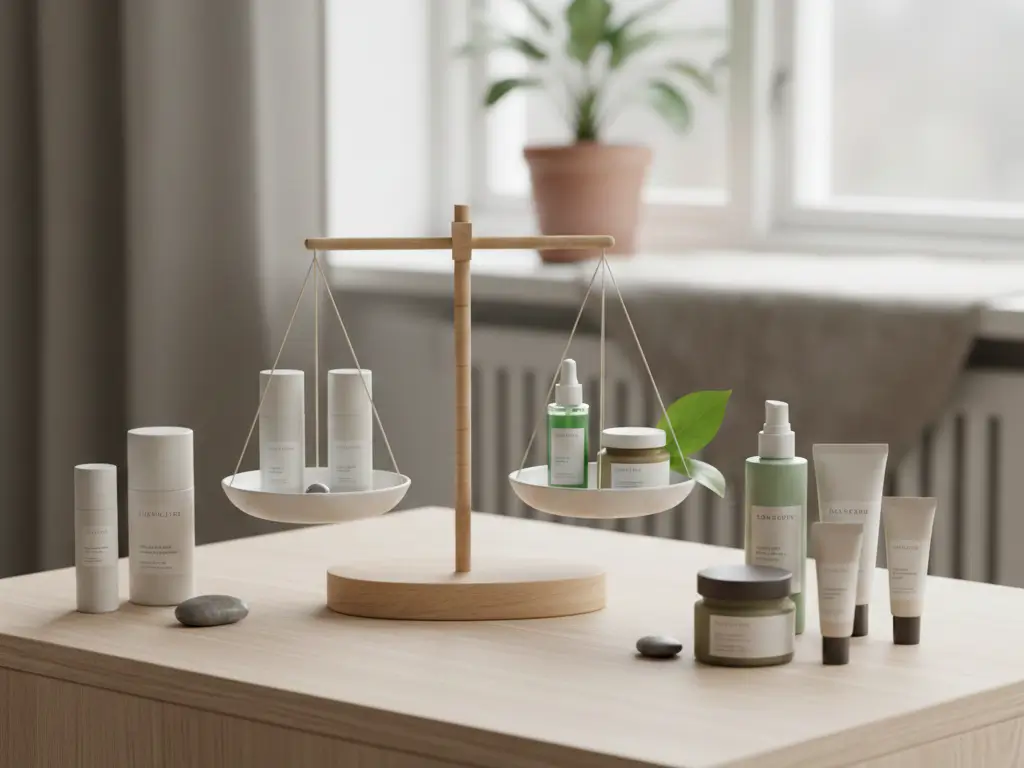
I’ve watched the skincare pendulum swing wildly over the past decade. First, we had 10-step Korean routines with essence, ampoules, and sleeping masks. Then minimalism hit, and suddenly three products made you high-maintenance. Now there’s “skinimalism,” which seems like minimalism with better PR.
Here’s what nobody’s saying: maybe the sweet spot isn’t at either extreme.
A Lagom skincare routine means using exactly what your skin needs, no more, no less. It’s the Swedish concept of “just right” applied to your face, and it’s way more nuanced than slapping on three products and calling it balanced.
The problem with most skincare philosophies is they give you a number. Five steps. Three products. Twelve if you’re serious about anti-aging. But your skin didn’t read those articles. It doesn’t care about trends or what worked for someone with completely different genetics, climate, and concerns.
What surprises me most about Lagom is how personal it gets. I’ve seen it mean six products for someone with rosacea and three for someone with combination skin. The philosophy isn’t about the count, it’s about intentionality. Every product should earn its place, and nothing should be there because Instagram said so.
What Is Lagom Skincare and Why It Matters Now
Lagom skincare applies the Swedish principle of “not too much, not too little” to create a personalized routine where every product serves a clear purpose without overwhelming your skin or your schedule. It prioritizes skin barrier health and sustainability over trends.
The Swedish word “lagom” doesn’t translate neatly into English, which is probably why we keep trying to force it into “minimalism.” It’s closer to “appropriate” or “suitable”, that Goldilocks zone where everything feels right.
In skincare terms, this means your routine should match your actual needs, not some influencer’s #shelfie or a dermatologist’s clinical protocol for severe acne when you’re dealing with occasional dryness.
Why does this matter right now? Because we’re collectively exhausted.
Between 2019 and 2023, the average number of skincare products owned by US consumers increased by 40%, according to market research from NPD Group. We’re buying more, using less of what we buy, and feeling guilty about both the waste and our “lazy” routines when we don’t use everything.
At the same time, dermatologists are seeing more cases of compromised skin barriers, often from using too many actives or switching products too frequently. Your skin barrier doesn’t benefit from variety the way your palate does.
Lagom offers a third path. It asks: What does YOUR skin actually need to be healthy? Not Instagram-perfect, not glass-skin smooth if that’s not your baseline, just healthy, comfortable, and protected.
For me, this philosophy shifted everything. I stopped adding products because they were “good ingredients” and started asking whether my skin had a problem that product would solve. Turns out, I’d been using niacinamide in four different products without realizing it. No wonder my niacinamide routine wasn’t giving dramatic results, my skin was already saturated.
The environmental angle matters too. A Lagom approach naturally reduces waste. You’re not buying products that’ll oxidize before you finish them or trying every new launch. This aligns beautifully with the principles outlined in any good organic skincare routine guide, which emphasizes intentional product selection.
How Lagom Differs from Minimalist and Maximalist Skincare Approaches
Minimalism focuses on using as few products as possible; maximalist approaches layer many targeted treatments. Lagom ignores product count entirely and asks whether each item serves your skin’s current needs, which might mean three products or eight, depending on your situation.
Here’s where people get confused. Lagom looks like minimalism from the outside, Swedish aesthetics, clean bathrooms, curated routines. But the philosophy works completely differently.
Minimalism says: Use the fewest products possible. Simplify. Cut back.
Maximalism says: Layer targeted treatments. Address every concern. More is more effective.
Lagom says: Use what’s appropriate. Nothing more, nothing less.
Let me show you how this plays out in practice:
| Approach | Morning Routine | Philosophy | Who It Fails |
| Minimalist | Cleanser, moisturizer, SPF (3 products) | Simplicity is virtue | People with multiple skin concerns needing targeted treatment |
| Maximalist | Cleanser, toner, essence, vitamin C, hyaluronic acid, peptide serum, eye cream, moisturizer, SPF (9+ products) | Each product optimizes results | People with sensitive skin or limited time; creates barrier damage risk |
| Lagom | Whatever YOUR skin needs today (3-8 products typically) | Appropriateness is wisdom | People who want rules instead of reflection |
I tested this framework personally over six months. In winter, my Lagom routine expanded to seven products because my skin genuinely needed more humectants and hydration in the dry Colorado climate. Come summer, it dropped to four because my skin stopped being parched.
A minimalist would’ve stuck with three products year-round, leaving my winter skin compromised. A maximalist would’ve kept all seven in summer, probably clogging my pores when I didn’t need that much moisture.
The Lagom approach requires more self-awareness but less dogma. You’re not following rules, you’re listening to your skin.
This also means Lagom can include facial massage tools like gua sha if they genuinely improve your lymphatic drainage and you’ll actually use them. But it excludes the jade roller collecting dust because it seemed aesthetic. The question is always: Does this serve a real purpose for MY skin right now?
Here’s what makes this challenging: Lagom requires you to know what “just right” feels like. If you’ve been following trends or fighting your skin for years, you might not remember what balanced actually feels like.
How to Find Your Personal Lagom Balance: A Practical Framework
Most skincare advice tells you what to use. Lagom asks you to justify what you’re using. It’s the difference between following a recipe and understanding cooking.
I developed this “Three Questions Method” after realizing I couldn’t explain why half my products were in my routine. They were just…there. Good ingredients, nice textures, but solving problems I didn’t actually have.
The Three Questions Method
Question 1: What specific problem does this solve?
Not “it’s good for anti-aging”, that’s too vague. What exact concern? Fine lines around your eyes? Uneven texture on your cheeks? Post-breakout marks that stick around for weeks?
If you can’t name a specific issue you’ve personally observed, the product might not belong.
Question 2: How do I know I have this problem?
Can you point to it in the mirror? Do you have before photos? Did a dermatologist diagnose it? Or did a product description convince you it’s a problem?
This question weeds out “solutions” to problems created by marketing. I realized I was using three different “brightening” products but couldn’t actually identify what needed brightening on my face.
Question 3: What would happen if I removed this?
This is the test. Remove the product for two weeks (assuming it’s not SPF, always keep SPF). Does the problem return? Does your skin feel off? Or do you honestly not notice a difference?
I removed my fermented essence this way. I loved the concept and the fermented ingredients sounded amazing, but removing it for three weeks changed absolutely nothing about my skin. It was a nice-to-have, not a need-to-have. Not Lagom for me.
Finding Your Baseline
Before you can know what’s “just right,” you need to know what “unbalanced” feels like in both directions.
Signs you’re using too much:
- Your skin feels congested despite regular cleansing
- You’re getting reactions to products that never bothered you before
- Your routine takes so long you skip it entirely on busy days
- Products start pilling or not absorbing
- Your skin barrier feels sensitive or reactive
Signs you’re using too little:
- Persistent dryness or tightness that won’t resolve
- Your skin concerns aren’t improving despite “good” genetics
- You’re skipping SPF or other basics
- Your skin feels unprotected in your climate
- Problems that would respond to treatment are being ignored
The Lagom sweet spot sits between these extremes. Your skin should feel comfortable, protected, and healthy, not project-perfect, just sustainably good.
This connects beautifully with mindful skincare practices that reduce stress by eliminating decision fatigue. When your routine is truly balanced, you’re not wondering if you should add or remove something. It just…works.
A Practical Lagom-Inspired Skincare Routine for Different Needs
A balanced Lagom routine typically includes 4-6 steps: gentle cleanser, treatment for your specific concern, moisturizer appropriate for your skin type, and SPF during the day. Add or subtract based on genuine need, not trends.
Here’s what “just right” might look like for different situations. These aren’t prescriptions, they’re examples of how Lagom thinking shapes real routines.
For Normal Skin With Mild Concerns (The 4-Product Core)
Morning:
- Gentle cleanser or water rinse
- Moisturizer with niacinamide
- SPF (mineral or chemical, based on preference)
Evening:
- Oil-based or balm cleanser
- Treatment (retinol 2-3x weekly OR vitamin C OR whatever addresses your one main concern)
- Moisturizer
This is probably the closest to minimalism, but notice it includes a treatment. True minimalism might skip that. Lagom says: if you have a concern worth addressing, address it efficiently.
For Dry or Mature Skin (The 6-Product Balance)
Morning:
- Gentle cream cleanser
- Hydrating toner or essence
- Antioxidant serum (vitamin C or similar)
- Moisturizer layered with facial oil
- SPF
Evening:
- Oil cleanser (double cleanse if wearing makeup)
- Treatment serum (bio-retinol or peptides)
- Rich moisturizer or night cream
This looks like more products, but each serves a clear need: dry skin requires multiple hydration layers plus occlusives to prevent water loss. Lagom doesn’t mean “less” when your skin genuinely needs more.
For Oily or Acne-Prone Skin (The 5-Product Strategy)
Morning:
- Gel or foam cleanser
- Lightweight treatment (niacinamide or white willow bark)
- Oil-free moisturizer
- Non-comedogenic SPF
Evening:
- Cleanser (double cleanse if needed)
- Active treatment (BHA 2-3x weekly or gentle retinoid)
- Lightweight moisturizer or gel cream
Don’t skip moisturizer, even oily skin needs hydration. But you don’t need seven layers. Lagom means finding that gel-cream that hydrates without heaviness, not skipping hydration entirely or piling on products that’ll clog pores.
Seasonal Adjustments (The Lagom Flexibility)
This is where Lagom really differs from rigid routines. Your “just right” in January probably isn’t your “just right” in July.
I add a hydrating serum in winter and remove it in humid summer months. I use weather-appropriate skincare adjustments without rebuilding my entire routine. One or two products flex with the seasons, everything else stays consistent.
The key is changing things for actual reasons (my skin feels tight in low humidity) rather than arbitrary ones (it’s fall, so I should use richer products even though my skin feels fine).
Common Mistakes When Applying the Lagom Philosophy to Skincare
The biggest Lagom mistake is confusing it with minimalism and under-treating genuine skin concerns. Balance doesn’t mean neglect, sometimes “just right” means more products, not fewer.
After talking to dozens of people trying Lagom skincare, I’ve noticed the same mistakes coming up repeatedly.
Treating Lagom as a Product Count
Someone decides their Lagom number is four products, then refuses to use five even when their skin clearly needs an additional treatment. That’s not balance, that’s arbitrary restriction.
Lagom is about appropriateness, not aesthetics. If you need six products to address your specific concerns without overdoing it, that’s YOUR Lagom. Don’t let anyone else’s three-product routine shame you.
Removing Active Treatments Too Quickly
In the rush to “simplify,” people cut out their retinoid or vitamin C, keeping only cleanser-moisturizer-SPF. Then they wonder why their hyperpigmentation isn’t fading.
Lagom doesn’t mean avoiding effective treatments. It means using targeted treatments for real concerns without layering redundant products. Your retinol alternative absolutely belongs if you’re actually addressing aging concerns.
Ignoring Individual Variation
I’ve seen people try to apply “Swedish skincare” rules created for Swedish climates and genetics to their life in Arizona with completely different skin needs. Lagom is a philosophy, not a specific routine to copy.
What’s balanced for someone in a humid climate won’t be balanced for someone in the desert. What works for resilient skin won’t work for reactive skin. The framework stays the same; the products change.
Forgetting That Balance Shifts
Your Lagom routine at 25 won’t be your Lagom routine at 45. Your routine while pregnant might need adjustments. Skincare through different life stages naturally requires different approaches.
I adjusted my routine when I moved from sea-level humidity to high-altitude dryness. Same philosophy, different products. That’s exactly how Lagom should work.
Skipping the “Why” Behind Each Product
This is the big one. People read that Lagom routines are “curated” and start curating based on packaging or brand reputation rather than actual skin needs.
Every product should answer those three questions. If you’re keeping something because it’s expensive, pretty, or “everyone uses this ingredient,” you’ve missed the point.
The beauty of a Lagom approach is how sustainable it becomes. You’re not chasing trends or buying products that’ll expire before you finish them. You’re not overwhelming your skin or wondering if you’re doing enough. You’ve found your balance point, and you can recognize when it shifts.
This philosophy pairs beautifully with the broader concepts of organic skincare for different skin types, which emphasizes listening to your skin’s individual needs rather than following one-size-fits-all advice.
Finding Your Personal “Just Right” Takes Time, And That’s the Point
A Lagom skincare routine isn’t something you build in a weekend by buying four new products. It’s a philosophy you apply over time, learning what your skin actually needs versus what you’ve been told it needs.
Start with the Three Questions Method. Look at every product currently in your routine and honestly ask: What does this solve? How do I know I need it? What happens without it?
You’ll probably find some products that clearly belong, your gentle cleanser that never strips your skin, the sunscreen without white cast that you actually wear every day, that one serum that visibly improved your skin texture.
You’ll also find products that are just…there. Not harmful, but not necessary. Those are your first candidates for removal.
- Identify your one or two main skin concerns that actually bother YOU (not concerns you’ve been told you should have).
- Keep only products that directly address those concerns or provide basic protection (cleansing, hydration, sun protection).
- Use this simplified routine consistently. Notice how your skin responds.
- Add back only what you genuinely missed. If you didn’t miss it, you’ve found your Lagom.
The goal isn’t perfection or even improvement by some external standard. It’s finding the sustainable routine that keeps your skin healthy without excess effort, products, or expense.
That’s Lagom. Not the minimalist fantasy of perfect skin from three products. Not the maximalist promise that more is always better. Just you, understanding your skin well enough to give it exactly what it needs.
And honestly? That kind of self-knowledge is worth more than any 10-step routine or miracle ingredient could ever deliver.
For more guidance on building intentional routines, explore the comprehensive approaches at Beauty Healing Organic, where balanced, thoughtful skincare is always the priority.