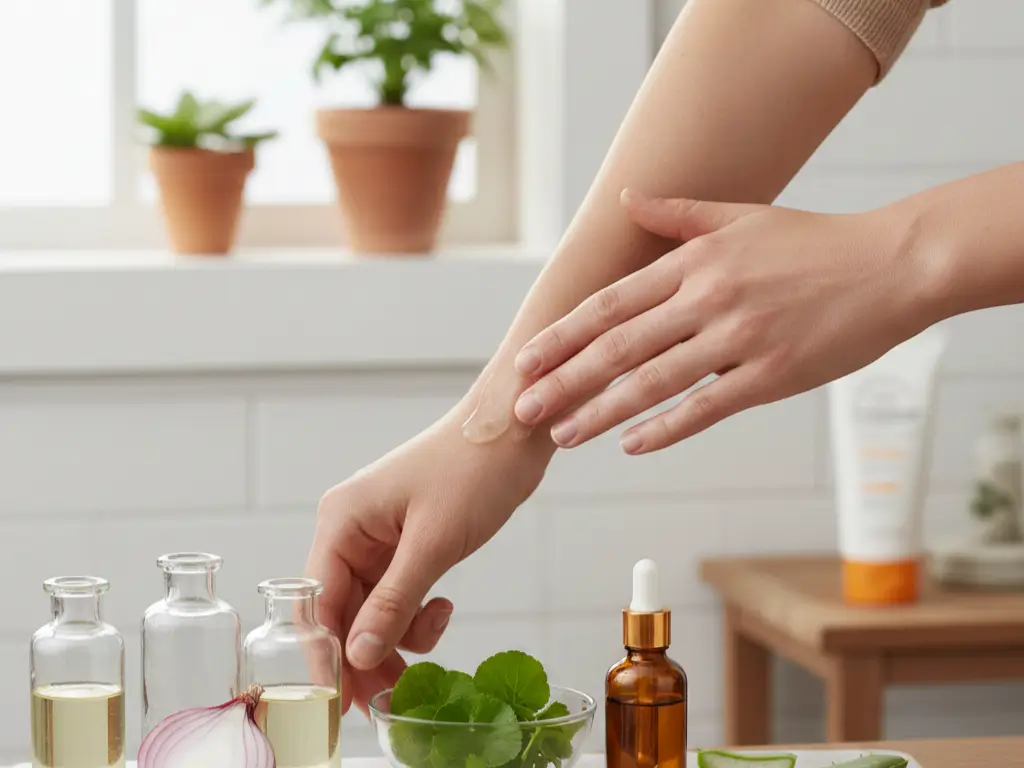
This article provides educational information about skincare and scar management. It is not intended to diagnose, treat, cure, or prevent any medical condition or disease. Always consult a licensed healthcare professional or dermatologist before starting new treatments on compromised skin. Individual results vary. If you have signs of infection, keloid formation, or unhealed wounds, seek professional medical advice immediately.
A natural approach to reducing the appearance of scars involves supporting the skin’s “remodeling phase” through hydration, massage, and specific phytochemicals. Effective natural agents include onion extract (anti-inflammatory), Centella Asiatica (collagen regulation), rosehip seed oil (tissue regeneration), and silicone alternatives like aloe vera for occlusion. Consistency and sun protection are critical for results.
Scars are more than just marks on the skin; they are the visible map of your body’s emergency response system. When tissue is damaged, your body prioritizes immediate survival, closing the wound quickly, over aesthetics. The result is collagen fibers laid down in a hasty, chaotic cross-hatch pattern rather than the neat “basket weave” of normal skin.
For many, the instinct is to immediately reach for the nearest bottle of Vitamin E oil. However, clinical data suggests we might need to rethink that strategy. A truly effective natural approach to reducing the appearance of scars isn’t about erasing history; it’s about giving your skin the tools it needs to reorganize that chaotic collagen into smoother, softer tissue.
This guide explores the bio-active botanical ingredients that show genuine promise in clinical studies, separating the “old wives’ tales” from the science of skin remodeling.
Who This Is For: Individuals with fully closed, healed wounds (no scabs/bleeding) looking to improve the texture and color of resulting scars (acne marks, minor injury scars, surgical lines).
Who This Is NOT For: Those with open wounds, infected injuries, or active keloids (raised, growing scars). These require medical intervention.
Understanding Scars: The Biology of Repair
Scars form when the dermis (deep skin layer) is damaged. The body repairs this by producing collagen fibers. Unlike normal skin, scar collagen lacks elasticity and hair follicles. The “remodeling phase” can last 6-18 months, which is the prime window for topical intervention to improve appearance.
To treat a scar naturally, you first have to understand what it is. A scar is essentially a patch job. During the healing process, cells called fibroblasts rush to the site and lay down collagen rapidly.
There are different types of scarring, and natural treatments affect them differently:
- Atrophic Scars: Pitted or depressed marks (common with acne).
- Hypertrophic Scars: Raised, red scars that stay within the wound boundary.
- Post-Inflammatory Hyperpigmentation (PIH): Dark spots left behind (technically not true scars, but pigment changes).
While you cannot physically remove a scar (it is permanent tissue), you can significantly influence its pliability (softness), height, and pigmentation.
If you are dealing with dark spots from breakouts, you might find our guide on hyperpigmentation and natural care helpful for distinguishing between pigment issues and textural scarring.
The Hydration Factor: Nature’s Occlusives
Hydration is the single most proven factor in scar reduction. Keeping a scar hydrated reduces fibroblast activity, preventing excessive collagen buildup. Natural occlusives like Shea Butter and Cocoa Butter mimic the effects of silicone sheeting by trapping moisture and regulating collagen production.
The medical gold standard for scars is silicone sheeting. Why? Because it creates occlusion, it seals moisture in. When a scar is dehydrated, the body sends signals to produce more collagen, often resulting in a thicker, harder scar.
Botanical Butters as Occlusives
While silicone is synthetic, certain natural ingredients can provide a similar semi-permeable barrier. High-quality botanical butters are excellent for keeping scar tissue pliable.
- Shea Butter: Rich in fatty acids and vitamins A and E (in their natural complex).
- Cocoa Butter: Forms a dense barrier that locks in moisture.
You can learn how to create your own barrier balms in our guide to DIY Shea, Cocoa, and Mango butters. The physical act of massaging these butters into the scar is just as important as the ingredients themselves. Mechanical stimulation helps break down rigid collagen bundles.
For those interested in how hydration aids healing in other areas, our humectants guide explains the science of moisture binding.
The “Big Three” Evidence-Based Natural Ingredients
Three natural ingredients stand out in dermatology literature for scar management: Onion Extract (blocks excessive collagen), Centella Asiatica (Gotu Kola, modulates healing), and Rosehip Seed Oil (rich in trans-retinoic acid for cell turnover).
1. Onion Extract (Allium Cepa)
It sounds surprising, but onion extract is one of the few natural ingredients found in mainstream pharmaceutical scar gels (like Mederma).
- The Science: It contains quercetin and kaempferol. Studies suggest these flavonoids inhibit fibroblast proliferation, essentially telling the skin, “You can stop building now,” which helps prevent raised scars.
- Usage: It is best used in formulated gels rather than raw onion juice, which can be irritating.
2. Centella Asiatica (Gotu Kola)
Often called “Tiger Grass,” this herb is a powerhouse in wound healing.
- The Science: It contains triterpenoids like asiaticoside. Research indicates it boosts the production of Type I collagen (stronger skin) while reducing the excessive inflammatory reaction that leads to scarring.
- Where to find it: Look for serums containing “Madecassoside” or pure Centella extract. You can read more about how specific extracts target skin concerns in our botanical extract guide.
3. Rosehip Seed Oil
This is arguably the most popular oil for scarring, and for good reason.
- The Science: Unlike other carrier oils, cold-pressed rosehip oil contains trace amounts of trans-retinoic acid (a natural precursor to Vitamin A). This encourages cell turnover, helping to fade the discoloration associated with fresh scars.
- Connection: For a deeper dive into Vitamin A alternatives, explore our bio-retinols guide.
Important Safety Considerations
Natural does not mean risk-free. Never apply topical treatments to open wounds. Vitamin E capsules applied directly to skin cause contact dermatitis in up to 30% of users. Lemon juice is phototoxic and can worsen scar pigmentation. Always patch test new ingredients.
Before you raid your kitchen cabinet, be aware of these risks:
The Vitamin E Myth
For decades, people have pierced Vitamin E capsules and applied them to scars. However, a study from the University of Miami showed that topical Vitamin E had no effect on the appearance of scars in 90% of cases and actually caused itchy, red rashes (contact dermatitis) in 33% of participants. It is safer to use oils naturally rich in Vitamin E (like Argan or Jojoba) rather than isolated, concentrated tocopherol.
The Sun Danger
UV radiation is a scar’s worst enemy. Fresh scar tissue has fewer melanocytes (pigment cells) and burns easily. Sun exposure will permanently darken a scar (hyperpigmentation).
- Action: Always protect scars with clothing or mineral sunscreen.
- Read More: Learn about gentle protection in our mineral sunscreen guide.
When to Seek Medical Attention
While natural methods can improve appearance, some situations require a doctor:
- Keloids: If a scar is growing beyond the original wound boundaries.
- Infection: Redness, heat, pus, or increasing pain.
- Restriction: If a scar crosses a joint and restricts movement (contracture).
Advanced Natural Techniques: Massage & Tools
Mechanical stimulation (massage) is clinically proven to disrupt fibrous tissue and increase pliability. Combining natural oils with tools like Gua Sha or manual massage breaks up adhesions and improves circulation to the scar tissue.
Applying an oil is good; applying an oil with massage is better.
The Role of Massage
Scar tissue is rigid. Regular, firm (but not painful) massage helps realign the collagen fibers to match the surrounding skin tension lines. This can make a raised scar flatter and a stiff scar softer.
- Apply a slip agent (like Dragon’s Blood resin infused oil or Rosehip oil).
- Use your thumb to massage in circular motions for 2-5 minutes.
- Perform this twice daily for at least 3 months.
Tools to Assist
For older, tougher scars, some find that gentle facial tools help apply consistent pressure.
- Gua Sha: Can be used gently around (not directly on fresh) scar tissue to improve blood flow.
- Micro-needling (Dermarolling): Caution Required. While effective for acne scars, this should generally be done by a professional or with extreme caution and sterility at home. See our guide on dermarolling for the safety protocols involved.
A Realistic Natural Protocol
A successful natural scar routine focuses on Protection, Hydration, and Regeneration.
- Morning: Vitamin C serum + Sunscreen.
- Evening: Massage with Rosehip/Tamanu oil + Occlusive butter.
- Weekly: Gentle exfoliation (once fully healed).
Step 1: The “Fade” Phase (Morning)
In the morning, focus on preventing darkening. A gentle Vitamin C serum can help manage pigment production.
- Resource: Vitamin C Skincare Guide.
- Follow with: SPF 30+. Even if you are indoors, window glass lets UV rays through.
Step 2: The “Remodel” Phase (Evening)
Night is when your skin does its heavy lifting.
- Cleanse: Use a gentle cleanser that doesn’t strip lipids.
- Actives: Apply a serum with Centella Asiatica or Onion Extract.
- Massage: Spend 5 minutes massaging with Tamanu Oil (known for wound healing properties) or Rosehip Oil.
- Seal: If the scar is on the body, cover with Shea Butter to lock in moisture overnight.
Step 3: Texture Management
Once the scar is mature (no redness), gentle exfoliation can help soften the edges.
- Enzymes: Papaya or Pineapple (bromelain) enzymes are gentler than scrubbing. See our pineapple/bromelain exfoliation guide.
- Acids: Low-strength AHAs (like lactic acid) can help surface texture. Read about natural exfoliating acids here.
Patience is the Key Ingredient
Reducing the appearance of scars is a marathon, not a sprint. The “remodeling phase” of skin healing can continue for over a year. While no natural ingredient can make a scar vanish as if it never happened, the right combination of hydration, massage, and bio-active botanicals like Centella and Rosehip can make the difference between a stiff, dark mark and one that fades softly into the background.
- Today: Assess your scar. Is it fully healed? If yes, start protecting it from the sun immediately.
- This Week: Patch test Rosehip oil or a Centella balm to ensure no sensitivity.
- This Month: Commit to a 5-minute nightly massage routine. Take a photo now to track progress in 3 months.
For more comprehensive guidance on holistic skin health, explore our comprehensive collection at Beauty Healing Organic.
If you have tried natural methods for 6 months with no change, or if your scar is causing physical discomfort or emotional distress, consult a board-certified dermatologist. Treatments like laser therapy or silicone injections can be used alongside natural care for optimal results.
SOURCES CITED
- Baumann, L. S., & Spencer, J. (1999). The effects of topical vitamin E on the cosmetic appearance of scars. Dermatologic Surgery, 25(4), 311-315. PubMed
- Sidgwick, G. P., McGeorge, D., & Bayat, A. (2015). A comprehensive evidence-based review on the role of topicals and dressings in the management of skin scarring. Archives of Dermatological Research, 307(6), 461–477. NCBI
- Bylka, W., et al. (2013). Centella asiatica in cosmetology. Advances in Dermatology and Allergology, 30(1), 46–49. NCBI
- American Academy of Dermatology. (n.d.). Scars: Diagnosis and treatment. AAD.org
- Cho, J. W., et al. (2010). Clinical and histological effects of onion extract gel on surgical scars. Journal of Cosmetic Dermatology, 9(1), 30-35.