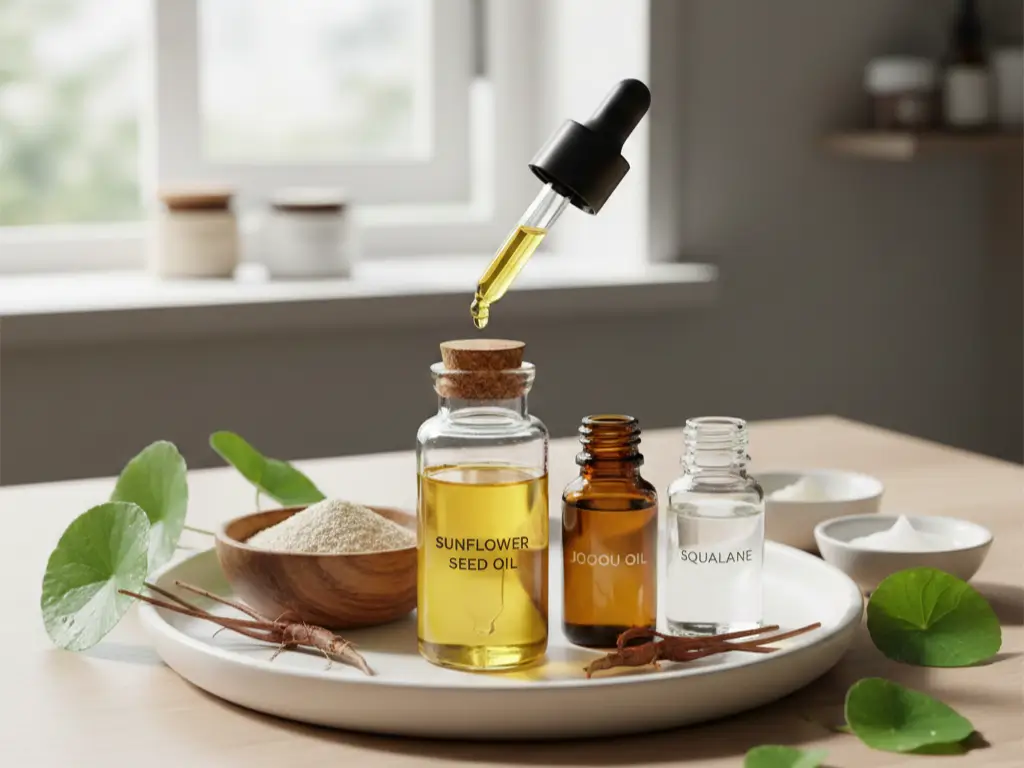
The best plant-based ingredients for strengthening a weak skin barrier are those that mimic the skin’s natural lipid matrix. Top choices include Sunflower Seed Oil (rich in linoleic acid for ceramide production), Jojoba Oil (mimics human sebum), Colloidal Oatmeal (soothes inflammation), Centella Asiatica (repairs tissue), and Squalane (prevents water loss).
This article provides educational information about skin barrier health and skincare ingredients. It is not intended to diagnose, treat, cure, or prevent any medical condition or disease, such as eczema, psoriasis, or dermatitis. Always consult a licensed dermatologist or healthcare professional before making health decisions or treating skin conditions. Individual results vary. If you have persistent irritation, infection, or pain, seek professional medical advice.
Why Your Moisturizer Might Not Be Enough
You apply layer after layer of hydrating serums, yet your skin remains tight, red, and prone to stinging. If this sounds familiar, you likely aren’t dealing with simple dryness—you are dealing with a compromised structural defense system.
Most people treat a weak barrier by “watering” the skin with hydration. But a damaged barrier isn’t just thirsty; it’s leaking. Imagine trying to fill a bucket that has holes in the bottom. No matter how much water you pour in, it drains out. This process is known in dermatology as Transepidermal Water Loss (TEWL).
To actually fix the leaks, you need “mortar”—ingredients that physically repair the gaps between your skin cells.
While many turn to synthetic options, nature offers sophisticated solutions that are surprisingly biomimetic—meaning they mimic the biology of your skin. By choosing specific plant-based ingredients that replicate your skin’s natural ratio of ceramides, fatty acids, and cholesterol, you can support your body’s ability to repair itself.
This guide is for individuals experiencing signs of a damaged barrier (redness, stinging, tightness) who want to explore botanical, non-prescription support. It is not a replacement for medical treatment for infected skin, severe atopic dermatitis, or open wounds.
Understanding the “Brick and Mortar” of Your Skin
The skin barrier (stratum corneum) functions like a brick wall. The “bricks” are skin cells (corneocytes), and the “mortar” holding them together is a lipid matrix composed of roughly 50% ceramides, 25% cholesterol, and 15% free fatty acids. When this lipid mortar is depleted, the wall cracks, allowing moisture to escape and irritants to enter.
To truly strengthen a weak barrier, you have to understand what you are rebuilding. Your skin barrier, or stratum corneum, is the outermost layer of the epidermis. Its primary job is twofold: keep water in and keep pathogens out.
When healthy, this layer is arranged in a tight, organized structure. But environmental stressors (UV rays, pollution), harsh skincare (over-exfoliation), or genetics can deplete the lipids that hold this structure together.
Signs Your Barrier Is Compromised:
- Stinging sensation: Even gentle products burn upon application.
- Redness and inflammation: The skin looks flushed constantly.
- Rough texture: Skin feels like sandpaper rather than soft tissue.
- Breakouts: Bacteria enter easily, causing inflammatory acne.
Restoring this requires ingredients that don’t just sit on top, but integrate into that lipid matrix.
The Safety Check: Why “Natural” Isn’t Always Barrier-Safe
Not all plant ingredients act as barrier repair agents; some can worsen a compromised barrier. Essential oils, citrus extracts, and high-oleic oils (like pure coconut oil for some skin types) can disrupt the lipid layer or cause contact dermatitis on broken skin. Safety dictates avoiding fragrance and potential allergens when the barrier is weak.
Before we dive into what to use, we must discuss what to avoid. When your barrier is damaged, your immune system is on high alert. Ingredients that your skin usually tolerates might trigger a reaction now.
Caution: Ingredients to Pause
- Essential Oils: While therapeutic, volatile compounds like limonene or linalool can penetrate broken skin and cause significant irritation.
- Physical Scrubs: Your “wall” is already crumbling; do not take a sledgehammer to it.
- High-Oleic Oils: Research suggests that oils very high in oleic acid (like olive oil) may actually increase permeability and disrupt the barrier if used alone on damaged skin.
Instead, we focus on linoleic acid-rich oils and waxes that support structural integrity.
1. The Architect: Sunflower Seed Oil (Helianthus Annuus)
Sunflower seed oil is a powerhouse for barrier repair because it is exceptionally rich in linoleic acid. This fatty acid is a precursor to ceramides, essential for maintaining the skin’s water-permeability barrier. Studies show it can preserve stratum corneum integrity and improve hydration without causing erythema (redness).
If you could only pick one plant oil for a damaged barrier, Sunflower Seed Oil (specifically the cold-pressed, high-linoleic variety) might be the most evidence-backed choice.
Why is it superior? Your skin needs linoleic acid to synthesize its own ceramides. When you are deficient in linoleic acid, your sebum becomes thick and sticky, and your barrier becomes permeable. Sunflower oil provides the raw materials your skin needs to patch the holes in the wall.
Why It Works:
- Ceramide Synthesis: It acts as a building block for your skin’s natural lipids.
- Anti-Inflammatory: It helps reduce the redness often associated with a weak barrier.
- Non-Comedogenic: It is lightweight and unlikely to clog pores, making it safe for acne-prone barrier damage.
How to Use It: Look for it as a primary ingredient in facial oils or cleanse with it. It serves as an excellent carrier in botanical oil blends for specific skin concerns.
2. The Mimic: Jojoba Oil (Simmondsia Chinensis)
Technically a liquid wax ester, Jojoba oil is chemically nearly identical to human sebum. Because of this biomimicry, the skin accepts it readily without occlusion. It reinforces the hydro-lipid film, preventing moisture loss while balancing oil production.
Jojoba is unique in the plant kingdom. While most plant oils are triglycerides, Jojoba is composed of wax esters. This matters because roughly 25-30% of your skin’s natural sebum is also made of wax esters.
When your barrier is weak, your natural sebum production might be dysregulated—either overproducing to compensate (oily/dehydrated) or underproducing (dry/cracking). Jojoba acts as a regulator. It signals to the skin that there is enough protection present, helping to stabilize the environment.
- High Stability: It doesn’t oxidize (go rancid) easily, which is crucial because oxidized oils can cause inflammation.
- Semi-Occlusive: It allows the skin to “breathe” while still trapping moisture, unlike heavy petrolatum-based products.
You can learn more about how different oils interact with skin biology in our guide to facial oils and skin types.
3. The Firefighter: Colloidal Oatmeal (Avena Sativa)
Colloidal oatmeal is an FDA-recognized skin protectant. It contains avenanthramides, potent antioxidants that reduce itching and inflammation, and beta-glucans, sugars that attract water to the skin and form a protective film. It is the gold standard for soothing the itch-scratch cycle associated with barrier damage.
When the barrier is broken, the nerve endings in your epidermis are exposed, leading to itching and stinging. Colloidal oatmeal is the best plant-based ingredient to calm this neurogenic inflammation.
The magic lies in the avenanthramides. These phenolic compounds effectively inhibit the release of inflammatory cytokines. Furthermore, oats contain saponins, which allow for extremely gentle cleansing without stripping lipids—vital when your skin is too fragile for traditional soaps.
Application Tip: A paste or mask made of colloidal oats and water can provide immediate relief for a stinging face. This is often more effective than applying oils immediately if the skin is hot and red.
4. The Healer: Centella Asiatica (Gotu Kola)
Centella Asiatica, often called “Cica,” is famed for its wound-healing abilities. Its active compounds—madecassoside, asiaticoside, asiatic acid, and madecassic acid—stimulate collagen synthesis and improve microcirculation. It helps repair the physical structure of the dermis and epidermis.
Originating from traditional medicine but validated by modern science, Centella is a heavy hitter for barrier repair. It doesn’t just soothe; it accelerates the reconstruction of tissue.
For a weak barrier, the most critical component is Madecassoside. It has been shown to increase hydration levels and reduce TEWL by regulating the expression of aquaporins (water channels) in the skin.
Best For:
- Post-acne healing (picking at skin damages the barrier).
- Skin that feels “raw” from over-exfoliation.
- Redness reduction.
5. The Sealant: Squalane (Phyto-Squalane)
Squalane is a hydrogenated, stable form of squalene, a lipid naturally produced by your skin cells. Plant-based squalane (usually from olives or sugarcane) is an exceptional emollient that fills the spaces between skin cells, instantly smoothing roughness and preventing moisture evaporation.
Don’t confuse Squalene (with an ‘e’) with Squalane (with an ‘a’). Squalene is unstable and can clog pores when it oxidizes. Squalane is the stable, barrier-safe version.
Because it is biologically similar to what your body produces, the risk of irritation is near zero. It acts as an inert “sealant,” locking in the hydration provided by humectants like glycerin or hyaluronic acid.
For a comprehensive approach, many people combine Squalane with other lipids. You can explore how it functions alongside other butters in our botanical butters guide.
6. The Stress-Reliever: Borage Oil (Borago Officinalis)
Borage oil contains one of the highest natural concentrations of Gamma-Linolenic Acid (GLA). GLA is an omega-6 fatty acid that the body converts into anti-inflammatory prostaglandins. Deficiencies in the enzyme that produces GLA are often linked to barrier disorders like eczema.
While Sunflower oil provides linoleic acid, Borage oil provides GLA. This is crucial for skin that is chronically dry or genetically prone to barrier weakness (like in atopic dermatitis). When applied topically, it bypasses the body’s metabolic roadblocks and delivers anti-inflammatory lipids directly to the skin cells.
Note on Smell: Unrefined Borage oil has a distinct, earthy scent. This is normal and a sign of potency.
7. The Hydration Trap: Tremella Mushroom (Tremella Fuciformis)
Known as the “snow mushroom,” Tremella acts as a natural alternative to hyaluronic acid. Its gelatinous structure holds massive amounts of water, and its particle size is smaller than hyaluronic acid, allowing for deeper penetration to hydrate the stratum corneum from within.
While oils and lipids are the “mortar,” you still need water in the bricks. A dehydrated barrier is brittle. Tremella mushroom provides intense hydration without the stickiness of synthetic humectants. It forms a flexible film over the skin that retains water while scavenging free radicals.
Understanding how humectants work is key to layering skincare. Check out our deep dive into humectants and hydration to see where this fits in your routine.
How to Layer Plant Ingredients for Repair
Using the right ingredients in the wrong order can render them ineffective. To strengthen a weak barrier, follow the “thinnest to thickest” rule, sealing water inside.
- Cleanse: Use a gentle, non-foaming cleanser (perhaps with oat extract). Avoid hot water.
- Hydrate: Apply a water-based serum or essence containing Centella Asiatica or Tremella Mushroom to damp skin.
- Repair: Apply a moisturizer containing Ceramides (or precursors like Sunflower Oil).
- Seal: Finish with 2-3 drops of Jojoba Oil or Squalane to lock the “wall” in place.
The “Skin Fasting” Concept:
Sometimes, less is more. If your barrier is severely compromised, consider a “skin fast” where you eliminate all active ingredients (retinoids, acids, Vitamin C) and strictly use a basic cleanse-moisturize-seal routine for 14-28 days (one full skin cycle).
When to Consult a Professional
If you do not see improvement after 2-4 weeks of gentle care, or if you experience signs of infection (yellow crusting, weeping fluid, spreading heat), consult a dermatologist immediately.
A weak barrier is often manageable at home, but it can mimic or lead to medical conditions.
Seek Medical Attention If:
- Worsening Symptoms: Redness spreads or becomes painful to the touch.
- Infection Signs: Pus, weeping, yellow/honey-colored crusting (could indicate impetigo or staph).
- No Relief: Hydration and oils provide zero relief after several weeks.
- Allergic Reaction: Swelling of the eyes, lips, or face.
A dermatologist can prescribe non-steroidal barrier repair creams or topical medications that go beyond what cosmetic plant ingredients can achieve.
Building Resilience
Strengthening a weak skin barrier isn’t an overnight fix; it is a reconstruction project. It requires patience and the consistent application of the right building blocks. By shifting your focus from “attacking” skin issues (with scrubs and acids) to “nourishing” your skin’s architecture with biomimetic plant ingredients, you encourage long-term resilience.
Start slowly. Pick one or two structural ingredients—like a high-quality Sunflower oil or a Centella serum—and introduce them into a simplified routine. Listen to your skin’s feedback.
For a deeper understanding of holistic skin health and more ingredient deep-dives, explore our comprehensive collection at beautyhealingorganic.com.
SOURCES CITED
- Danby, S. G., et al. (2013). “Effect of olive and sunflower seed oil on the adult skin barrier: implications for neonatal skin care.” Pediatric Dermatology. PubMed.
- Pazyar, N., et al. (2013). “Jojoba in dermatology: a succinct review.” Giornale Italiano di Dermatologia e Venereologia.
- Reynertson, K. A., et al. (2015). “Anti-inflammatory activities of colloidal oatmeal (Avena sativa) contribute to the effectiveness of oats in treating itch associated with dry, irritated skin.” Journal of Drugs in Dermatology.
- Bylka, W., et al. (2013). “Centella asiatica in cosmetology.” Postepy Dermatologii i Alergologii. NCBI.
- Vaughn, A. R., et al. (2018). “Natural Oils for Skin-Barrier Repair: Ancient Compounds Now Backed by Modern Science.” American Journal of Clinical Dermatology.
- American Academy of Dermatology Association. (n.d.). “Dry skin relief.” AAD.org.