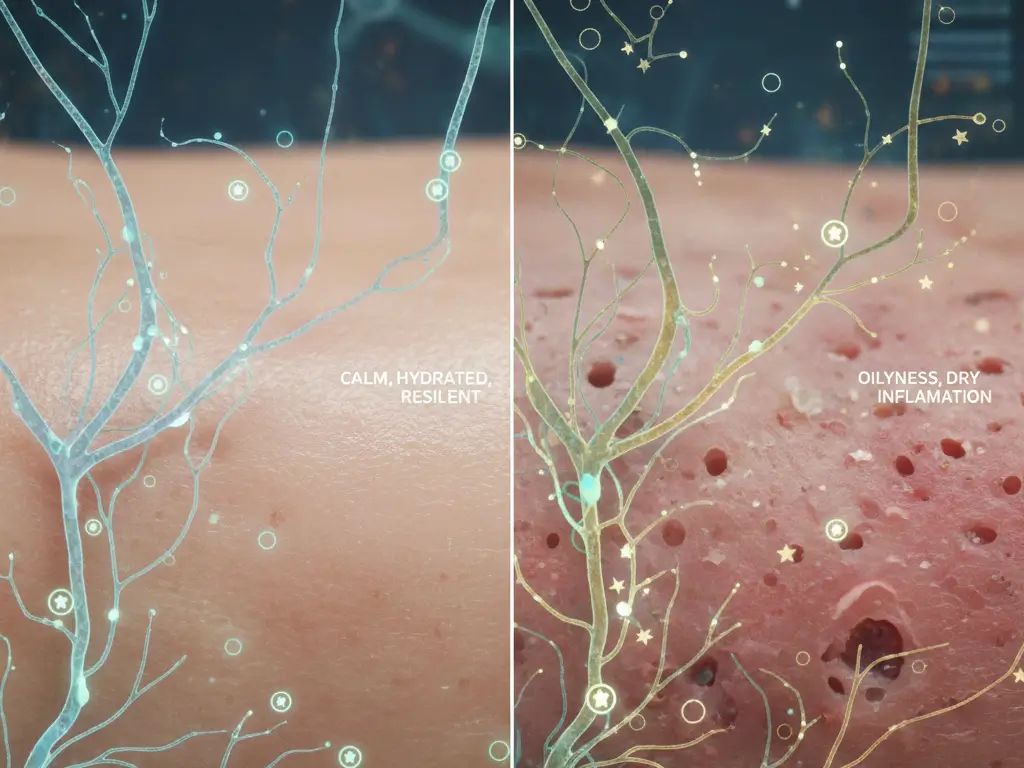
Your skin has its own regulatory system that most skincare routines completely ignore. It’s called the endocannabinoid system (ECS), and it influences everything from oil production to inflammation responses.
Your skin contains a network of receptors and signaling molecules that help maintain balance. When this system works well, your skin stays calm, hydrated, and resilient. When it’s disrupted, problems like excess oiliness, dryness, or inflammation can follow.
This article provides educational information about the endocannabinoid system and skin biology. It is not intended to diagnose, treat, cure, or prevent any skin condition. Research on topical cannabinoids remains limited, and individual responses vary significantly. Always consult a board-certified dermatologist before making changes to your skincare routine, especially if you have existing skin conditions or sensitivities. This guide presents current research while acknowledging its limitations.
The CBD skincare market has exploded in recent years. You’ve probably seen serums, creams, and masks featuring cannabidiol as a star ingredient. But here’s what most marketing won’t tell you: the story is bigger than any single product.
Your body produces its own cannabinoids. Your skin has receptors specifically designed to respond to them. Understanding this built-in system might change how you think about skin health entirely.
I’ve spent considerable time reviewing the research on this topic. What I found surprised me. The science is genuinely fascinating, but it’s also younger and more complex than marketing materials suggest.
What Is the Endocannabinoid System?
The endocannabinoid system is a biological network of receptors, enzymes, and signaling molecules that helps regulate various body functions, including skin health. Your body produces its own cannabinoids (endocannabinoids) that interact with this system to maintain balance.
Scientists first identified this system in the early 1990s while researching how cannabis affects the body. What they discovered was unexpected: we have an entire regulatory network that responds to cannabinoid-like compounds.
The ECS has three main components:
Endocannabinoids – These are molecules your body makes naturally. The two most studied are anandamide (sometimes called the “bliss molecule”) and 2-AG (2-arachidonoylglycerol). Think of them as internal messengers.
Receptors – CB1 and CB2 receptors sit on cell surfaces throughout your body. When endocannabinoids bind to these receptors, they trigger specific responses. CB1 receptors appear mostly in the nervous system, while CB2 receptors concentrate in immune cells, and interestingly, in skin.
Enzymes – These break down endocannabinoids once they’ve done their job. The main ones are FAAH and MAGL.
According to research published in the journal Trends in Pharmacological Sciences, the ECS acts as a “homeostatic regulator”, essentially, a balance-keeper. When something goes out of range, this system works to restore equilibrium.
This connects to how we understand plant-based ingredients that support the skin barrier and the broader concept of skin homeostasis.
How Does the Endocannabinoid System Function in Your Skin?
Your skin expresses all components of the endocannabinoid system. Research suggests this cutaneous ECS helps regulate sebum production, skin cell growth, inflammation responses, and even hair follicle cycling, though scientists are still mapping the full picture.
Here’s where things get genuinely interesting. Your skin isn’t just passive tissue. It’s your largest organ, and it has its own sophisticated regulatory machinery.
A 2009 review in Trends in Pharmacological Sciences noted that nearly every skin cell type expresses ECS components. This includes:
- Keratinocytes (the main cells of your outer skin layer)
- Sebocytes (cells in sebaceous glands that produce oil)
- Hair follicle cells
- Immune cells in the skin
Sebum Production
Sebocytes, the cells producing your skin’s natural oil, contain CB2 receptors. Research suggests the ECS plays a role in regulating how much sebum these cells produce. When the system is balanced, oil production tends to stay in check.
This matters if you’ve struggled with overly oily or excessively dry skin. Understanding effective skin barrier care includes recognizing these regulatory systems.
Inflammation Responses
CB2 receptors appear throughout skin immune cells. Preliminary research indicates the ECS may help modulate inflammatory responses. When functioning optimally, this could mean calmer, less reactive skin.
Skin Cell Lifecycle
Your skin constantly renews itself. Old cells shed; new ones form. Some research suggests endocannabinoids influence how skin cells proliferate and differentiate, though this research remains in early stages.
What Skin Concerns Connect to the Endocannabinoid System?
Researchers are investigating connections between ECS function and several skin concerns, including acne, eczema, psoriasis, and general skin sensitivity. However, much of this research remains preliminary, and clinical applications are still developing.
I want to be direct here: the research is promising but young. Most studies have occurred in laboratory settings or animal models. Large-scale human clinical trials remain limited.
That said, here’s what scientists are exploring:
Acne and Oiliness
Since sebocytes contain cannabinoid receptors, researchers have examined whether ECS dysfunction might contribute to excess sebum production. A 2014 study in the Journal of Clinical Investigation found that CBD (a plant cannabinoid) could reduce sebum production in human sebocyte cultures. This is intriguing, but laboratory cells aren’t the same as real human skin in real conditions.
Inflammatory Skin Conditions
Given the ECS’s role in inflammation regulation, researchers are investigating potential connections to conditions like eczema and psoriasis. Some studies have found altered endocannabinoid levels in affected skin. For those dealing with sensitive, reactive skin, our guide on clean beauty for sensitive and acne-prone skin offers practical approaches.
Skin Sensitivity and Barrier Function
There’s preliminary research suggesting the ECS might influence skin barrier integrity. A well-functioning barrier keeps moisture in and irritants out. This connects to broader discussions about maintaining skin hydration and barrier health.
| Skin Concern | ECS Connection (Research Status) | Evidence Level |
| Acne/Oiliness | Sebocyte regulation via CB2 | Early/Promising |
| Eczema | Inflammation modulation | Preliminary |
| Psoriasis | Altered endocannabinoid levels | Preliminary |
| General Sensitivity | Barrier function support | Emerging |
Having a potential connection doesn’t mean we have effective treatments. Research and practical application are different things.
Can Topical Cannabinoids Support Skin Health?
Topical products containing cannabinoids like CBD may offer benefits for some users, but research on effectiveness remains limited. Product quality varies enormously, and what works in laboratory studies doesn’t always translate to real-world results.
Here’s where I need to separate marketing from science.
CBD and other plant cannabinoids can interact with the skin’s ECS. Topical application allows these compounds to reach receptors in the skin without significant systemic absorption (meaning they generally don’t enter your bloodstream in meaningful amounts).
What the Research Shows:
According to a 2020 review in Clinical, Cosmetic and Investigational Dermatology, topical cannabinoids show potential for several skin applications. However, the authors noted significant limitations:
- Most studies are small
- Product formulations vary wildly
- Regulatory standards are inconsistent
- Placebo-controlled trials are scarce
The Quality Problem:
Not all CBD products are equivalent. Without strict regulation, you might find:
- Products with less CBD than labeled
- Products with more THC than labeled
- Contaminated products
- Products where CBD can’t actually penetrate skin effectively
If you’re exploring facial oils and their various types, understanding that quality and formulation matter enormously applies doubly to cannabinoid products.
Practical Considerations:
If you’re curious about trying cannabinoid skincare:
- Research the brand’s third-party testing
- Start with one product to assess response
- Patch test before full application
- Set realistic expectations
- Consult a dermatologist if you have existing skin conditions
Natural Ways to Support Your Skin’s Endocannabinoid System
Beyond topical products, you may support your skin’s ECS through lifestyle factors including diet, stress management, sleep, and movement. Your body produces its own endocannabinoids, and certain habits may influence this production.
This is the perspective most CBD marketing completely misses. Your ECS isn’t just waiting for external cannabinoids. It’s an active system your body maintains.
Omega Fatty Acids
Endocannabinoids are derived from fatty acids. Adequate intake of omega-3 and omega-6 fatty acids provides the building blocks your body needs. Research suggests omega-3s may also support ECS receptor function.
Foods rich in these fatty acids include fatty fish, walnuts, flaxseeds, and hemp seeds. For topical support, our guide to oils and butters explores fatty acid-rich options.
Stress Management
Chronic stress appears to disrupt ECS function. Your body produces endocannabinoids partly in response to stress, but ongoing stress may deplete this system.
Practices like meditation, adequate sleep, and regular movement may help maintain ECS balance. The connection between stress and skin health is well-documented, exploring mindful skincare to reduce stress addresses this relationship directly.
Sleep Quality
Research indicates endocannabinoid levels fluctuate with circadian rhythms. Poor sleep may disrupt normal ECS cycling. Prioritizing consistent, quality sleep supports many body systems, potentially including skin health.
Movement
Exercise increases endocannabinoid production. The “runner’s high” may partly result from elevated anandamide levels. Regular physical activity supports overall ECS function.
Gut Health
Emerging research explores connections between gut microbiome health and ECS function. The gut-skin axis represents another fascinating area where internal health influences skin.
Some adaptogens used in skincare may also support stress response and overall balance.
When to Consult a Dermatologist
Consult a board-certified dermatologist for persistent skin concerns, before adding new active ingredients to your routine, if you have diagnosed skin conditions, or if you’re experiencing unexpected reactions.
This educational information doesn’t replace professional guidance. See a dermatologist if you experience:
- Persistent acne not responding to basic care
- Signs of eczema, psoriasis, or other inflammatory conditions
- Significant skin sensitivity or reactions
- Any concerns about specific skin conditions
- Questions about integrating cannabinoid products with existing treatments
For those dealing with specific conditions like rosacea, our guide to organic ingredients for rosacea complements, but never replaces, professional care.
Dermatologists can offer personalized recommendations based on your skin type, conditions, and medical history.
Moving Forward With Your Skin’s Natural Balance
Your skin’s endocannabinoid system represents fascinating biology that mainstream skincare has only recently begun acknowledging. It’s a regulatory network that’s always working, whether you apply cannabinoid products or not.
Here’s my honest take: the science is genuinely promising, but we’re still in early chapters. Marketing has outpaced research. Many product claims stretch beyond what evidence supports.
That doesn’t mean this area lacks value. Understanding how your skin maintains balance gives you better perspective on what supports skin health. Sometimes the answer is a product. Often it’s lifestyle factors, stress management, and consistent foundational care.
- Evaluate your baseline skin health and any patterns you notice with stress, sleep, or diet
- If interested in cannabinoid skincare, research brands thoroughly and consider patch testing one quality product
- Support your body’s natural ECS through omega fatty acids, stress management, and consistent sleep
For comprehensive approaches to skin health, explore our resources at Beauty Healing Organic, where science meets clean beauty with evidence-based guidance.
Your skin has sophisticated regulatory machinery built in. Work with it, not just on it.
SOURCES CITED
- Bíró, T., et al. (2009). “The endocannabinoid system of the skin in health and disease: novel perspectives and therapeutic opportunities.” Trends in Pharmacological Sciences, 30(8), 411-420.
- Oláh, A., et al. (2014). “Cannabidiol exerts sebostatic and antiinflammatory effects on human sebocytes.” Journal of Clinical Investigation, 124(9), 3713-3724.
- Tóth, K.F., et al. (2019). “Cannabinoid Signaling in the Skin: Therapeutic Potential of the ‘C(ut)annabinoid’ System.” Molecules, 24(5), 918.
- Baswan, S.M., et al. (2020). “Therapeutic Potential of Cannabidiol (CBD) for Skin Health and Disorders.” Clinical, Cosmetic and Investigational Dermatology, 13, 927-942.
- Di Marzo, V. (2018). “New approaches and challenges to targeting the endocannabinoid system.” Nature Reviews Drug Discovery, 17(9), 623-639.
- Río, C., et al. (2018). “The endocannabinoid system of the skin. A potential approach for the treatment of skin disorders.” Biochemical Pharmacology, 157, 122-133.
- Sheriff, T., et al. (2020). “The potential role of cannabinoids in dermatology.” Journal of Dermatological Treatment, 31(8), 839-845.