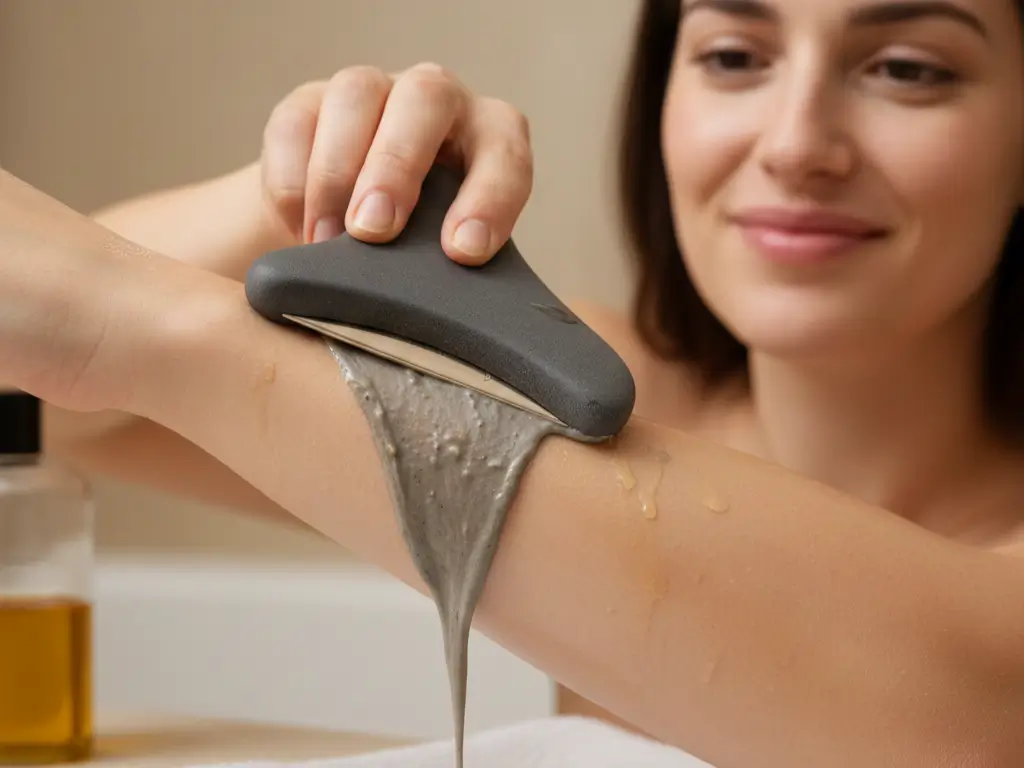
I still remember the first time I used a body plane. I was skeptical. It looked like a dull razor or a fancy cheese slicer, and I honestly didn’t understand how scraping a piece of metal or stone over my leg was going to do anything my trusty washcloth couldn’t.
Then I saw the “sludge.”
That’s the unglamorous truth about this tool. When used correctly with oil, it lifts a greyish mixture of dead skin cells and environmental debris right off your body. It is equal parts gross and deeply satisfying. But beyond the visual proof, the way my skin felt afterward, smooth, not stripped, changed my mind completely.
If you are tired of abrasive scrubs that leave you red and raw, or if you feel like your lotion just sits on top of your skin without absorbing, this might be the missing link in your routine.
Here is the no-nonsense guide to understanding, choosing, and actually using body planes and scrapers.
What Exactly Is a Body Plane?
A body plane (or body scraper) is a handheld tool, typically made of stainless steel, crystal, or wood, with a blunt edge designed to be dragged across the skin. Unlike razors, it does not cut; instead, it provides deep exfoliation and supports lymphatic drainage by mechanically lifting dead skin cells and stimulating blood flow.
The History You Probably Didn’t Know
We tend to think of these tools as modern “wellness trends,” but they are actually ancient technology.
In ancient Greece and Rome, athletes and bathers didn’t use soap and loofahs. They used a curved metal tool called a strigil. They would oil their bodies, let the oil soften the dirt and sweat, and then scrape it all off. It was the original deep cleanse.
Modern body planes and scrapers work on this exact same principle. They rely on the combination of a lubricant (oil) and a tool to shear off the top layer of debris without disrupting the skin’s pH balance like harsh soaps can.
Why Not Just Use a Scrub?
Sugar and salt scrubs are popular, but they have a flaw. They are abrasive. When you scrub hard, you risk creating micro-tears in the skin barrier. A plane offers a controlled, even pressure. It removes the rough texture without the scratching sensation.
The Science: Fascia, Lymph, and Exfoliation
These tools operate on two levels. Superfacially, they perform physical exfoliation by removing keratin buildup (dead skin). Deeper down, the pressure stimulates the fascia (connective tissue) and lymphatic system, encouraging fluid movement and reducing puffiness.
The Exfoliation Factor
Think about how you shave wood. If you sand it, you create dust and might scuff the surface unevenly. If you plane it, you remove a smooth, consistent layer to reveal fresh wood underneath.
Your skin behaves similarly. Conditions like keratosis pilaris (those bumps on the back of your arms) are essentially plugs of dead protein. I have found that natural remedies for keratosis pilaris often work best when you mechanically remove that plug. A scraper gently dislodges these keratin plugs better than chemical acids alone.
The Lymphatic Connection
You might be familiar with facial tools, but the body has a lymphatic system that needs attention too. When you scrape with long, upward strokes, you are mimicking the mechanics of gua sha. This helps move stagnant fluid.
I notice this most after a long flight or a day sitting at a desk. My legs feel heavy. A five-minute session with a scraper seems to “wake up” the circulation. It’s not magic; it’s just mechanics. You are manually pushing fluid toward your lymph nodes so your body can process it.
Step-by-Step: How to Use a Body Scraper Properly
To use a body plane effectively, apply a generous amount of body oil to damp skin. Hold the tool at a 45-degree angle. Apply medium pressure and scrape in long strokes toward your heart. Wipe the “sludge” off the blade frequently. Rinse your body and moisturize immediately afterward.
This is where most people mess up. They try to use it on dry skin (ouch) or with soap (too slippery). Here is the routine that actually works.
1. The Setup (The Shower Soak)
You need your skin to be soft. I usually do this at the end of a shower or bath. The warm water softens the bonds between dead skin cells. Turn off the water, or step out of the stream. You don’t want the water washing away your oil immediately.
2. The Lubrication
This is non-negotiable. You need slip. If you drag a metal tool on dry skin, you will just irritate yourself.
Apply a heavy layer of body oil. You can explore Amazonian oils or simple jojoba oil. The oil acts as a buffer. It protects your live skin cells while the tool grabs the dead ones.
3. The Angle and Stroke
Hold the tool firmly. Place the edge against your skin at a 45-degree angle.
- Too flat (90 degrees): You won’t scrape anything.
- Too sharp (10 degrees): It feels aggressive.
Pull the tool up your limb, towards your heart. This is standard dry brushing protocol too, always move toward the center of the body to support circulation.
4. The “Sludge” Check
After 3-4 strokes, look at the edge of the tool. You should see a milky, greyish residue. That is the mix of oil, dirt, and dead skin. Wipe it off on a towel or rinse it. If you don’t see this, you might not be pressing hard enough, or your skin might not be damp enough.
5. The Rinse
Once you’ve done your whole body (arms, legs, torso), rinse off. You don’t need to scrub with soap again unless you feel too oily. Pat dry and apply a lotion or butter. Since you just removed the dead layer, your botanical butters will absorb significantly better.
Choosing Your Weapon: Metal, Stone, or Wood?
Stainless steel body planes are the most hygienic and durable, offering the best “edge” for exfoliation. Stone tools (like jade or quartz) are better for energetic work and temperature therapy but can break. Wood is porous and harder to keep clean, making it less ideal for wet exfoliation.
Here is a breakdown of what I’ve found testing different materials:
| Material | Durability | Hygiene | Best Use |
| Stainless Steel | High (Indestructible) | Excellent (Non-porous) | Heavy exfoliation and debris removal |
| Crystal (Jade/Quartz) | Low (Fragile) | Good | Lymphatic drainage and cooling sensation |
| Wood | Medium | Low (Hard to sanitize) | Dry massage or cellulite work (Maderotherapy) |
| Ceramic | Medium | Good | Gentle scraping for sensitive skin |
My Recommendation
If your main goal is that deep clean and exfoliation, go with stainless steel. It mimics the Roman strigil best. It’s easy to clean with hot water and soap, and you never have to worry about dropping it in the shower.
However, if you are looking for a more spiritual or relaxing ritual, a large rose quartz stone has a nice weight to it. Just be incredibly careful with slippery hands, I have shattered a beautiful stone tool on a bathroom tile, and it is heartbreaking.
Body Plane vs. Other Exfoliation Methods
Body planes offer a non-abrasive physical exfoliation that preserves the skin barrier better than scrubs. Compared to dry brushing, planes are used wet and provide deeper hydration. Compared to chemical exfoliants, planes provide instant smoothing results but don’t offer the long-term cell turnover benefits of acids.
vs. Dry Brushing
Dry brushing is great for waking up the nervous system. It’s scratchy and invigorating. But it happens on dry skin. If you have sensitive skin or eczema, dry brushing can trigger a flare-up.
Body planing happens with oil. This makes it far more forgiving for dry or sensitive skin types. You get the circulation boost without the “scratch.”
vs. Exfoliating Mitts
The exfoliating glove or mitt (like the Korean Italy towel) is the closest competitor. Both remove visible dead skin. The mitt relies on friction and water; the plane relies on oil and an edge.
- The Mitt: Better for speed. You can scrub down fast.
- The Plane: Better for ritual and hydration. Because you must use oil, you leave the shower moisturized.
vs. Scrubs
I’ve largely abandoned sugary scrubs. They dissolve unevenly and often leave my shower floor a slippery, gritty mess. Plus, many contain jagged walnut shells or plastic microbeads (though thankfully, those are being banned). A plane is a one-time purchase that creates zero waste.
Common Mistakes That Will Ruin the Experience
The most common errors are pressing too hard (causing bruising), using the tool on dry skin, scraping over active acne or varicose veins, and neglecting to clean the tool. Always avoid broken skin and use sufficient oil to prevent “skipping” or dragging.
The “Bruise” Factor
You might have seen photos of gua sha results where the back looks red and purple (called “sha”). While that is a specific therapeutic outcome in Traditional Chinese Medicine, it is not the goal for your daily beauty routine.
If you see deep red marks (petechiae), you are pressing too hard. You want a pink flush (blood flow), not bruising.
Skipping the Rinse
This sounds obvious, but please clean your tool. Dead skin and oil are a breeding ground for bacteria. Wash your plane with warm, soapy water after every single use. If you have acne-prone skin on your body, check our body mapping acne guide for more on that, using a dirty tool will only spread bacteria.
Ignoring Contraindications
Do not scrape over:
- Varicose veins (you don’t want to put pressure on damaged veins).
- Active rashes or sunburns.
- Open cuts.
- Moles that are raised (you can nick them).
Integrating This Into Your “Everything Shower”
We all know the concept of the “Everything Shower”, that once-a-week event where you do the hair mask, the shaving, the exfoliating, and the moisturizing.
The body plane fits perfectly here. I suggest doing this ritual once a week. Because it is deep exfoliation, doing it daily is overkill and might thin your skin barrier too much.
My Suggested Routine:
- Cleanse: Wash body with a gentle soap.
- Soak: Let the steam soften your pores for 5 minutes.
- Oil & Plane: Turn off water, apply oil, scrape the full body.
- Rinse: quick rinse to remove the debris.
- Shave: If you shave, do it now. Your razor won’t get clogged with dead skin because you just planed it off.
- Treat: Apply a body sculpting treatment or firming oil.
The Bottom Line
Is a body plane essential? Technically, no. You can live without it. But is it effective? Absolutely.
It bridges the gap between hygiene and massage. It forces you to touch your body, acknowledge your tension spots, and manually remove the physical weight of the day (and the dead skin cells).
If you struggle with rough texture, ingrown hairs, or just generally dull skin, swapping your loofah for a stainless steel scraper is a massive upgrade. It’s cleaner, lasts a lifetime, and frankly, seeing that residue come off is weirdly addictive.
For more deep dives into natural beauty tools and holistic skin health, visit Beauty Healing Organic.
Just remember: heavy on the oil, light on the pressure. Your skin will thank you.