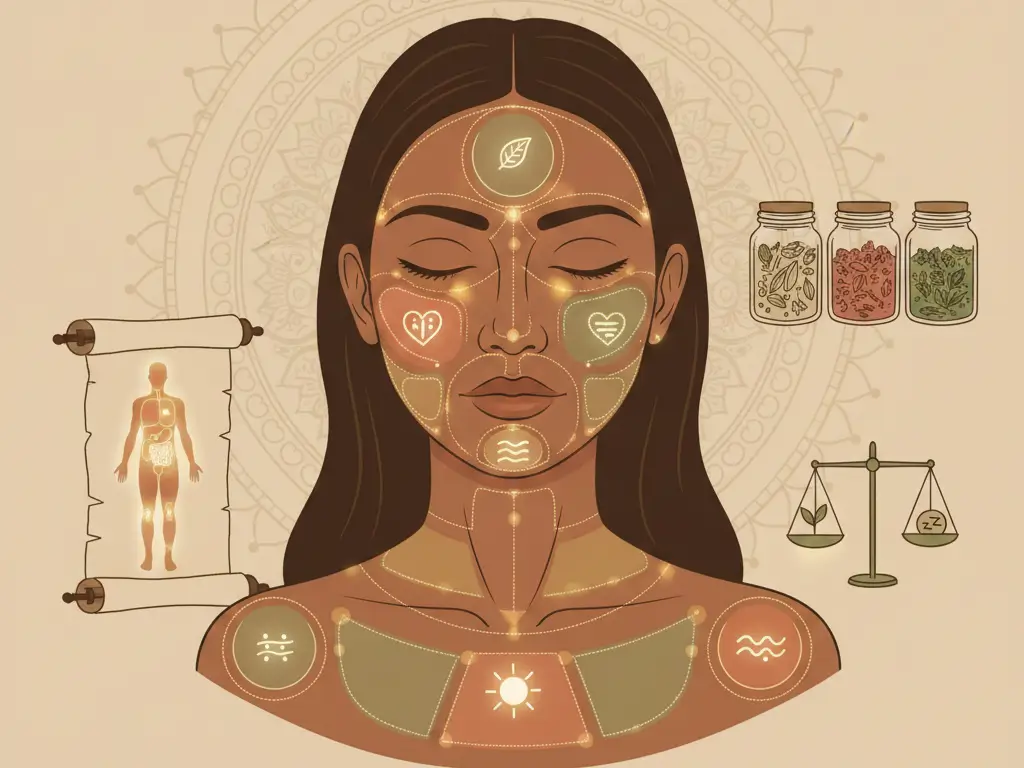
Ayurvedic body mapping (often called face mapping) is an ancient diagnostic tool based on the belief that specific zones of the skin correspond to internal organs and doshas (energetic forces). While not a substitute for medical diagnosis, it is traditionally used to identify lifestyle imbalances in diet, sleep, and stress levels.
This article provides educational information about Ayurvedic body mapping and traditional skincare practices. It is not intended to diagnose, treat, cure, or prevent any medical condition or disease. Always consult a licensed healthcare professional or board-certified dermatologist before making any health decisions, starting new treatments, or changing existing medical regimens. Individual results and health needs vary. If you have persistent acne, changing moles, or skin concerns, seek professional medical advice.
The Mirror of Your Health
Imagine if your skin could talk. In many ways, it does.
For thousands of years, practitioners of Ayurveda, India’s traditional system of medicine, have viewed the skin not just as a protective barrier, but as a dynamic dashboard reflecting the state of your internal health. This concept, often referred to as “face mapping” or body mapping, suggests that a breakout on your chin or dryness on your cheeks isn’t random. Instead, it’s viewed as a signal, a gentle nudge from your body asking for balance.
However, in the US, we often treat skin issues in isolation. We apply topical creams to a pimple without asking why it arrived in that specific spot. While modern dermatology focuses heavily on bacteria and sebum, Ayurvedic philosophy zooms out to look at the “gut-skin axis,” stress levels, and hormonal rhythms.
This guide explores the fascinating world of Ayurvedic body mapping. We will bridge the gap between ancient wisdom and modern understanding, helping you interpret these traditional signals while knowing exactly when to step away from the mirror and consult a doctor.
Understanding Ayurvedic Body Mapping
Ayurvedic body mapping relies on the concept of the three Doshas, Vata (air/ether), Pitta (fire/water), and Kapha (earth/water). Practitioners believe that imbalances in these energies manifest in specific skin zones. For example, the forehead is often linked to Vata and digestion, while the cheeks are linked to Pitta and metabolism.
The Science vs. The Tradition
It is vital to distinguish between traditional beliefs and clinical evidence. In Ayurveda, the body is an interconnected web. If your “Agni” (digestive fire) is weak, it shows up on your skin. Modern science calls this the gut-skin axis, a concept gaining significant traction in peer-reviewed research.
While a dermatologist might not diagnose a liver issue solely based on a pimple between your eyebrows, they likely agree that a high-sugar diet (which taxes the liver) can exacerbate acne. Therefore, we use body mapping as a tool for self-reflection, not medical diagnosis.
If you are new to these concepts, you might want to start with our broad ayurvedic beauty guide to understand the foundational philosophies before diving into specific zones.
The Ayurvedic Face Map: A Zone-by-Zone Guide
The face is the primary canvas for Ayurvedic reading. Here is how traditional practitioners interpret specific zones, along with modern lifestyle considerations.
1. The Forehead: Vata & The Digestive System
In Ayurveda, the forehead is ruled by Vata dosha and is traditionally associated with the digestive system and nervous system.
- Traditional Interpretation: Breakouts or congestion here may indicate difficulty breaking down food, irregular bowel movements, or high stress (worry/anxiety).
- Modern Correlation: Stress increases cortisol, which triggers oil production. Furthermore, a diet high in processed foods can disrupt the gut microbiome, potentially leading to inflammation visible on the forehead.
- Lifestyle Adjustment: Focus on hydration. You might explore fermented ingredients to support gut health or increase your water intake.
2. Between the Brows: The Liver & “Wine and Dine” Zone
This area is famously linked to the liver in both Traditional Chinese Medicine and Ayurveda.
- Traditional Interpretation: Deep lines or redness here can signal unexpressed anger or an overburdened liver (often from alcohol or rich, greasy foods).
- Modern Correlation: While not a liver function test, diets high in dairy, sugar, and alcohol are known inflammatory triggers for acne.
- Lifestyle Adjustment: Reduce late-night snacking. Consider incorporating bitter greens like arugula or dandelion tea, which are traditionally used to support liver function.
3. The Cheeks: Pitta, Lungs & Metabolism
The cheeks are often associated with the respiratory system and metabolism (Pitta energy).
- Traditional Interpretation: Redness, broken capillaries, or acne here may signal overheating in the body, inflammation, or respiratory distress.
- Modern Correlation: This is where environment meets biology. Your cheeks are constantly exposed to pollution. Additionally, dirty pillowcases and cell phones are common culprits for “mechanical acne” in this zone.
- Lifestyle Adjustment:
- Environmental Protection: If you live in a city, adopting an anti-pollution skincare routine is essential to protect the skin barrier.
- Hygiene: Change your pillowcases frequently, consider a silk pillowcase for less friction and bacteria retention.
- Cooling: If you have high Pitta (heat), look for cooling ingredients like cucumber or rose. A DIY rosewater glycerin mist can be incredibly soothing for flushed cheeks.
4. The Nose: Heart & Blood Pressure
The nose is traditionally linked to the heart and circulatory system.
- Traditional Interpretation: Redness or swelling here might indicate high blood pressure or poor circulation.
- Modern Correlation: Rosacea often manifests on the nose and cheeks and is linked to vascular reactivity. Alcohol and spicy food are common triggers for both rosacea flare-ups and Pitta aggravation.
- Lifestyle Adjustment: Monitor your intake of spicy foods. Check your blood pressure regularly if you notice persistent redness.
5. The Jawline and Chin: Kapha & Hormones
Perhaps the most well-known correlation, the chin and jawline are linked to the reproductive system and hormonal balance.
- Traditional Interpretation: Cystic acne here is a sign of Kapha imbalance or hormonal fluctuation.
- Modern Correlation: Science strongly supports this. Androgens stimulate oil glands, which are abundant in the jaw area, leading to hormonal acne during menstrual cycles or high-stress periods.
- Lifestyle Adjustment: Managing stress is key, as cortisol impacts hormones. You might also explore adaptogens in skincare like Ashwagandha (applied topically or taken internally after consulting a doctor) to help the body manage stress.
Beyond the Face: Decoding Body Zones
Body mapping extends to the chest, back, and shoulders. In Ayurveda, these zones correlate to energy channels, but in dermatology, they are often linked to friction, sweat, and product residue.
Chest & Shoulders (The Stress Zone)
Breakouts on the chest (décolletage) are often linked to unreleased emotions or stress in Ayurvedic thought.
- Practical Tip: Physically, this area is prone to sweat accumulation. If you exercise, ensure you are showering immediately. For aging concerns in this delicate area, seeing a firming neck and decolletage routine can help maintain skin elasticity.
Back (“Bacne”)
In Ayurveda, the back can represent “backing up” of energy or digestion.
- Practical Tip: This is a common issue for active individuals. Our guide on athlete body acne and chafing explores how sweat trapped under synthetic clothing causes folliculitis. Switching to breathable fabrics and using a sulfate-free shampoo (so suds running down your back don’t clog pores) can make a significant difference.
Identifying Your Dosha Skin Type
To truly utilize Ayurvedic mapping, you must understand your dominant Dosha. Most people are a mix, but one energy usually dominates your skin behavior.
Vata Skin (Air/Ether)
- Characteristics: Dry, thin, cool to the touch, prone to fine lines and dehydration.
- Mapping Tendency: Issues usually appear on the forehead; prone to premature aging.
- Care Strategy: Hydration is paramount. Vata skin loves heavy moisture. Look into botanical butters like shea or mango butter to seal in moisture.
Pitta Skin (Fire/Water)
- Characteristics: Sensitive, reddish, warm, prone to freckles, moles, and acne.
- Mapping Tendency: Issues appear in the T-zone and cheeks; prone to inflammation.
- Care Strategy: Cooling and soothing. Avoid harsh scrubs. Instead, use a Jade roller (vs Rose Quartz) to physically cool the skin and reduce puffiness.
Kapha Skin (Earth/Water)
- Characteristics: Thick, oily, cool, smooth, prone to cystic acne and large pores.
- Mapping Tendency: Issues appear on the chin and jawline; prone to congestion.
- Care Strategy: Stimulation and detoxification. Kapha skin benefits from dry brushing to move lymphatic fluid and regular exfoliation using clays to draw out impurities.
Safety & Considerations: When to Stop Mapping
While body mapping is a powerful tool for mindfulness, it has strict limitations. Misinterpreting serious skin signs as simple “imbalances” can be dangerous.
Who Should NOT Rely on Body Mapping:
- Those with Sudden Mole Changes: Ayurveda focuses on acne and texture. If a mole changes shape, color, or size, this is not a Dosha imbalance, this requires an immediate cancer screening.
- Chronic Conditions: Eczema, Psoriasis, and Rosacea are complex medical conditions. While diet helps, they often require medical management.
- Severe Cystic Acne: If acne is painful, deep, and leaving scars, “drinking more water” is likely insufficient. You may need medical intervention to prevent permanent scarring.
When to Seek Medical Attention:
- Signs of Infection: Red streaks, heat radiating from a spot, or fever.
- Rapid Spread: A rash that spreads quickly across the body.
- Non-Healing Lesions: A sore or spot that hasn’t healed in 3-4 weeks.
- Psychological Distress: If your skin condition is affecting your mental health or daily life.
Please read our guide on the psychology of scent and essential oils to understand how stress impacts well-being, but never hesitate to seek a doctor’s help for physical symptoms.
Integrating Mapping into Your Routine
Once you have identified potential triggers through mapping, how do you adjust your routine?
1. The “Clean” Reset
If your mapping suggests your skin is overburdened (congestion in liver/digestion zones), simplify. Cut out potential irritants. A full face clean beauty guide can help you transition to products with fewer synthetic triggers that might be confusing your skin’s natural balance.
2. Lymphatic Support
Ayurveda emphasizes the flow of “Rasa” (nutrient fluid). Stagnation leads to dullness. Tools like Gua Sha or a Kansa wand (a traditional Ayurvedic tool) can help mechanically move stagnant lymph, reducing puffiness and helping the skin detoxify naturally.
3. Internal Alignment
Remember the gut-skin connection. If your forehead is breaking out, don’t just apply cream. Look at your plate. Incorporating gut-skin axis friendly foods helps address the root cause, honoring the Ayurvedic principle that beauty is built from the inside out.
Listening to the Messenger
Your skin is constantly communicating with you. A pimple on your chin might be an annoyance, or it might be a gentle reminder that your cycle is approaching and you need to rest. Dryness on your forehead might be a signal to drink more water and turn off the news.
Ayurvedic body mapping isn’t about judging your skin or finding faults; it’s about cultivating a relationship with your body. It empowers you to act as a detective rather than a victim of your breakouts.
Next Steps:
- Immediate: Stand in front of a mirror and observe where your primary skin concerns are located using the zones above.
- This Week: Choose one lifestyle factor linked to that zone (e.g., pillowcase hygiene for cheeks, water intake for forehead) and improve it.
- When to call a pro: If you see no change after 4 weeks of lifestyle adjustments, or if your condition worsens, consult a dermatologist.
For more holistic strategies and in-depth guides on natural wellness, explore our comprehensive collection at beautyhealingorganic.com.
SOURCES CITED
- National Center for Complementary and Integrative Health (NCCIH). (2019). Ayurvedic Medicine: In Depth. https://www.nccih.nih.gov/health/ayurvedic-medicine-in-depth
- American Academy of Dermatology Association. (n.d.). Adult Acne. https://www.aad.org/public/diseases/acne/really-acne/adult-acne
- Sinha, P., et al. (2021). The Gut-Skin Axis in Health and Disease: A Paradigm with Therapeutic Implications. Nutrients. https://www.ncbi.nlm.nih.gov/pmc/articles/PMC7916842/
- Chen, Y., & Lyga, J. (2014). Brain-Skin Connection: Stress, Inflammation and Skin Aging. Inflammation & Allergy – Drug Targets. https://www.ncbi.nlm.nih.gov/pmc/articles/PMC4082169/
- Bagatin, E., et al. (2019). Adult female acne: a guide to clinical practice. Anais Brasileiros de Dermatologia. https://www.ncbi.nlm.nih.gov/pmc/articles/PMC6360964/