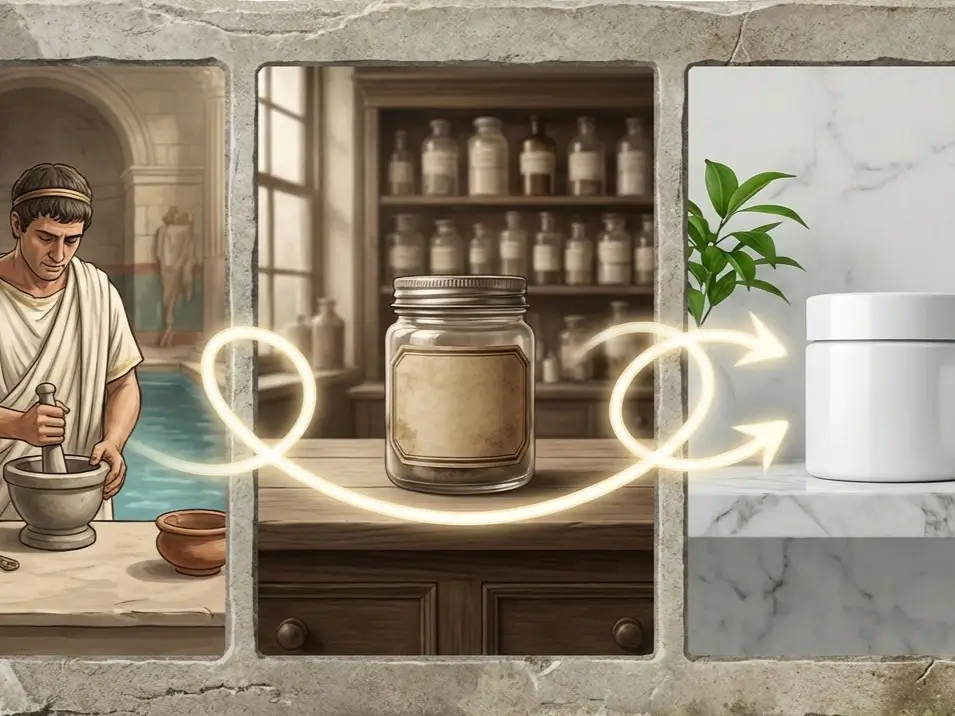
I keep a jar of my great-grandmother’s cold cream recipe on my bathroom shelf. Right next to it sits a $48 “clean beauty” cold cream from a trendy brand. When I compared the ingredient lists, I laughed out loud, they’re nearly identical. Both would’ve made perfect sense to Galen, the Roman physician who invented cold cream around 150 CE.
Cold cream is a cleansing and moisturizing emulsion invented in ancient Rome, reformulated with petroleum derivatives in the early 1900s, then reimagined again by the clean beauty movement starting around 2015.
Here’s what makes this story fascinating: we didn’t improve cold cream over 2,000 years. We changed it, abandoned core principles, then circled back to something remarkably close to the original. The journey reveals more about our cultural anxieties than about skincare chemistry.
If you’ve ever wondered why your grandmother swore by Pond’s while your dermatologist recommends something that looks suspiciously similar (minus the mineral oil), you’re watching this circle complete itself. Understanding where cold cream came from, and where it detoured, helps you make better choices about what actually belongs on your face.
What Is Cold Cream and Why Did It Stay Popular for 2,000 Years?
Cold cream is a water-in-oil emulsion that cleanses skin while leaving a protective layer. It earned its name from the cooling sensation created when water evaporates from the surface. The formula survived two millennia because it solves a fundamental problem: removing makeup and dirt without completely stripping skin’s natural oils.
The brilliance of cold cream isn’t complicated. It works like the oil cleansing method that clean beauty enthusiasts rediscovered in the 2000s, because it essentially IS oil cleansing, just emulsified with water for better spreadability.
Traditional cold cream contains four basic components:
- Oil phase (historically olive oil, later mineral oil) – dissolves makeup and sebum
- Wax (typically beeswax) – provides structure and skin protection
- Water phase (often rose water) – creates the cooling effect and lighter texture
- Emulsifier (borax in original formulas) – binds oil and water
When you massage it onto skin, the oil phase breaks down makeup and sunscreen. When you tissue it off, you remove the dissolved gunk. The thin layer left behind isn’t residue, it’s intentional protection, which is why cold cream doubled as a night moisturizer for generations.
I think the longevity comes down to this: cold cream doesn’t ask your skin to do anything. Modern cleansers often contain surfactants that strip everything away, forcing your skin to rebuild its barrier from scratch. Cold cream works WITH your skin’s existing oil, supplementing rather than replacing. For approaches that respect your skin’s natural balance, check out our guide to natural emulsification, which explains how traditional formulas achieve stability without modern synthetics.
What’s interesting here is that this gentle approach fell completely out of favor by the 1980s, only to become the foundation of modern cleansing balms and oils. We renamed it, repackaged it, and called it innovative.
Galen’s Original Cold Cream Formula: The Accidental “Clean Beauty” Pioneer
Roman physician Galen created cold cream around 150 CE using beeswax, olive oil, rose water, and borax. His formula would qualify as “clean beauty” by most modern standards, plant-based oils, minimal ingredients, and a natural emulsifier system that’s still used in organic skincare today.
Galen called it Ceratum Galeni (Galen’s wax). He wasn’t trying to create a beauty product, he was formulating a medical ointment that could deliver herbs to skin while providing a cooling effect for inflammation. The beauty application came later.
His approximate formula looked like this:
- Beeswax: 1 part
- Olive oil: 3 parts
- Rose water: 1 part
- Borax: small amount as emulsifier
What I find remarkable is that Galen understood emulsion chemistry without microscopes or modern chemistry. He knew that beeswax plus borax could bind oil and water into a stable cream. The borax (sodium borate) reacts with beeswax to form sodium borate beeswax, a natural emulsifier. This same principle appears in botanical butters guide formulations that rely on traditional emulsification.
The rose water wasn’t just fragrance. Roses were medicinal plants in Roman pharmacy, valued for anti-inflammatory properties we’ve since confirmed scientifically. When you understand botanical extracts for specific skin concerns, you realize Galen was practicing evidence-based medicine with the tools available.
By medieval times, cold cream had spread throughout Europe and the Middle East. Monastery gardens grew roses specifically for medicinal cold cream. The formula barely changed for 1,700 years, a remarkable consistency that suggests it worked well enough that nobody felt compelled to mess with it.
Then petroleum happened.
The 20th Century Detour: How Petroleum Changed Cold Cream Forever
Between 1900-1950, most cold cream manufacturers replaced olive oil with mineral oil (petroleum-derived) and added synthetic fragrances, parabens, and other preservatives. The changes made cold cream cheaper to produce, more stable, and aligned with germ theory’s emphasis on “pure” ingredients, even though those ingredients came from fossil fuels.
Pond’s Cold Cream, first sold in 1846, originally used a formula closer to Galen’s. By 1907, the ingredients had shifted dramatically. The reformulation wasn’t greed, it was responding to real concerns.
Why petroleum entered skincare:
- Consistency – Olive oil quality varied by harvest; mineral oil was identical batch to batch
- Stability – Plant oils oxidize (go rancid); mineral oil is chemically inert
- Germ theory – By the 1920s, “pure” meant sterile and synthetic, not plant-derived
- Cost – Petroleum byproducts were abundant and cheap
Here’s the uncomfortable truth nobody mentions in clean beauty circles: in 1925, petroleum-based cold cream probably WAS safer than some rancid olive oil versions sold by questionable manufacturers. The cosmetics industry wasn’t regulated. At least mineral oil wouldn’t grow bacteria.
Typical 1950s cold cream formula:
- Mineral oil: 45%
- Petroleum jelly: 12%
- Beeswax: 12%
- Borax: 0.5%
- Water: 30%
- Synthetic fragrance: 0.5%
- Parabens (preservative): trace
This formula dominated from the 1940s through the 1990s. It worked, millions of women removed makeup successfully with Pond’s for decades. But it solved different problems than Galen’s version. Where his formula nourished skin with fatty acids and antioxidants from olive oil, the modern version provided occlusion without nutrition.
The shift reflects what we valued: standardization, shelf stability, and germ-free purity over botanical benefits. If you’re curious about how fermented ingredients represent another return to traditional preservation methods that clean beauty is reviving, you’re seeing the same pattern play out.
What changed my thinking on this was realizing both formulas were “right” for their eras. Galen didn’t have electric lighting, his users weren’t wearing theatrical makeup that needed industrial-strength removal. 1950s women weren’t wrong to trust chemistry over inconsistent plant oils.
But we’re not in the 1950s anymore.
Cold Cream vs. Modern Cleansers: What Ancient Rome Got Right (And Wrong)
Ancient cold cream excelled at gentle, nourishing cleansing for normal-to-dry skin but struggled with heavy modern makeup and required manual removal. Modern cleansers rinse clean and work faster but often over-strip skin, creating the dryness they claim to solve.
Let me be honest about both sides.
| Aspect | Traditional Cold Cream | Modern Foam/Gel Cleanser | Modern Cleansing Balm |
| Makeup removal | Excellent for light makeup | Poor for oil-based products | Excellent, comparable to cold cream |
| Skin barrier impact | Maintains/strengthens | Often disrupts | Maintains |
| Convenience | Requires removal step | Rinses clean | Requires removal step |
| Ingredient complexity | 4-8 ingredients | 15-30+ ingredients | 8-15 ingredients |
| Cost to produce | Low with natural oils | Moderate | High |
| Best for skin type | Dry, mature, sensitive | Oily, acne-prone | Most types |
What Galen got right:
- Oil dissolves oil (makeup, sebum, sunscreen) more effectively than surfactants
- Leaving some oil on skin prevents the tight, stripped feeling
- Minimal ingredients mean minimal sensitization risk
- The massage technique improves circulation and lymphatic drainage
What he got wrong (or rather, what his formula wasn’t designed for):
- Modern waterproof mascara needs stronger solvents
- Combination/oily skin often feels too greasy
- You MUST remove it thoroughly or you’re sleeping in dissolved dirt
- Two-step process (apply, then remove) takes longer than rinsing
I tested this myself for 30 days, alternating between my homemade cold cream and a popular gel cleanser. My dry-skinned, 40-year-old face preferred cold cream by day 10. Less tightness, fewer fine lines, and my winter eczema patches calmed down. But I’ll admit, on nights when I was exhausted, rinsing a gel cleanser felt easier than the tissue-removal step cold cream requires.
For understanding how different cleansing methods affect your skin barrier care, the distinction matters. Surfactant cleansers break down your acid mantle temporarily. Oil-based methods don’t, which is why the oil cleansing method has found devoted followers despite the extra effort.
The modern compromise? Cleansing balms, which are basically cold cream with better marketing and prettier packaging. They combine Galen’s oil-dissolves-oil principle with modern expectations for sensory experience.
Modern Cold Cream in Clean Beauty: Are We Actually Going Backward?
The clean beauty movement has revived cold cream-style formulas using plant oils, natural emulsifiers, and minimal ingredients, essentially returning to pre-1900 principles. This isn’t regression; it’s applying traditional approaches to modern needs while avoiding petroleum derivatives and synthetic preservatives.
Here’s where the story gets circular.
In 2015, I started seeing “cleansing balms” everywhere. Brands charged $40-60 for jars that contained, essentially, fancy cold cream. The ingredients looked like Galen’s notes: plant oils (now jojoba, meadowfoam, or squalane instead of olive), waxes (candelilla replacing some beeswax for vegan versions), botanical waters, and natural emulsifiers.
The formulas were old. The branding was new. And the prices reflected our current values, we’ll pay premium prices for sustainability and transparency that we get with clean beauty at Sephora and similar retailers.
Why cold cream principles are back:
- Microbiome awareness – We now understand that stripping skin disrupts beneficial bacteria; oil cleansing doesn’t
- Ingredient transparency – Consumers want to recognize what’s in products
- Sustainability concerns – Plant oils are renewable; petroleum isn’t
- Synthetic sensitivity – More people react to fragrance, sulfates, and preservatives
Modern “clean” cold creams improve on Galen’s formula in smart ways. They use:
- Vitamin E as a natural preservative (extends shelf life of plant oils)
- Multiple oils targeted to skin types instead of one-size-fits-all olive oil
- Emulsifying wax (often from plant sources) for better texture
- Essential oils for preservation and aromatherapy, not just scent
You’ll find these principles detailed in our DIY organic lotion and emulsion guide, which explains how home formulators are recreating commercial “clean” creams.
What surprises me is that we’re treating these formulas as innovative when they’re actually conservative, in the literal sense of conserving traditional knowledge. The innovation is in matching historical approaches to contemporary concerns. Someone worried about anti-pollution skincare or blue light protection can now find cold cream-style cleansers formulated with those concerns in mind.
Are we going backward? Only if you think progress is a straight line. I think we’re spiraling, covering similar ground but at a different elevation. We have access to Galen’s wisdom PLUS modern dermatological research, PLUS global ingredient sourcing that he never imagined.
My great-grandmother’s cold cream and my $48 boutique version aren’t the same, even with similar ingredients. Hers used whatever oil was in the kitchen. Mine uses organic meadowfoam seed oil chosen for specific fatty acid ratios that support barrier function. Both work. Both honor the same principle. The difference is intentionality.
For those exploring whether to make their own or buy commercial versions, our DIY clean beauty at home guide walks through the considerations. Making cold cream is actually one of the easier formulation projects, which explains how it survived across centuries and continents without industrial production.
What Cold Cream’s Journey Tells Us About “Progress” in Skincare
Cold cream’s 2,000-year story isn’t about one formula being objectively better. It’s about different eras solving different problems with the tools they valued.
Galen solved: How do I deliver medicine to skin while soothing inflammation?
Victorian apothecaries solved: How do I make this shelf-stable for commercial sale?
1950s chemists solved: How do I make this sterile, consistent, and affordable?
2020s formulators solve: How do I make this sustainable, transparent, and microbiome-friendly?
The core principle, oil dissolves oil, emulsify it for better application, never changed. Just the details.
If you’re standing in front of a cold cream display wondering what to choose, here’s what I’d consider:
Go with traditional/clean cold cream if you:
- Have dry, sensitive, or mature skin
- Want minimal ingredients you recognize
- Don’t mind a two-step cleansing process (apply, then remove)
- Value sustainability and renewable ingredients
Stick with modern alternatives if you:
- Have oily or acne-prone skin that doesn’t need additional oil
- Need one-step convenience (rinse-off cleansers)
- Wear heavy makeup requiring stronger solvents
- Prefer products that feel completely “clean” after use
The best choice isn’t the oldest or newest formula. It’s the one that matches your skin’s current needs and your honest assessment of which routine you’ll actually follow. Our organic skincare routine guide at Beauty Healing Organic can help you figure out where cold cream fits into a complete regimen, whether you choose vintage-inspired formulas or modern interpretations.
What I’ve learned from cold cream’s history is that skincare wisdom often gets buried and then rediscovered. The next time you see “revolutionary” skincare, it’s worth asking: Is this actually new, or are we finally circling back to something that worked all along?