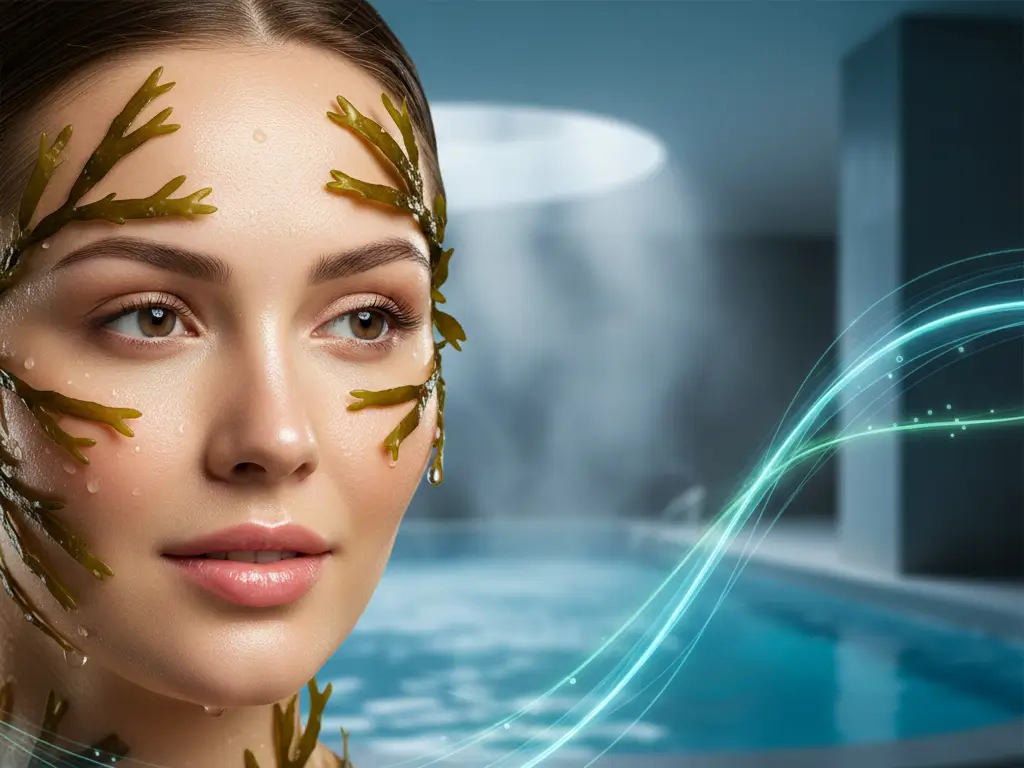
Marine algae in thalassotherapy acts as a dense nutrient delivery system for the skin. Through a process called osmosis, the mineral-rich content of seaweed, including magnesium, calcium, and iodine, helps rebalance skin moisture, reduce inflammation, and support the skin barrier. It is particularly noted for its ability to mimic human blood plasma, allowing for deep absorption of trace elements.
This article provides educational information about marine algae and thalassotherapy. It is not intended to diagnose, treat, cure, or prevent any medical condition or disease. Always consult a licensed healthcare professional before making any health decisions, especially if you have thyroid conditions, iodine sensitivities, or are pregnant. Individual results vary.
There is a fascinating biological coincidence that researchers have studied for over a century: the mineral composition of seawater is strikingly similar to that of human blood plasma.
This connection forms the foundation of thalassotherapy (from the Greek word thalassa, meaning sea). While many of us associate seaweed wraps with luxury spa vacations, the biological reality is much more potent. We aren’t just talking about relaxation; we are talking about remineralization.
In my investigation into marine ingredients, I’ve found that algae isn’t just a slimy plant to step over at the beach. It is a bio-accumulator, concentrating the ocean’s nutrients up to 100,000 times more than the surrounding water. When applied to the skin, these marine plants offer a level of bioavailability that land-based plants often struggle to match.
If you have been exploring marine algae and thalassotherapy, you likely want to know if the science holds up against the marketing. Let’s dive into the mechanisms of how the ocean heals.
What Is Thalassotherapy and Why Use Algae?
Thalassotherapy is the therapeutic use of the marine environment, including seawater, algae, mud, and climate, to promote health and well-being. Algae (seaweed) is the powerhouse of this therapy because it concentrates minerals and vitamins from the water, delivering high doses of antioxidants, amino acids, and trace elements directly to the skin to support cellular function and hydration.
The Historical Context
The concept isn’t new. In the 19th century, French biologist René Quinton famously demonstrated the physiological similarities between seawater and internal body fluids. This led to the explosion of thalassotherapy centers across Europe.
Today, we utilize marine algae not just for general wellness, but for targeted skincare results. The ocean provides a unique cocktail of ingredients that are difficult to replicate in a lab.
How Algae Interacts with Skin
The primary mechanism here is osmosis. Because the chemical structure of algae allows for the transport of fluids, a warm seaweed wrap or bath encourages the skin to absorb minerals while expelling toxins through perspiration.
This is particularly relevant if you are interested in botanical extracts for specific skin concerns. While land plants rely on roots in soil, algae absorbs nutrients through its entire surface directly from the water, making it incredibly nutrient-dense.
The Bio-Affinity Connection: Why Seaweed Works
Seaweed works through bio-affinity, meaning its chemical structure is compatible with human skin physiology. Marine algae are rich in sulfated polysaccharides (like fucoidan), which are structurally similar to the glycosaminoglycans found in human skin. This allows them to effectively lock in moisture, soothe inflammation, and support the synthesis of collagen and elastin without causing irritation.
The Power of Polysaccharides
If you look at the ingredients list of high-end marine skincare, you might see terms like “alginates” or “fucoidan.” These are sugars found in the cell walls of seaweed.
Research suggests that these compounds are exceptional humectants. If you have read our guide to humectants and hydration, you know that keeping water in the skin is half the battle against aging. Algae forms a breathable, protective film on the skin’s surface, preventing transepidermal water loss (TEWL) more effectively than many synthetic alternatives.
Mineral Absorption
Our bodies require trace minerals like magnesium, potassium, and zinc for enzymatic reactions. However, our modern diet often lacks them. Transdermal absorption (through the skin) via thalassotherapy is a potential pathway to restore these levels.
- Magnesium: Essential for cellular repair and calming inflammation.
- Zinc: Vital for controlling acne and oil production.
- Sulfur: Often called the “beauty mineral” for its role in collagen production.
For those dealing with body acne or irritation from workouts, utilizing these mineral-rich treatments can be a game-changer. You can read more about managing athlete body acne and chafing to see where marine minerals fit into a recovery routine.
Specific Algae Types and Their Skin Benefits
Different colors of algae offer different benefits. Brown algae (Laminaria, Fucus) is highest in iodine and minerals, making it ideal for metabolic stimulation and slimming. Red algae (Chondrus crispus) acts as a powerful hydrator and texturizer. Green algae (Ulva lactuca) is rich in magnesium and peptides, often used for firming and structural support of the skin.
1. Brown Algae (The Detoxifiers)
Examples: Kelp (Laminaria digitata), Bladderwrack (Fucus vesiculosus)
This is the heavy hitter of thalassotherapy. Brown algae is famously rich in iodine. It is traditionally used in body care and sculpting treatments because it helps stimulate circulation and lymphatic drainage.
- Best for: Cellulite reduction, detoxification, and revitalizing tired skin.
- Key Component: Fucoidan, which has shown promise in studies for enhancing wound healing and reducing inflammation.
2. Red Algae (The Hydrators)
Examples: Irish Moss, Nori
Red algae often grows deeper in the ocean and has developed strong defense mechanisms against UV rays. It contains high levels of beta-carotenes and antioxidants. In the world of hydroquinone alternatives, certain red algae species are being studied for their ability to inhibit tyrosinase, the enzyme responsible for hyperpigmentation.
- Best for: Dry skin, brightening, and UV protection.
- Key Component: Carrageenan, a natural gelling agent that creates a smooth, hydrated skin surface.
3. Blue-Green Algae (The Superfoods)
Examples: Spirulina
Technically cyanobacteria, these are powerhouse ingredients for protein. They are rich in amino acids, which are the building blocks of skin structure. Spirulina is often used in DIY two-ingredient masks for a quick nutrient boost to dull skin.
Safety Considerations: Iodine, Thyroid, and Allergies
While beneficial, marine algae poses risks for certain individuals. The high iodine content in brown algae can overstimulate the thyroid or interfere with medication. Allergic reactions to iodine or specific marine proteins are possible. Always patch test, and avoid high-iodine body wraps if you have hyperthyroidism, are pregnant, or have a shellfish/iodine allergy.
It is critical to address the safety profile of these potent ingredients. Just because it is natural does not mean it is neutral.
Who Should Be Cautious?
- Thyroid Conditions: The skin is surprisingly efficient at absorbing iodine. If you have Hashimoto’s, Graves’ disease, or any thyroid instability, a full-body seaweed wrap could trigger palpitations or hormonal swings.
- Pregnancy: Due to the iodine absorption and the detoxifying nature of thalassotherapy (which releases waste products into the bloodstream for elimination), rigorous treatments are often restricted during pregnancy. Always check our guide on pregnancy-safe skincare and consult your OB-GYN.
- Acne-Prone Skin: While algae is anti-inflammatory, some extracts are comedogenic (pore-clogging). Specifically, certain sulfated polysaccharides can trigger breakouts in highly sensitive acne types.
Sourcing Matters
Not all seaweed is created equal. Algae acts as a sponge, if the water is polluted with heavy metals (arsenic, lead), the algae will contain them too.
- Look for: Brands that harvest from protected waters (like the Brittany coast in France or specific clean zones in the North Atlantic).
- Avoid: Generic dried seaweed from unknown industrial waters.
Integrating Thalassotherapy into Your Routine
You don’t need a plane ticket to France to benefit from algotherapy. Home integration includes using micronized algae powders in baths, applying algae-infused serums for hydration, or using seaweed sheets for targeted masking. The key is consistency and combining marine ingredients with other barrier-supporting botanicals.
1. The Thalasso Bath
This is the easiest entry point. Using micronized laminaria or sea salt blends can replicate the spa experience.
- Protocol: Add a cup of high-quality marine salts or algae powder to warm (not hot) water. Soak for 20 minutes to allow for mineral exchange.
- Pairing: To enhance the experience, incorporate dry brushing before the bath to stimulate the lymphatic system and open pores for better absorption.
2. Marine Skincare Layering
Modern formulations allow us to use algae extracts in daily serums.
- Routine: Apply a seaweed-based essence after cleansing. Follow with your preferred oil. Algae pairs beautifully with facial oils because the water-binding capacity of the algae helps the oil lock in moisture more effectively.
3. The DIY Algae Mask
For a potent treatment, mix spirulina or kelp powder with water or aloe vera.
- Caution: Algae smells… like the ocean. It can be strong. You might want to mix it with clays to temper the scent and add drawing power.
4. Supporting the Barrier
Marine ingredients are excellent for repairing a compromised barrier. If you have over-exfoliated or are dealing with windburn, look for creams containing “marine exopolysaccharides.” These create a “second skin” effect. This is a great strategy when dealing with plant ingredients for skin barrier repair.
When to Consult a Professional
While home treatments are fantastic for maintenance, there are times when professional guidance is non-negotiable.
Seek professional advice if:
- You have a history of thyroid dysfunction: You need an endocrinologist to clear you for high-iodine treatments.
- You have persistent skin conditions: Eczema and psoriasis can benefit from thalassotherapy, but they can also flare up if the water is too hot or the salt concentration is too high. A dermatologist should guide your regimen.
- You experience swelling or hives: This indicates a potential iodine or marine protein allergy. Stop immediately and seek medical attention.
The Future of Blue Beauty
The ocean remains our planet’s greatest reservoir of biological diversity. Thalassotherapy and the use of marine algae represent a bridge between ancient healing traditions and modern biochemistry.
The evidence suggests that when sourced correctly and used safely, marine algae offers a unique “biomimetic” support system for our skin, providing the minerals and hydration we often lack.
- Check your current skincare for “Laminaria,” “Fucus,” or “Algae Extract.” You might already be using it!
- Try a simple mineral bath soak to see how your skin reacts to marine salts.
- If you have specific aging or hydration concerns, look for serums containing red algae or fucoidan.
For more holistic skincare guidance and deep dives into ingredient science, explore our comprehensive collection at beautyhealingorganic.com.
SOURCES CITED
- Chlomou, I., & Panagiotidis, P. (2022). The History of Thalassotherapy in the Context of Wellness and Medical Tourism. Journal of Tourism and Hospitality Management. (Historical context of Quinton plasma).
- Fitton, J. H., et al. (2019). Therapies from Fucoidan: An Update. Marine Drugs, 17(11), 635. https://www.ncbi.nlm.nih.gov/pmc/articles/PMC6920849/
- Wang, J., et al. (2019). Potential Applications of Fucoidan in Cosmetic Industries. Marine Drugs. https://pubmed.ncbi.nlm.nih.gov/30901844/
- American Thyroid Association. (2023). Iodine Deficiency and Excess. https://www.thyroid.org
- Pangestuti, R., & Kim, S. K. (2011). Biological activities and health benefit effects of natural pigments derived from marine algae. Journal of Functional Foods. (Regarding Red Algae/Astaxanthin).