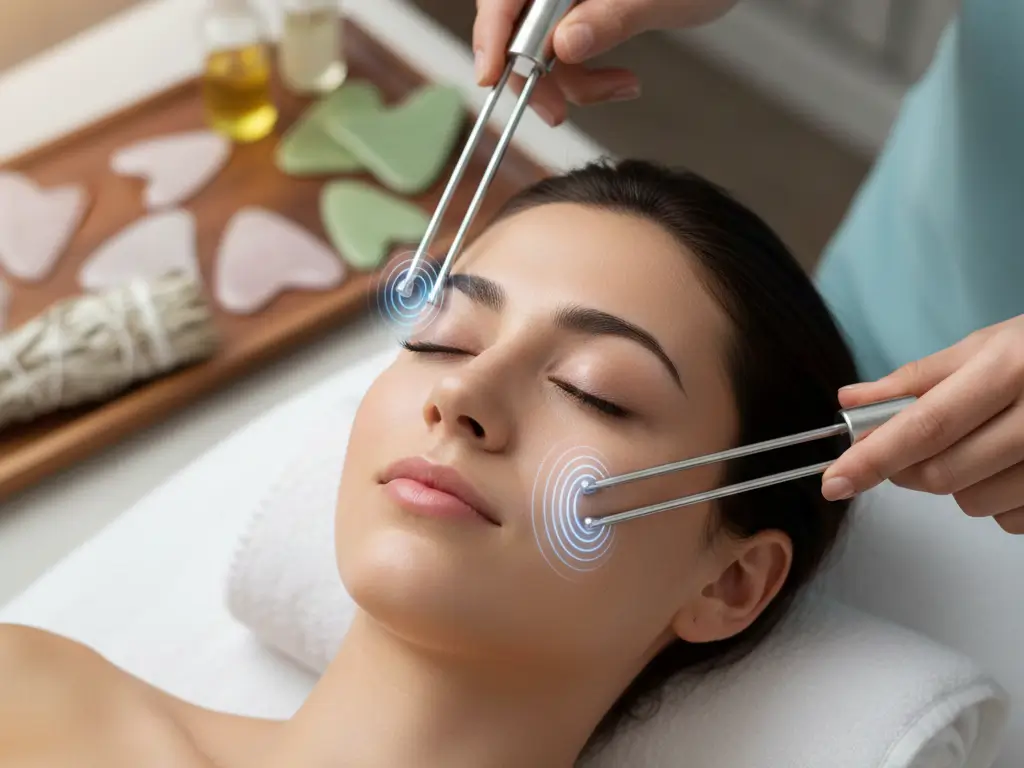
Incorporating tuning forks into a beauty routine involves using weighted forks (typically 128 Hz or 136.1 Hz) to apply sound vibration directly to the skin, facial muscles, and acupressure points. This practice, known as vibrational beauty, aims to release deep muscular tension, stimulate localized circulation, and support lymphatic drainage through sonic resonance rather than manual pressure.
This article provides educational information about vibrational beauty tools. It is not intended to diagnose, treat, cure, or prevent any medical condition. Individual results vary. Avoid using tuning forks directly on broken bones, implants, or if you have a pacemaker. If you have specific health concerns, consult a licensed healthcare professional before starting.
The beauty industry is constantly looking for the next “miracle” tool. We’ve rolled jade over our cheeks, scraped our jawlines with gua sha stones, and shocked our muscles with microcurrent devices. But the latest frontier in holistic skincare isn’t about pushing or pulling the skin, it’s about resonating with it.
Sound therapy has moved out of the yoga studio and into the vanity cabinet. Using tuning forks for beauty, often called “facial tuning” or “sonic sculpting”, offers a different approach to skin health. Instead of working solely on the surface, these tools send vibration deep into the fascia and musculature.
If you struggle with chronic jaw tension (TMJ), furrowed brows that won’t relax, or skin that looks tired despite your best serums, physics might offer the solution your skincare routine is missing.
Understanding Vibrational Beauty: The Science of Sound
Vibrational beauty relies on the principle of resonance. When a weighted tuning fork is placed on the body, it transmits mechanical vibration through the skin to the fascia and bone. Research suggests that specific low-frequency vibrations may stimulate the release of nitric oxide, a molecule that relaxes blood vessels and improves circulation.
To understand why anyone would touch a vibrating metal fork to their face, you have to understand the difference between sound you hear and sound you feel.
In sound therapy, there are two main types of forks:
- Unweighted Forks: These are standard tuning forks used for music. They create a clear sound and are used around the body to affect the energy field.
- Weighted Forks: These have weights at the ends of the prongs. They vibrate strongly but make very little sound. These are the tools used in skincare.
When you place the stem of a weighted fork on your face, the vibration travels through the fluid and bone of your head. This is significant because water transmits sound four times faster than air, and our bodies are mostly water.
This deep resonance acts like a micro-massage for your cells. While manual massage (like facial massage tools guide) works by compressing tissue, vibration works by oscillating it. This can help “shake loose” stagnant fluid and relax muscles that are stuck in a contracted state, specifically the masseter (jaw) and procerus (brow) muscles.
Selecting the Right Frequency for Skincare
For facial use, the most common frequencies are 128 Hz (often called the Master Fork) and 136.1 Hz (the Om tuner). The 128 Hz frequency is favored for physical issues like inflammation and muscle spasms, while 136.1 Hz is chosen for its grounding, calming effects on the nervous system.
You don’t need a symphony of forks to see results. For a vibrational beauty routine, less is often more.
The 128 Hz Fork (The Physical Healer)
This frequency is based on the Pythagorean scale. In alternative therapy circles, 128 Hz is believed to spike nitric oxide production. Nitric oxide is a vasodilator, it opens up blood vessels. In skincare terms, better blood flow means more oxygen and nutrients delivered to the skin cells and more efficient removal of metabolic waste. It’s the sonic equivalent of a vigorous workout for your face.
The 136.1 Hz Fork (The Cosmic Om)
This frequency is calculated based on the rotation of the Earth around the Sun. While that sounds esoteric, the physical effect is deeply grounding. This fork is heavier and often produces a stronger, deeper vibration. It is excellent for “sedating” angry, tense muscles and calming the nervous system, which directly impacts the skin through the mindful skincare connection.
Safety and Contraindications
While generally safe, tuning forks should not be used directly on fresh bruises, varicose veins, broken skin, or fractures. Avoid using them near pacemakers or other implanted electrical devices. Pregnant individuals should consult a doctor before using vibrational tools on the body.
Before you start pinging away at your face, we need to address safety. Vibrational tools are powerful.
- Dental Issues: If you have loose teeth, recent dental surgery, or metal implants, be cautious using weighted forks on the jawline. The vibration can feel uncomfortable or jarring to the teeth.
- Fillers and Botox: Wait at least 2 weeks after injectables before using tuning forks. While there is no conclusive evidence that vibration “moves” filler, it is better to let the product settle.
- Broken Skin: Never place a fork on active acne lesions or open wounds. This can spread bacteria and cause pain.
- Pressure: The weight of the fork is enough. Do not press down; let the vibration do the work.
The Ritual: A Step-by-Step Vibrational Routine
A typical tuning fork facial involves cleansing, applying a facial oil for slip (optional), activating the fork by striking it against a puck or palm, and placing the stem on specific acupressure points or gliding it along muscle bands. Hold until the vibration stops, then reactivate.
Here is how to integrate this tool into your evening regimen.
Step 1: The Setup and Slip
Start with clean skin. While you can use tuning forks on dry skin, applying a high-quality botanical oil helps the stem glide and prevents dragging.
- For Dry Skin: Try a rich oil like Argan or Marula (see our facial oils guide).
- For Oily Skin: Jojoba or Grapeseed work well.
Step 2: Activation
Hold the fork by the handle (stem). Strike the weighted end gently against the heel of your hand or a rubber “hockey puck” activator. Never strike it on a hard table or your knee bone, it hurts the fork and you.
Step 3: The Chest and Neck (Opening the Drain)
Just like with dry brushing for lymphatic drainage, you must open the pathways first.
- Activate the fork.
- Place the stem on the center of your chest (sternum) to calm your heart rate.
- Move to the terminus points (collarbone hollows). Place the stem gently in the hollow to stimulate lymph flow.
Step 4: The Jaw Release
This is where tuning forks shine compared to other tools.
- Activate the fork.
- Place the stem directly on the masseter muscle (the big muscle at the back of the jaw that pops when you clench).
- Feel the vibration penetrate deep into the jaw joint.
- Hold until the vibration fades completely. Repeat 2-3 times on each side.
Step 5: The Brow Melt
- Activate the fork.
- Place the stem right between your eyebrows (the “third eye” point).
- This spot is famous for holding tension from staring at screens. The vibration here can help relax the procerus muscle, potentially softening the look of “11” lines.
Step 6: Under-Eye Depuffing
Caution: Be extremely gentle here. Do not place the fork on the eye itself.
- Activate the fork.
- Place the stem on the orbital bone (the cheekbone socket), not the soft tissue.
- The vibration travels through the bone to help disperse fluid accumulation, aiding with under-eye puffiness.
Pairing Tuning Forks with Other Modalities
Tuning forks pair well with gua sha and botanical skincare. Use the tuning fork first to break up dense fascial adhesions (“knots”), then use gua sha to sweep away the released fluid. Finish with calming botanicals to nourish the skin.
You don’t have to choose between your tools. In fact, they work synergistically.
The “Shake and Sweep” Method:
Think of a tuning fork as a jackhammer (a gentle one) breaking up concrete, and a gua sha tool as the broom sweeping it away.
- Vibrate: Use the tuning fork on tight areas like the jaw and neck to loosen the fascia.
- Glide: Follow up with a gua sha tool to flush the lymph and shape the face.
- Nourish: Finish with a nutrient-dense balm. Since vibration brings blood to the surface, your skin is primed to absorb nutrients. Consider using botanical butters like shea or mango for a seal of moisture.
Botanical Synergy:
Because this practice stimulates circulation, it pairs beautifully with ingredients that support vascular health. Look for products containing Arnica or Vitamin K if you are prone to redness. If you are looking for anti-aging support, pairing the increased circulation from the fork with bio-retinols can enhance skin turnover.
Why Choose Vibration Over Hands?
Vibration penetrates deeper than manual pressure without stretching the skin. This makes it ideal for sensitive skin or aging skin where dragging tools might cause irritation or elasticity loss. It also offers a sensory component that down-regulates the nervous system, lowering cortisol.
The skin is the boundary between our inner and outer worlds. Stress manifests in the skin as inflammation, dullness, and breakouts (often called the “brain-skin axis”).
While fingers are fantastic, they can sometimes apply too much friction. Vibration bypasses friction. It talks directly to the nerves. When you use a tuning fork, you are engaging the parasympathetic nervous system (rest and digest). Lowering cortisol levels is arguably the most effective anti-aging strategy available, as high stress degrades collagen.
For those interested in the deeper connection between specialized tools and skin health, exploring facial massage tools can help you decide which modality suits your lifestyle.
Tuning Into Your Glow
Incorporating tuning forks into your beauty routine is more than just a trend; it is a return to physics-based healing. By using sound vibration, you can access deep layers of muscle and fascia that fingers and stones simply cannot reach.
It transforms a skincare routine from a chore into a resonant ritual. You aren’t just applying cream; you are tuning your instrument. Whether you are looking to soften a clenched jaw, depuff tired eyes, or simply find a moment of stillness in a chaotic world, the hum of a 128 Hz fork might be exactly what your beauty cabinet needs.
- Identify where you hold tension in your face. Is it the jaw? The brow?
- Acquire a weighted tuning fork (start with 128 Hz or 136.1 Hz).
- Practice the “Jaw Release” step every evening for 5 minutes before bed.
For more holistic strategies and tool guides, explore our comprehensive collection at beautyhealingorganic.com.
SOURCES CITED
- Salamon, E., Kim, M., Beaulieu, J., & Stefano, G. B. (2003). Sound therapy induced relaxation: down regulating stress processes and pathologies. Medical Science Monitor, 9(5). (Discusses Nitric Oxide release and vibration).
- Goldsby, T. L., Goldsby, M. E., McWalters, M., & Mills, P. J. (2017). Effects of Singing Bowl Sound Meditation on Mood, Tension, and Well-being. Journal of Evidence-Based Complementary & Alternative Medicine.
- Beaulieu, J. (2010). Human Tuning: Sound Healing with Tuning Forks. Biosonic Enterprises. (Expert Source on 128 Hz frequencies).