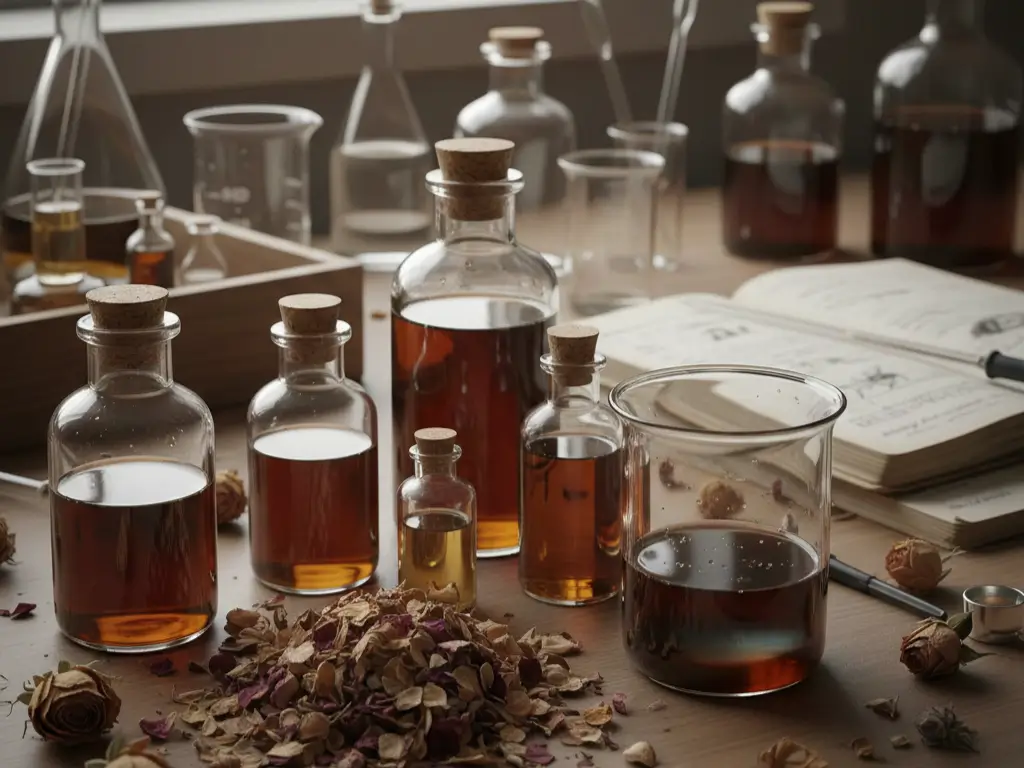
I spent $200 on a “natural” perfume three years ago that disappeared from my skin within 45 minutes. Every single time.
The sales associate promised it would “develop beautifully with my body chemistry.” What she didn’t mention: natural perfumes behave completely differently than conventional fragrances, and most people don’t know how to make them work.
Natural perfumery uses botanical ingredients (essential oils, absolutes, resins) instead of synthetic molecules to create fragrances. These scents typically last 2-6 hours depending on concentration, application method, and your skin’s natural pH and oil levels.
Here’s what changed my approach: I started treating perfume creation like cooking instead of chemistry. When you understand how ingredients layer and interact, similar to building flavors in a dish, suddenly the whole process makes sense. You don’t need 50 essential oils any more than you need 50 spices to cook well.
This guide walks through what actually works in natural perfumery, the honest limitations nobody talks about, and how to create or choose scents that last on your specific skin type.
What Makes a Perfume “Natural” (And Why It Matters for Your Skin)
Natural perfumes contain only plant-derived ingredients like essential oils, absolutes, CO2 extracts, and botanical fixatives, avoiding synthetic fragrance molecules, phthalates, and petroleum-based carriers. This matters because natural ingredients interact differently with your skin’s microbiome and can affect how scents develop throughout the day.
The term “natural” in perfumery isn’t regulated the way “organic” is in food. I’ve seen products labeled natural that contained nature-identical synthetics (molecules that mimic natural compounds but are lab-created).
True natural perfumes use:
- Essential oils: Steam-distilled or cold-pressed from plants (lavender, bergamot, sandalwood)
- Absolutes: Solvent-extracted highly concentrated floral essences (jasmine, rose, tuberose)
- CO2 extracts: Supercritical carbon dioxide extraction that captures more complete scent profiles
- Resins and balsams: Natural fixatives like benzoin, frankincense, myrrh
- Carrier bases: Organic alcohol, jojoba oil, or fractionated coconut oil
The skin connection matters more than most people realize. Your skin microbiome affects how fragrance molecules break down on your skin. This is why the same perfume smells completely different on two people.
What surprised me: natural doesn’t automatically mean gentle. Essential oils are highly concentrated plant compounds, some contain hundreds of individual molecules. Citrus oils can be photosensitizing. Cinnamon bark oil can irritate sensitive skin. Rose absolute can trigger reactions in people with pollen allergies.
If you’re dealing with rosacea or sensitive skin, you’ll want to test natural perfumes carefully. Some people tolerate synthetic musks better than natural jasmine absolute.
The counterintuitive part: “hypoallergenic” conventional perfumes sometimes cause fewer reactions than all-natural versions because they use fewer, simpler molecules. Natural complexity isn’t always better for reactive skin.
Understanding Fragrance Notes: The Kitchen Approach to Scent Building
Fragrance notes work like cooking layers, top notes (citrus, herbs) provide immediate impact but fade quickly, middle notes (florals, spices) create the main character, and base notes (woods, resins) provide lasting depth. Understanding this structure helps you layer scents effectively and set realistic expectations for how perfumes evolve.
Think of building a perfume like making a sauce. You don’t just dump everything in at once.
Top notes are your fresh garnish, bright, attention-grabbing, gone in 15-120 minutes:
- Citrus (bergamot, lemon, grapefruit)
- Light herbs (basil, mint, verbena)
- Sharp greens (galbanum, violet leaf)
Middle notes are your main dish, they appear as top notes fade and stick around 2-4 hours:
- Florals (rose, lavender, ylang-ylang, neroli)
- Soft spices (cardamom, coriander, black pepper)
- Light woods (cedarwood, cypress)
Base notes are your foundation, they emerge last and can linger 5-24 hours:
- Heavy woods (sandalwood, vetiver, patchouli)
- Resins (frankincense, benzoin, myrrh)
- Vanillin-rich (vanilla, tonka bean)
- Earthy roots (orris, angelica)
The ratio matters. Most balanced perfumes follow roughly 15-20% top, 40-50% middle, 30-40% base. Too many top notes and your scent disappears. Too many base notes and it takes an hour to smell like anything.
I learned this the hard way when I created a blend with 60% patchouli and vetiver. It smelled like damp earth for the first two hours, then finally softened into something wearable. My husband asked if I’d been gardening.
The psychology of scent plays a role here too. Citrus top notes create an immediate positive impression, they’re associated with cleanliness and energy. But if they’re not supported by good middle and base notes, people remember your perfume as “that thing that smelled good for five minutes.”
When layering multiple products, work from richest to lightest. Apply your body butter or botanical oil first, then fragrance. The oils help anchor scent molecules.
How Long Do Natural Perfumes Actually Last? (And How to Extend Them)
Natural perfumes typically last 2-6 hours depending on concentration (10-30% fragrance oil), your skin type, and application method. Oily skin holds scent longer than dry skin, pulse points amplify fragrance, and layering with unscented oils can extend wear time by 2-3 hours.
Let’s be honest about longevity. Natural perfumes won’t last 12 hours like many synthetic fragrances. The molecules are generally larger and more volatile.
Here’s what you can realistically expect:
| Concentration Type | Fragrance % | Typical Duration | Best For |
| Perfume oil (attar) | 15-30% | 4-8 hours | Close-to-skin scent, sensitive skin |
| Eau de Parfum (EDP) | 15-20% | 3-6 hours | Daily wear, moderate projection |
| Eau de Toilette (EDT) | 5-15% | 2-4 hours | Hot weather, layering |
| Body mist | 1-5% | 1-2 hours | Refreshing, subtle scent |
Your skin type matters more than most perfume guides acknowledge. I have dry skin and used to get frustrated when perfumes disappeared in an hour. Then I started applying facial oil to my pulse points first, suddenly the same perfume lasted twice as long.
What actually extends wear time:
- Moisturize first: Apply unscented jojoba or fractionated coconut oil to pulse points before perfume
- Layer strategically: Use matching body lotion or body oil before fragrance
- Target pulse points: Wrists, neck, behind ears, inner elbows, warmth activates scent
- Hair application: Spray on brush or apply oil-based perfume to hair ends (not scalp)
- Clothing: Natural fibers hold scent better than synthetics
What doesn’t work (despite common advice):
- Vaseline under perfume, it creates a barrier that prevents absorption
- Rubbing wrists together, breaks down fragrance molecules faster
- Storing in bathroom, heat and humidity degrade essential oils
The fixative game-changer: Adding 10-15% natural fixatives to DIY blends significantly extends longevity. Benzoin resin, vetiver, sandalwood, and frankincense all slow down evaporation of lighter notes.
When I tested this, a bergamot-heavy blend that normally lasted 90 minutes stretched to 4 hours with 15% benzoin added. The scent evolved more slowly and elegantly.
For daily wear, I’ve found that reapplying once after lunch is more practical than trying to make a single application last all day. Keep a small roller bottle in your bag.
Natural Perfume vs. Synthetic: Which Should You Choose for Different Situations?
Natural perfumes work best for close-to-skin scents, skin sensitivity, and environmental concerns, but synthetic fragrances offer better longevity, consistency, and certain scent notes (clean musk, ocean, specific florals). Your choice depends on priority: ingredient transparency vs. performance.
This isn’t about one being universally better. I use both.
Choose natural perfumes when:
- Ingredient transparency matters: You know exactly what’s in the bottle
- You prefer evolving scents: Natural perfumes change as they interact with your skin chemistry
- Environmental impact is priority: Biodegradable, less processing (though sourcing still matters)
- You want skin benefits: Many essential oils offer antioxidant or anti-inflammatory properties
- Close-to-skin scent is ideal: Natural perfumes tend to have softer sillage (scent trail)
Choose synthetic or hybrid fragrances when:
- All-day longevity is required: Professional settings where you can’t reapply
- You want specific modern notes: Ocean, clean laundry, certain gourmand notes don’t exist in nature
- Consistency matters: Each bottle smells identical (natural ingredients vary by harvest)
- Projection is important: You want people to notice your scent from across a room
- Cost per wear: Synthetic perfumes often cost less for equivalent wear time
What nobody mentions: some synthetic molecules are actually safer than their natural counterparts. Synthetic musks replaced deer musk and civet (from animals). Some synthetic florals are less allergenic than the natural absolutes.
I keep a natural sandalwood-based perfume oil for daily wear and close situations, and a conventional parfum for events where I want projection and all-day wear.
The hybrid approach makes sense for many people. Brands like those featured in clean beauty at Sephora often use predominantly natural ingredients with a few safe synthetics for performance.
If you’re building a complete clean beauty routine, remember that fragrance is just one piece. Sometimes it makes sense to be flexible here while being strict about skincare ingredients.
Building Your First Natural Fragrance
Begin with 3 oils, one from each note category, in a 1:2:3 ratio (top:middle:base). Mix 12 drops total into 10ml carrier oil or alcohol. Let it cure for 48 hours before judging the scent. Start with: bergamot (top) + lavender (middle) + sandalwood (base).
You don’t need 40 essential oils to start. I created my daily-wear perfume with five ingredients.
Starter formula (makes 10ml perfume oil):
- Choose your carrier:
- Jojoba oil for perfume oil (skin-nourishing, neutral scent)
- 190-proof organic alcohol for spray perfume (evaporates cleanly)
- Select 3-5 essential oils using the pyramid:
- 1-2 top notes
- 1-2 middle notes
- 1-2 base notes
- Simple beginner blend (20% concentration):
- 2 drops bergamot (top)
- 4 drops lavender (middle)
- 6 drops sandalwood (base)
- Fill to 10ml with jojoba oil
- Let it cure: Natural perfumes need 48 hours minimum for notes to marry. I prefer 1-2 weeks.
The process is similar to DIY formulation for skincare, you’re combining active ingredients in specific ratios for desired effects.
My tested combinations that actually work:
Fresh citrus-herbal (spring/summer):
- 3 drops grapefruit
- 2 drops basil
- 4 drops geranium
- 6 drops vetiver
- Jojoba to 10ml
Warm spice-floral (fall/winter):
- 2 drops bergamot
- 3 drops cardamom
- 5 drops ylang-ylang
- 5 drops frankincense
- Jojoba to 10ml
Storage matters. Essential oils degrade in light and heat. Use dark glass bottles and store in a cool, dry place, not your bathroom. Similar principles apply to storing organic skincare.
Common mistakes I made (so you don’t have to):
- Using too much: Started with 30% concentration and it was overwhelming. 15-20% is plenty.
- Judging immediately: Blends smell harsh at first. That 48-hour cure time isn’t optional.
- Skipping base notes: Created beautiful scents that disappeared in an hour.
- Not tracking formulas: Made something I loved and couldn’t recreate it. Write everything down.
If you want to expand beyond basics, explore specialty natural ingredients like CO2 extracts and rare absolutes. But master the fundamentals first.
For those interested in the broader context of natural ingredients, the clean beauty science behind why certain botanicals work together is fascinating. Plant compounds evolved to work synergistically in nature, we’re just bottling those relationships.
Your Scent Strategy: What Actually Matters
Natural perfumery isn’t about recreating synthetic performance with plants. It’s about working with different strengths.
stop expecting natural perfumes to behave like conventional ones. They’re closer to skincare that happens to smell good, they interact with your skin, change throughout the day, and work best when matched to your body chemistry.
Test your current perfumes on different skin areas. Apply the same scent to your inner wrist, inner elbow, and behind your ear. Notice which spot holds scent longest, that’s your personal best application point.
If you’re wearing perfume daily, calculate your cost per wear. A $15 essential oil blend you make yourself that lasts 3 months (with daily use) costs $0.16 per wear. A $120 natural perfume that lasts 4 months costs $1 per wear. Sometimes DIY makes sense, sometimes it doesn’t.
If you’ve tested three DIY blends and none last more than an hour on your skin, your body chemistry might need professionally formulated fixative blends. Some people’s skin pH breaks down certain essential oils rapidly, this isn’t failure, it’s biology.
Natural perfumery continues evolving. I’m watching upcycled fruit and seed actives enter the fragrance world, using byproducts from food production. The future might smell like pomegranate seed CO2 extract and coffee fruit absolute.
For more on building a complete natural body care routine that complements your fragrance choices, visit Beauty Healing Organic for practical guides that skip the fluff.
The scent you wear daily should make you feel more like yourself, not like you’re trying to smell like someone else. That’s the real art of natural perfumery.