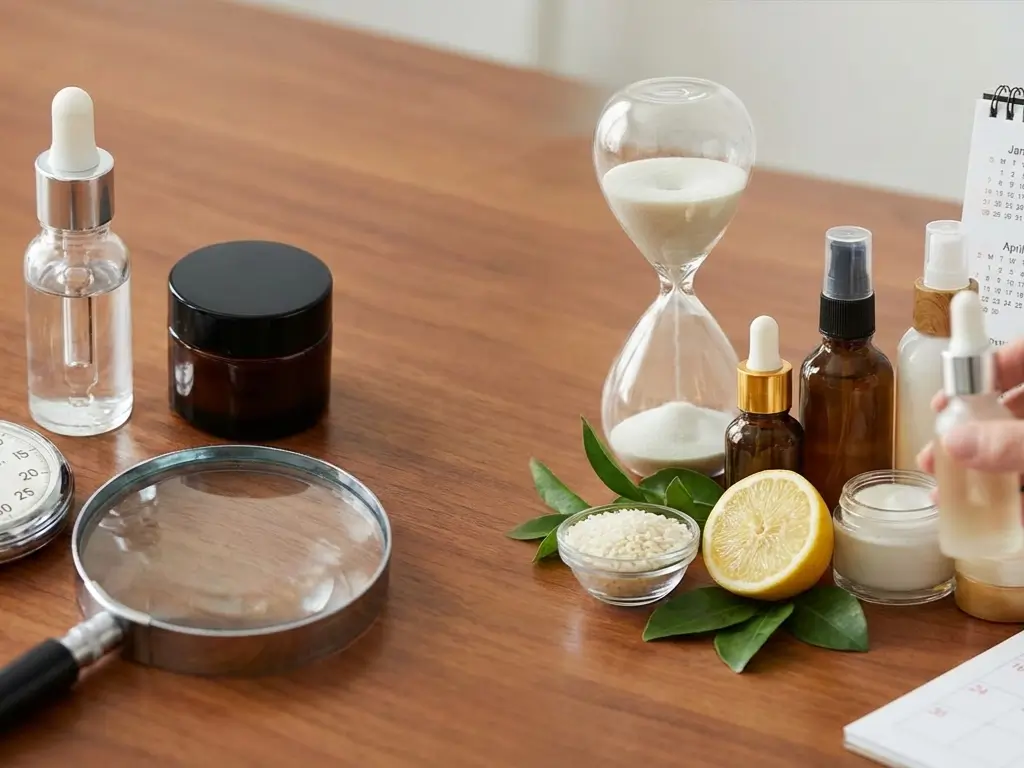
Here’s something most skincare articles won’t tell you straight: hydroquinone works faster than any natural alternative. Period.
But you’re here because you’ve heard about the FDA reclassifying it, read about potential side effects like ochronosis (paradoxical darkening), or you’re simply uncomfortable using a prescription-strength ingredient for what might be a mild case of post-acne marks. That’s completely fair. I’ve spent the last three years testing natural alternatives on my own stubborn melasma, and I’ve learned what works, what’s mostly marketing, and, critically, how long you’ll actually wait for results.
The most effective natural alternatives to hydroquinone are alpha arbutin (at 2%), vitamin C (15-20% L-ascorbic acid), niacinamide (5-10%), azelaic acid (10%), and kojic acid (1-4%), used consistently for 8-12 weeks minimum.
Natural alternatives take 2-3 times longer than hydroquinone to show comparable results. They’re gentler, yes. Safer for long-term use, absolutely. But if you’re expecting your dark spots to vanish in four weeks like they might with prescription hydroquinone, you’ll be disappointed and waste money hopping between products.
Why Are People Looking for Hydroquinone Alternatives?
Hydroquinone was reclassified by the FDA in 2020 as requiring more safety data, leading to concerns about long-term use, potential side effects like ochronosis, and limited availability in over-the-counter products at effective concentrations (2%).
The hydroquinone controversy is weirdly US-specific. While it’s still widely used globally, American consumers got spooked when the FDA moved it from “generally recognized as safe” to “needs more data” status. Dermatologists still prescribe it at 4% concentration, but the over-the-counter market shifted hard toward “natural” alternatives.
Here’s what actually drove people away:
Ochronosis risk – This is the big one. Prolonged use (we’re talking years, not months) can cause paradoxical darkening, especially on darker skin tones. It’s rare, but terrifying when it happens because it’s harder to treat than the original hyperpigmentation.
Rebound hyperpigmentation – Stop using hydroquinone suddenly after months of use, and your dark spots can come back darker. You have to taper off carefully.
Irritation and sensitivity – At 4% prescription strength, hydroquinone can be harsh. Redness, dryness, and increased sun sensitivity are common. If you already have sensitive skin or conditions like rosacea (which you can learn more about in our guide to organic ingredients for rosacea), hydroquinone might not be your friend.
What’s interesting is that many dermatologists still consider hydroquinone the gold standard for melasma and stubborn hyperpigmentation. They just recommend cycling it, 12 weeks on, 12 weeks off, rather than continuous use.
If you’re dealing with mild post-inflammatory hyperpigmentation from acne or sun spots, natural alternatives make total sense. You probably don’t need the big guns. But if you’ve had deep melasma for years, I’ll be honest with you in the last section about managing expectations.
What Are the Most Effective Natural Alternatives to Hydroquinone?
Alpha arbutin (2%), vitamin C (15-20% L-ascorbic acid), niacinamide (5-10%), azelaic acid (10%), kojic acid (1-4%), and licorice root extract (with 20%+ glabridin) are the most researched natural alternatives with clinical evidence for reducing hyperpigmentation.
Not all “natural” brightening ingredients are created equal. The percentage matters enormously, and this is where most products fail you. A face cream with “brightening vitamin C” at 0.5%? That’s marketing, not treatment.
Here’s what actually works, with the concentrations you need:
Alpha Arbutin (2%)
This one’s my personal winner for safety-to-effectiveness ratio. Alpha arbutin is a biosynthetic (lab-created from natural sources) that works similarly to hydroquinone by inhibiting tyrosinase, the enzyme that triggers melanin production. The key difference? It’s much gentler and doesn’t have the same long-term risks.
You need at least 2% concentration. Most products contain 0.5-1%, which isn’t useless but will take forever. I saw noticeable fading of sun spots after about 10 weeks using a 2% alpha arbutin serum twice daily. Some people confuse alpha arbutin with beta arbutin, they’re different. Alpha is more stable and effective.
Vitamin C (15-20% L-Ascorbic Acid)
Here’s where people get confused: there are multiple forms of vitamin C. L-ascorbic acid is the most researched for hyperpigmentation, but it’s also the most unstable and irritating. You need 15-20% concentration to see real brightening effects.
The problem? At that concentration, it can sting and oxidize quickly (turning orange in the bottle means it’s dead). If you have sensitive skin, try vitamin C derivatives like tetrahexyldecyl ascorbate or ascorbyl glucoside at similar percentages. They’re gentler but possibly less potent. Our vitamin C skincare guide breaks down all the forms if you want the deep dive.
In my testing, 20% L-ascorbic acid gave me mild brightening after 6 weeks, but I had to buffer it with hyaluronic acid because straight application was too harsh.
Niacinamide (5-10%)
This is the Swiss Army knife of skincare. Niacinamide (vitamin B3) doesn’t just brighten, it improves skin barrier function, reduces inflammation, and plays well with almost everything. Studies show 5% is effective, but 10% works faster.
What I love about niacinamide: it works on active acne AND the dark marks left behind. If you’re dealing with both, this should be in your routine. It took about 8 weeks for me to see fading of post-acne marks using 10% niacinamide serum. Learn how to incorporate it properly in our niacinamide clean beauty guide.
Azelaic Acid (10%)
Technically derived from grains, azelaic acid is prescription at 15-20% but available over-the-counter at 10%. It’s particularly effective for melasma and post-inflammatory hyperpigmentation, plus it has antibacterial properties that help with acne.
The downside? It can be drying and cause purging initially. I use it every other night to avoid irritation. Results showed up around week 9 for me.
Kojic Acid (1-4%)
Derived from mushrooms, kojic acid is a powerful tyrosinase inhibitor. The problem is it’s also a potential irritant and can cause contact dermatitis in some people. If you’re going to try it, start with 1% and patch test.
I found 2% kojic acid effective but had to cycle it (4 weeks on, 2 weeks off) because my skin got sensitive with continuous use. It’s often combined with other ingredients rather than used solo.
Licorice Root Extract (20%+ Glabridin)
This one’s tricky because “licorice root extract” on a label doesn’t tell you the glabridin concentration, the active compound that brightens. Look for products specifically mentioning glabridin content or using licorice as a primary ingredient, not just a tiny addition.
It’s gentle and anti-inflammatory, making it great for sensitive skin. But it’s also slower-acting. I saw modest results after 12 weeks.
The reality is that these ingredients work best in combination, not isolation. Which brings us to…
How Long Do Natural Alternatives Take to Fade Hyperpigmentation?
Natural alternatives typically require 8-12 weeks of consistent use to show noticeable results for mild hyperpigmentation, 16-24 weeks for moderate melasma, and may never fully resolve deep or hormonal pigmentation without professional treatment.
This is the part where most articles get vague. They say “with regular use” or “over time” without defining what that means. I’m giving you real numbers based on both research and personal testing.
Here’s the honest timeline breakdown:
| Type of Hyperpigmentation | Hydroquinone (4% Rx) | Natural Alternatives | Best Natural Option |
| Superficial sun spots | 4-6 weeks | 8-12 weeks | Vitamin C + alpha arbutin |
| Post-acne marks (PIH) | 6-8 weeks | 10-16 weeks | Niacinamide + azelaic acid |
| Melasma (mild) | 8-12 weeks | 16-24 weeks | Alpha arbutin + kojic acid |
| Melasma (moderate-severe) | 12-16 weeks | 24+ weeks or incomplete | Professional treatment needed |
What affects your timeline
Your skin tone matters. Darker skin tones (Fitzpatrick IV-VI) often take longer to see fading and have higher risk of post-inflammatory hyperpigmentation from harsh treatments. Be extra cautious with exfoliating acids and high percentages.
Sun exposure will sabotage everything. I don’t care how diligent you are with your brightening serum, if you’re not using SPF 30+ daily, you’re wasting your time. UV exposure triggers melanin production faster than any ingredient can inhibit it. Check out our sun protection and after-sun guide for comprehensive coverage strategies.
The depth of pigmentation determines everything. Epidermal (surface-level) hyperpigmentation responds to topicals. Dermal (deeper) pigmentation often doesn’t. You can’t always tell which you have without a Wood’s lamp examination at a dermatologist’s office.
Hormonal causes (melasma from pregnancy or birth control) are notoriously stubborn. If hormones are still triggering pigmentation, topicals are fighting an uphill battle. I learned this the hard way with my melasma, it improved with treatment but never fully cleared until I addressed the hormonal component.
My personal timeline
I had moderate melasma on my upper lip and cheeks. Using a combination routine (detailed in the next section), I saw:
- Week 4: No visible change (don’t panic here)
- Week 8: Slight lightening, maybe 15%
- Week 12: Noticeable improvement, about 40% lighter
- Week 20: 60-70% improvement, good enough that makeup easily covered the rest
- Week 30: Plateaued, the remaining pigmentation didn’t budge with natural alternatives alone
That plateau is important to acknowledge. Sometimes natural alternatives get you 70-80% of the way there, and that might be good enough. Or it might be the signal to try something stronger.
Can You Combine Natural Brightening Ingredients Safely?
Yes, you can safely combine most natural brightening ingredients, but pair actives carefully: use vitamin C in the morning with sunscreen, niacinamide anytime (now proven compatible with vitamin C), and alpha arbutin or kojic acid at night with hydrating ingredients to prevent irritation.
This is where you actually accelerate results. Single ingredients are fine, but strategic combinations work synergistically, meaning 1+1=3, not just 2.
Here’s my tested combination framework:
Morning Routine (Brightening + Protection)
- Cleanser (gentle, not stripping)
- Vitamin C serum (15-20% L-ascorbic acid)
- Niacinamide serum (5-10%) – Yes, you can mix these despite old myths
- Moisturizer with licorice root extract or kojic acid if available
- Sunscreen (non-negotiable, SPF 30+, reapply every 2 hours if outdoors)
The vitamin C works as both a brightening agent and antioxidant that boosts sunscreen effectiveness. Niacinamide calms any vitamin C irritation while adding its own brightening power. For more on proper application order, see our skincare layering guide.
Evening Routine (Treatment + Repair)
- Double cleanse if wearing makeup/sunscreen
- Exfoliating acid 2-3x/week (azelaic acid or AHA like mandelic acid from our natural exfoliating acids guide)
- Alpha arbutin serum (2%)
- Kojic acid product (1-2%) if tolerating well
- Rich moisturizer with niacinamide if not used in morning
- Face oil if needed for dryness
The exfoliating acid (on alternating nights if you’re sensitive) helps ingredients penetrate better and speeds cell turnover, bringing hyperpigmented cells to the surface faster so they shed. Don’t do this every night unless your skin is tough, irritation causes more dark spots.
What NOT to combine
Vitamin C (L-ascorbic acid) and retinol in the same application, different pH requirements make them less effective together. Use vitamin C in morning, retinol at night. Speaking of retinol alternatives, our bio-retinols guide covers gentler options like bakuchiol that still support cell turnover for brightening.
Multiple strong exfoliants, don’t use AHA, BHA, and azelaic acid all in one night. Your skin barrier will hate you, and damaged barriers create more pigmentation problems.
High-percentage actives without hydration, I made this mistake early on. Layering three brightening serums without a good hydrating base (hyaluronic acid or essence) left my skin irritated and sensitive. Learn from proper hydration techniques in our humectants hydration guide.
The boost nobody talks about
Physical tools accelerate everything. I use a gua sha after applying serums to improve microcirculation and product absorption. Some people swear by LED light therapy for hyperpigmentation, though results are mixed.
After testing dozens of combinations over three years at Beauty Healing Organic, here’s what worked best for my melasma: morning vitamin C (20%) + niacinamide (10%), evening alpha arbutin (2%) + azelaic acid (10%) every other night. Boring but effective.
When Should You Skip Natural Alternatives and See a Dermatologist?
See a dermatologist if you have deep or dermal melasma, hyperpigmentation that’s worsened after 12 weeks of consistent natural treatment, any new or changing dark spots (rule out skin cancer), or pigmentation covering large areas that affects your quality of life.
I’m all for natural alternatives, obviously, given where you’re reading this, but I’d be doing you a disservice if I pretended they’re always the answer.
Red flags that mean “book that appointment”
New, irregular dark spots that appeared quickly or are changing shape. I’m not trying to scare you, but hyperpigmentation can occasionally be a sign of melanoma or other skin conditions. Any new spot that looks different from your others needs professional evaluation.
You’ve been consistent with effective concentrations for 16+ weeks and seen zero improvement. At this point, you might have dermal pigmentation (too deep for topicals), mixed melasma (both dermal and epidermal), or an underlying condition triggering continued pigmentation. A dermatologist can do a Wood’s lamp exam to determine depth and cause.
Your hyperpigmentation came with texture changes, raised, bumpy, or rough areas. This suggests something beyond simple pigmentation, possibly post-inflammatory changes that need professional treatment.
You’re dealing with large areas of melasma covering cheeks, forehead, or upper lip. While mild melasma might respond to natural alternatives, moderate to severe cases often need prescription combinations like triple cream (hydroquinone + tretinoin + steroid) or procedures like chemical peels and laser treatments.
The emotional toll is significant. Some people minimize this, but if your hyperpigmentation is affecting your confidence, mental health, or willingness to go out without heavy makeup, you deserve faster, more aggressive treatment options than natural alternatives provide. There’s no moral superiority in suffering longer with gentler options if prescription treatments would meaningfully improve your life.
What dermatologists can offer that natural alternatives can’t
Prescription-strength ingredients, 4% hydroquinone (vs. 2% OTC), 0.05-0.1% tretinoin (dramatically increases cell turnover), 15-20% azelaic acid (vs. 10% OTC).
Professional procedures, chemical peels with glycolic or trichloroacetic acid at concentrations you can’t buy for home use, laser treatments like Q-switched or Picosure that target pigment specifically, microneedling with brightening serums for better penetration.
Accurate diagnosis, not all dark spots are simple hyperpigmentation. You might have melasma, post-inflammatory hyperpigmentation, lentigines, or something requiring different treatment entirely.
What I’ve noticed in the clean beauty community is sometimes an almost religious avoidance of dermatologists, as if seeing one means you’ve failed at natural skincare. That’s nonsense. I use a combination approach: natural ingredients for maintenance and mild issues, dermatologist for stubborn cases that aren’t responding.
My melasma? After 20 weeks of natural alternatives got me 70% improvement, I saw a dermatologist. She added prescription tretinoin at night (which I cycled with my natural routine) and did a series of three gentle peels. That combination got me to 90% clearance. I now maintain with mostly natural ingredients and see her yearly to monitor.
If your situation involves pregnancy-related melasma, definitely consult a dermatologist about what’s safe. Our pregnancy-safe skincare guide covers general guidelines, but professional input is essential for prescription-level decisions.
The Bottom Line
Natural alternatives to hydroquinone work, but they require patience, proper concentrations, and realistic expectations.
Here’s what I wish someone had told me three years ago: you don’t have to choose between all-natural or nothing. Start with natural alternatives if your hyperpigmentation is mild to moderate. Give them a solid 12-16 weeks at effective concentrations before judging results. If you plateau before reaching your goals, add professional treatment rather than endlessly cycling through new natural products.
Choose two ingredients from this guide based on your skin sensitivity and type of hyperpigmentation. For most people starting out, I’d recommend morning vitamin C (15%) plus evening alpha arbutin (2%). Add niacinamide once you’re tolerating those well. Give it 8 weeks before changing anything.
After 8-12 weeks, add a gentle exfoliant (azelaic acid or mandelic acid) 2-3 times weekly to boost cell turnover. This is when you’ll likely see results accelerate.
You see no improvement by week 16, you develop irritation or new dark spots, or you just want faster results and are open to prescription options.
The skincare industry, both conventional and natural, profits from your frustration. Products promise miracles, don’t deliver fast enough, so you buy something new. Break that cycle. Pick effective ingredients at proper concentrations, stick with them long enough to work, and be honest about when you need professional intervention.
Your dark spots didn’t appear overnight. They won’t disappear overnight either, whether you’re using hydroquinone or natural alternatives. But with consistency and smart ingredient combinations, they will fade.