Here is the thing about hair tools: we usually buy them hoping for a miracle, use them once, and then toss them in a drawer when we don’t wake up looking like a shampoo commercial.
The boar bristle brush is probably the most misunderstood tool in that drawer.
You might have heard it’s “good for your hair.” But if you pick one up and try to rip it through a tangled, wet messy bun, you’re going to hate it. You might even damage your hair. I see this happen constantly. People treat it like a plastic vent brush, get frustrated, and give up.
This isn’t a detangler. It’s a conditioning tool. It is a mechanical method of moving oil from point A (your scalp) to point B (your dry ends). When you understand the mechanics, how the microscopic scales on the bristles interact with your hair shaft, it starts to make sense.
How Does a Boar Bristle Brush Actually Work?
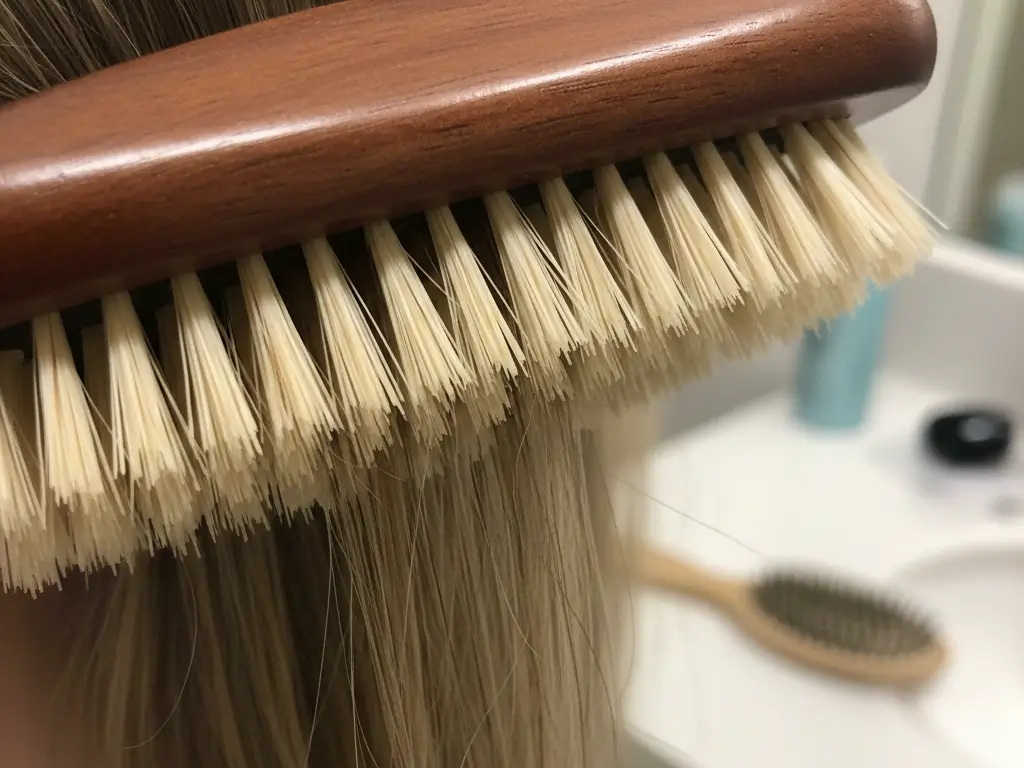
A boar bristle brush works because the structure of the boar hair is similar to human hair. Under a microscope, the bristles have tiny scales and a porous surface. These scales trap sebum (your natural scalp oil) and physically drag it down the hair shaft. This seals the cuticle, reduces frizz, and acts as a natural serum.
The Science of “Sebum Transport”
Most synthetic brushes are smooth plastic. They slide right past the oil sitting on your scalp. Boar bristles are different. They are textured.
Think of a plastic bristle like a slide at a playground, everything slips off. Think of a boar bristle like a velcro strip. It grabs the oil produced at your follicles.
When you brush from root to tip, you are taking that concentration of oil, which makes your roots look greasy, and distributing it to the mid-lengths and ends, which are usually thirsty for moisture. This is why I often tell people that their scalp isn’t “too oily,” it’s just that the oil is stuck at the source.
By moving this oil, you are coating the hair strands. This coating reflects light (hello, shine) and creates a barrier against humidity. It is essentially the original anti-frizz serum, long before bottles of silicone hit the shelves.
If you are struggling with scalp issues, this mechanical action also exfoliates the skin. It lifts away buildup and dead skin cells, which can help with scalp microbiome balance. However, you have to be gentle. A heavy hand here does more harm than good.
Finding Your Match: Pure Boar vs. Mixed Bristles
If you have fine or thin hair, choose a 100% pure boar bristle brush. The soft bristles won’t damage delicate strands. If you have thick, curly, or coarse hair, you need a mixture brush (boar + nylon). The nylon pins penetrate the density to reach the scalp, while the boar bristles redistribute the oil.
The Density Problem
This is where most people waste their money. They buy a pure boar brush, try to use it on thick hair, and realize the bristles just graze the surface.
I’ve tested dozens of brushes, and here is the rule of thumb I use:
- Fine/Thin Hair: You need 100% boar bristles. Your hair doesn’t offer much resistance, so the soft natural bristles can reach the scalp easily.
- Medium/Normal Hair: You can go either way, but a brush with widely spaced pure bristles usually works best.
- Thick/Coarse/Curly Hair: You absolutely need a “porcupine” style mix. This doesn’t mean porcupine quills; it refers to the look. These brushes have a longer nylon pin paired with shorter boar bristles.
The nylon pin leads the way. It separates the hair and reaches the scalp to detangle slightly and stimulate blood flow. The boar bristles follow behind, smoothing the cuticle and moving the oil. Without that nylon pin, you are essentially just polishing the top layer of your hair while the underneath stays messy.
Using the right tool for your specific texture is critical. It’s similar to how you would choose botanical oils for your hair type, one size definitely does not fit all.
The Brushing Ritual: It’s Not Just About Detangling
Never use a boar bristle brush on wet hair; it will cause breakage. To use it correctly:
- Start with dry hair.
- Detangle first with a wide-tooth comb.
- Section your hair.
- Brush from the very root to the very tip.
- Repeat each section 3-4 times to fully coat the strands.
The “Grease Phase”
I need to be honest with you about the transition period. When you start doing this properly, really stimulating the scalp and moving oil, your hair might feel heavier or greasier for the first week or two.
This is normal. Your scalp is used to you stripping away oils with harsh shampoos, so it overproduces oil to compensate. As you distribute that oil mechanically, your scalp eventually gets the message that it doesn’t need to work so overtime.
Here is my preferred technique:
- Detangle First: Use a wooden comb or a plastic detangler first. Boar bristles have too much tension for removing knots. If you hit a snag with a boar brush, you will likely tear the hair.
- Bend Over: Flip your head upside down. This helps reach the nape of the neck (a place we often neglect) and adds volume.
- Root to Tip: Place the brush on your scalp. Feel the bristles touch the skin. Then, pull slowly through to the ends. If you stop halfway, you are just depositing oil in the middle of your hair, which looks dirty.
- Sectioning is Key: If you have thick hair, you can’t just brush the top. You have to lift sections and brush the underneath layers.
This ritual can be surprisingly relaxing. It’s a form of self-care that connects you to your body, similar to the practice of dry brushing for your skin. You are physically stimulating circulation, which brings nutrients to the hair follicle.
Boar Bristle vs. Bamboo vs. Nylon
Boar Bristle is for conditioning, smoothing, and oil distribution (dry hair only). Bamboo/Wood pins are for scalp massage and gentle detangling (wet or dry). Nylon/Plastic is strictly for heavy-duty detangling and blow-drying.
Which Tool for Which Job?
I often see bathroom counters cluttered with tools that serve the same purpose. Let’s simplify what you actually need.
| Feature | Boar Bristle | Bamboo Hairbrush | Plastic/Vent Brush |
| Primary Job | Conditioning & Shine | Massage & Detangling | Styling & Drying |
| Best State | Dry Hair Only | Wet or Dry | Wet or Dry |
| Oil Transfer | High (Excellent) | Low (Neutral) | None |
| Scalp Feel | Scratchy/Stimulating | Massaging/Gentle | Sharp/Hard |
| Static | Reduces Static | Reduces Static | Creates Static |
The Bamboo Advantage:
If you are looking for scalp stimulation without the intense tension of boar bristles, bamboo is a great alternative. The wooden pins are usually thicker and rounded. They massage the scalp in a way that feels almost like acupressure. I often recommend bamboo brushes for people with sensitive scalps who find boar bristles too scratchy.
The Plastic Problem:
Plastic brushes generate static electricity. Have you ever brushed your hair in winter and watched it stand up? That’s usually plastic on hair. Natural materials like boar bristle and wood have a neutral charge, which helps lay the cuticle down rather than ruffling it up.
If you are interested in avoiding synthetic tools entirely, you might want to look at natural vegan makeup brushes as well. The shift away from plastic in beauty tools is happening for a reason, natural fibers generally interact better with our skin and hair structure.
Cleaning and Care: The Part Most People Ignore
You must clean a boar bristle brush weekly. It traps oil, dead skin, and product buildup.
- Remove loose hair with a comb.
- Soak bristles (not the handle) in warm water and gentle shampoo.
- Scrub bristles gently with your fingers.
- Rinse cold.
- Dry bristles-down on a towel to protect the wooden handle.
Why You Can’t Skip This
This is the gross part, but we have to talk about it. Because the brush is designed to trap oil and dust, it gets dirty fast. If you keep using a dirty brush, you are just putting yesterday’s dirt back onto today’s clean hair.
I’ve seen people complain that their brush “stopped working” or made their hair dull. Usually, the bristles are just caked in sulfate-free shampoo residue and dry shampoo powder.
The Water Warning:
Most high-quality boar bristle brushes have wooden handles. Wood and water do not get along. When you wash your brush, do not submerge the whole thing. The wood will swell, crack, and the bristles will fall out.
Dip just the bristles into your soapy water. I like to use a little tea tree oil in the wash water for its antiseptic properties, helpful if you deal with natural dandruff remedies.
After rinsing, shake it out vigorously. Then, place it bristles-down on a towel. This ensures the water drips away from the rubber cushion and the wooden handle. If water sits in that cushion, it can grow mold. And nobody wants to brush mold into their hair.
Common Myths and Mistakes
I want to clear up a few things I hear constantly.
Myth 1: It makes hair grow faster.
Technically, no brush makes hair grow. However, the massage increases blood flow to the scalp, which brings nutrients to the follicle. So, it creates a better environment for growth, but it’s not a magic wand.
Myth 2: It works for all styles.
If you have tight curls or coils, a dense boar brush might disrupt your curl pattern if used dry. In this case, you might use it specifically for smoothing edges or doing slick-back styles, rather than full-head brushing.
Myth 3: More brushing is better.
The old “100 strokes a night” advice is overkill. That much friction can actually wear down the cuticle layer. Brush enough to cover the strands, then stop. We are looking for polish, not abrasion.
Who Should NOT Use a Boar Bristle Brush?
While I love these brushes, they aren’t for everyone.
If you have extremely damaged or breaking hair, the tension might be too much. You need to focus on repair treatments first, perhaps looking into natural hair care treatments that focus on moisture and protein balance.
Also, if you have very oily hair naturally, you might find that this brush distributes too much oil, making your hair look flat faster. In that case, use it right before you plan to wash your hair as a pre-shampoo conditioning treatment.
Integrating This Into a Holistic Routine
Switching to a boar bristle brush is rarely a standalone change. It usually happens when you start looking at your beauty routine and realizing how many synthetic, harsh tools you’re using.
It connects to a broader philosophy. Just as you might swap a plastic loofah for a konjac sponge or try oil cleansing for your face, moving to natural hair tools is about working with your body’s biology rather than fighting it.
If you are exploring the broader philosophy at https://beautyhealingorganic.com, you’ll see that the best results usually come from simple, mechanical changes rather than expensive chemical products.
The Bottom Line
Is a boar bristle brush worth the investment? Yes, if you are willing to use it correctly.
If you want a brush you can rip through wet hair in 30 seconds, stick to a wet brush. But if you want to improve the actual condition of your hair, reduce your reliance on styling products, and embrace your natural texture, this tool is unmatched.
- Check your hair density. (Can you see your scalp easily? Go pure boar. Is it a dense forest? Go mixed bristle).
- Commit to brushing your hair before you wash it this week. This loosens debris and makes your shampoo work better.
- Clean your brush. Seriously, go do it now.
It takes a little patience to break in the brush (and your hair), but the shine is real.