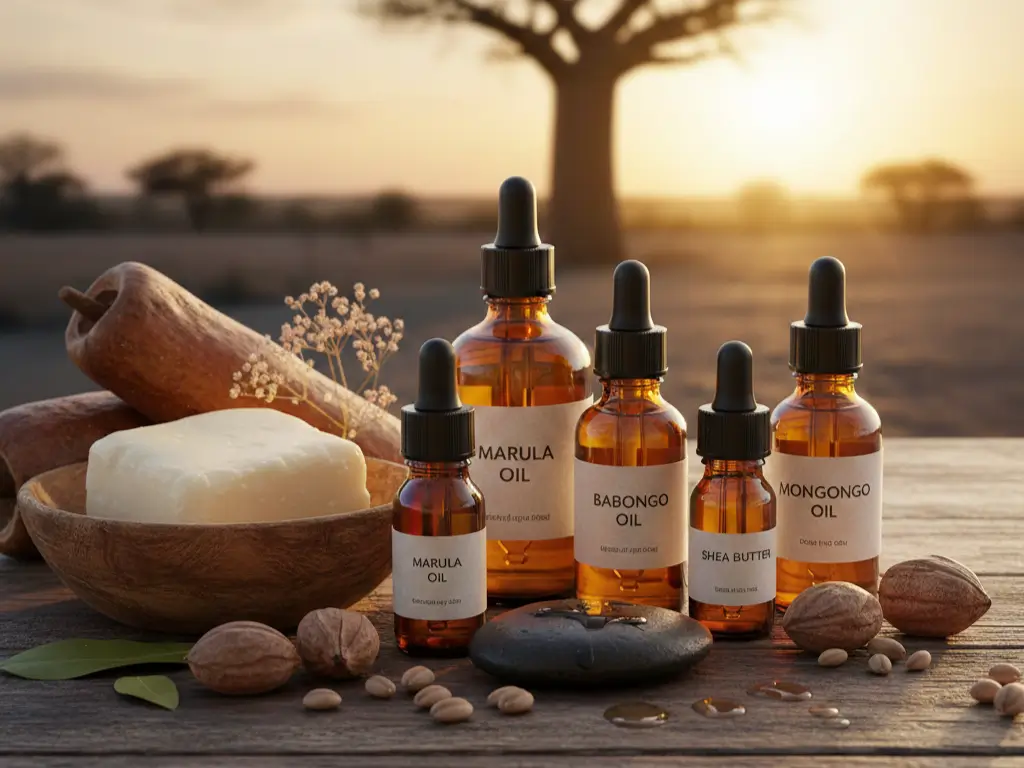
African oils and ingredients, including marula, baobab, mongongo, and shea, evolved in extreme climates (intense sun, dry conditions, temperature swings), which created botanicals high in antioxidants, stable fatty acids, and protective compounds that address oxidation, dehydration, and barrier damage.
Most beauty ingredients come from temperate climates with moderate conditions. African botanicals survived, and thrived, in some of Earth’s harshest environments. The Kalahari Desert. The Sahel’s dry season. Equatorial sun exposure.
That environmental stress created chemical defense systems we can borrow for skin protection. A baobab tree stores thousands of gallons of water through nine-month droughts. Its seed oil mirrors that moisture-retention strategy. Marula trees withstand temperature swings from 36°F to 113°F, producing oils with exceptional oxidative stability.
Why African Beauty Ingredients Work: The Climate Connection
African botanicals evolved protective compounds (antioxidants, stable fatty acids, water-binding proteins) to survive extreme UV exposure, drought, and temperature fluctuations, the same stressors that damage human skin.
Most skincare guides list ingredients without explaining why they developed their properties. The why matters.
Think about what plants face in sub-Saharan climates. UV radiation levels that would destroy more delicate species. Months without rain. Daytime heat followed by cold nights. These conditions forced evolutionary adaptations.
High antioxidant content
Marula oil contains up to 60% more antioxidants than most other oils. Why? The marula tree faces relentless oxidative stress from equatorial sun. It developed high levels of vitamin C, vitamin E, and flavonoids as UV shields. When you apply that oil topically, you’re borrowing that UV-damage protection system.
Exceptionally stable fatty acid profiles
Many plant oils oxidize quickly (go rancid) when exposed to heat and light. Mongongo oil and baobab oil remain stable because their fatty acid ratios evolved for hot, sunny environments. This means they won’t break down on your skin or in your bathroom cabinet as fast as more delicate oils.
Water-retention mechanisms
Baobab trees can store up to 32,000 gallons of water. The seed oil contains omega fatty acids that form protective barriers, mimicking the tree’s moisture-conservation strategy. When formulated properly, this translates to reduced transepidermal water loss in skin.
I’m not saying African ingredients are “better” than all alternatives. But understanding their evolutionary context explains their specific strengths. For concerns related to oxidation (addressing hyperpigmentation), barrier damage, or moisture retention, they often outperform ingredients from less extreme climates.
What surprised me most? How well they work in dry US climates, Arizona, Colorado, high-altitude regions. Makes sense when you realize they evolved for similar conditions.
Core African Oils and What They Actually Do
The five most-studied African oils, marula, baobab, mongongo, Kalahari melon seed, and argan, each have distinct fatty acid profiles and active compounds that determine their best uses beyond general “moisturizing.”
Let’s get specific. Not all oils do the same thing, despite what product marketing suggests.
Marula oil (Sclerocarya birrea)
Cold-pressed from marula fruit kernels.
Fatty acid profile: 70-78% oleic acid (omega-9), 4-7% palmitic acid, 0.5-1% linoleic acid. High in amino acids and vitamin E.
What this means practically: Oleic acid penetrates deeply and suits dry, mature skin well. But if you’re acne-prone, the low linoleic acid content might not balance your skin’s oil production. (Acne-prone skin typically has low linoleic acid levels in its sebum.)
Best for: Dry, dehydrated, or mature skin. Anti-aging routines. Works exceptionally well in facial oil blends or as the final step in layered routines.
What I’ve noticed: It absorbs faster than argan despite the high oleic content. Probably due to the amino acid content.
Baobab oil (Adansonia digitata)
Extracted from seeds inside the baobab fruit.
Fatty acid profile: Balanced, roughly 30% oleic, 30% linoleic, 25% palmitic. High in vitamins A, D, E, and F.
What this means: The balanced omega-6 to omega-9 ratio makes it suitable for more skin types, including combination skin. The vitamin profile supports barrier repair.
Best for: Compromised skin barriers, eczema-prone skin, general moisturizing without heaviness. Particularly effective for barrier repair protocols.
Texture note: Lighter than marula. Absorbs completely in 3-5 minutes on my normal-dry skin.
Mongongo oil (Schinziophyton rautanenii)
From mongongo nuts in the Kalahari region.
Fatty acid profile: High in polyunsaturated fatty acids (linoleic dominant), plus eleostearic acid (unique to this oil). Contains vitamin E and calcium.
What this means: The eleostearic acid provides UV-protective properties (not a substitute for sunscreen, but additional protection). Linoleic acid suits oilier or acne-prone skin better than oleic-heavy oils.
Best for: Oily, combination, or acne-prone skin needing moisture without congestion. Sun protection routines as a complementary step.
Harder to find: Mongongo isn’t as commercially available as marula or argan. When you do find it, check sourcing practices.
Kalahari melon seed oil (Citrullus lanatus)
From a wild watermelon species.
Fatty acid profile: 60-70% linoleic acid, omega-6 heavy. Extremely lightweight.
What this means: Perfect for oily skin types who’ve avoided oils thinking they’d cause breakouts. The high linoleic content can actually help regulate sebum production.
Best for: Oily, acne-prone, or combination skin. Summer routines when heavier oils feel uncomfortable.
My experience: This is what I recommend to people who say “oils break me out.” Usually, they’ve only tried coconut or other comedogenic oils.
Argan oil (Argania spinosa)
Technically North African (Morocco), but worth including.
Fatty acid profile: 45% oleic, 35% linoleic. High in vitamin E and squalene.
What this means: Another balanced profile. The squalene content adds additional skin-identical moisturization.
Best for: All skin types, particularly as a botanical hair treatment or in combination with other active ingredients.
Oversaturated market: Argan is everywhere now. Quality varies wildly. More on that below.
One thing most guides don’t mention: You can blend these. A 50/50 marula-kalahari melon blend gives you oleic acid penetration with linoleic acid balancing. Customize based on your skin’s response.
African Butters and Extracts Beyond the Basics
Shea butter, African black soap, and rooibos extract offer different mechanisms, occlusion, gentle surfactants, and antioxidants respectively, that complement the oils and address specific concerns from body dryness to sensitive skin cleansing.
Most people know shea butter. Fewer understand how to use it effectively or what else African botanical traditions offer.
Shea butter (Vitellaria paradoxa)
From shea tree nuts across the Sahel region.
Two types matter:
- Unrefined (yellow/ivory): Retains vitamins A, E, and F. Nutty smell. More active compounds.
- Refined (white): Processed to remove color and scent. Fewer nutrients but more neutral.
For skincare, unrefined works better despite the scent. The triterpene content provides anti-inflammatory effects that refined versions lose.
Best uses: Extremely dry skin, elbows, knees, feet. Body care routines in winter climates. Works excellently in DIY butter blends.
Face use? Possible for very dry skin, but the texture works better for body application in my experience. Too occlusive for facial use unless you’re in a desert climate or have severely compromised barriers.
African black soap
Traditional West African soap from Ghana and Nigeria.
Real formulation: Plantain skin ash, palm kernel oil, shea butter, and cocoa pod ash. The ash provides gentle alkalinity for saponification without harsh synthetic surfactants.
What it does: Cleanses without stripping. The ash provides mild physical exfoliation. Anecdotally helps with body acne, though I haven’t seen clinical studies confirming this specifically.
Quality issue: Many “African black soaps” sold in the US contain synthetic detergents and aren’t authentic. Real African black soap is brown-black, crumbly, and has an earthy (not perfumed) smell.
Best for: Body cleansing, particularly for those avoiding sulfates in cleansers. Can be drying on face, use cautiously and follow with hydration.
Rooibos extract (Aspalathus linearis)
From South African red bush tea.
Active compounds: Aspalathin and nothofagin (unique antioxidants), zinc, alpha-hydroxy acids.
What this means: Antioxidant protection plus mild exfoliation. The zinc content helps with inflammation.
Best for: Sensitive skin routines, anti-pollution protocols, or as a gentle alternative to stronger acids.
Format: Usually appears in toners, essences, or mists. You can also brew strong rooibos tea, cool it, and use as a facial rinse (free option to test the ingredient).
Kigelia africana extract
From the sausage tree (named for its fruit shape).
Emerging ingredient: Contains flavonoids, saponins, and sterols. Traditional use for skin firmness.
Limited research: Some studies suggest firming effects, but clinical evidence is thin compared to established ingredients. Interesting to watch, not a must-have yet.
You’ll see it in firming neck and décolletage products, but verify it’s not just marketing filler.
Matching African Ingredients to Your Specific Skin Concerns
Choose African oils and ingredients based on your primary concern and skin type, dry skin needs oleic-rich oils (marula), oily skin needs linoleic-rich (mongongo, Kalahari melon), and sensitive skin benefits from balanced profiles (baobab) and soothing extracts (rooibos).
Here’s the practical matching I use:
| Skin Concern | Best African Ingredient | Why It Works | How to Use |
| Dry/Dehydrated | Marula oil, Baobab oil | High oleic acid penetrates; baobab’s balanced profile prevents water loss | 3-5 drops after serums, AM/PM |
| Oily/Acne-Prone | Kalahari melon, Mongongo oil | High linoleic acid balances sebum production | 2-3 drops PM only, or mix with moisturizer |
| Aging/Fine Lines | Marula oil, Shea butter | Antioxidants combat oxidative stress; triterpenes in shea support collagen | Oil PM, shea on body or very dry areas |
| Sensitive/Reactive | Baobab oil, Rooibos extract | Balanced fatty acids don’t irritate; rooibos soothes inflammation | Gentle application, patch test first |
| Hyperpigmentation | Mongongo oil, Rooibos | UV-protective compounds; antioxidants reduce oxidative triggers | Layer under sunscreen AM, alone PM |
| Barrier Damage | Baobab oil, Unrefined shea | Omega balance repairs lipid barrier; shea’s ceramide-like compounds seal | Multiple thin layers vs. one thick application |
What I got wrong initially: Thinking all “moisturizing oils” work the same. They don’t. The fatty acid profile determines whether an oil will help or potentially worsen your specific situation.
For acne-prone skin, the linoleic acid content matters more than whether something is “natural” or “African” or any other marketing term. Same with dry skin and oleic acid.
If you’re dealing with multiple concerns, layer strategically. I use Kalahari melon on my T-zone and marula on my cheeks when my combination skin acts up. No rule says you must use one oil all over.
For targeted skin concerns beyond basic types, this botanical extract guide helps layer African ingredients with other active botanicals.
What to Look for When Buying African Beauty Ingredients
Quality African oils should be cold-pressed, stored in dark glass, sourced transparently (with region/cooperative named), and priced appropriately, if it’s dramatically cheaper than comparable oils, it’s likely diluted or low-grade.
This is the part most guides skip. Quality varies dramatically, and “African oil” on a label doesn’t guarantee you’re getting the real thing.
Processing method matters: Look for “cold-pressed” or “unrefined.” Heat processing destroys many of the heat-sensitive antioxidants that make these oils valuable in the first place. If the label doesn’t specify processing, assume refined.
Storage and packaging: These oils are stable, but not indestructible. Dark glass bottles (amber or cobalt blue) protect from light degradation. Plastic bottles suggest a manufacturer cutting corners. Clear glass is acceptable only if the product is boxed to prevent light exposure.
Sourcing transparency: Ethical brands tell you where ingredients come from. “Marula oil from women’s cooperatives in Namibia” is a good sign. “Marula oil” with no sourcing information is a red flag. This isn’t just about ethics, it’s a quality indicator. Companies proud of their sourcing generally have higher quality standards throughout.
Price reality check:
- Authentic marula oil: $15-30 per ounce
- Authentic baobab oil: $12-25 per ounce
- Authentic mongongo oil: $20-35 per ounce (rarer, pricier)
- Authentic argan oil: $10-20 per ounce (oversupplied market)
If you’re seeing “pure marula oil” for $5 per ounce, it’s either diluted with cheaper oils or such low quality it won’t perform as expected.
The dilution trick: Many products list “marula oil” as the first ingredient but don’t specify percentage. It might be 10% marula, 90% grapeseed oil (much cheaper). Not necessarily bad if it’s disclosed, but you should know what you’re paying for.
Smell and texture test:
- Marula: Nutty, slightly fruity smell. Light-medium texture.
- Baobab: Mild, slightly sweet. Light texture.
- Unrefined shea: Nutty, earthy. Should be soft but not liquid at room temperature.
If your “African black soap” smells like synthetic fragrance and lathers like typical soap, it’s probably a commercial soap with some authentic soap added for marketing.
Certification questions: “Organic” certification for wild-harvested African ingredients is complicated. Many authentic producers can’t afford certification even if their practices are organic. Don’t dismiss uncertified products from transparent sources, but do verify their sourcing story.
Where I buy: I look for brands that specialize in African ingredients or botanical oils specifically rather than general beauty retailers carrying one or two African oils as trend items. Specialists usually have better sourcing relationships.
What makes me walk away: Ingredients lists that say “marula oil blend” without specifying what else is in the blend. That asterisk is doing heavy lifting.
Making African Ingredients Work in Your Existing Routine
You don’t need to overhaul your entire routine. These ingredients integrate into what you’re already doing.
Oil application timing: Oils should go after water-based serums but before heavy creams. If you’re using actives like niacinamide or vitamin C, apply those first, wait 30-60 seconds, then add your African oil.
The oil helps seal in the actives without preventing penetration if you time it right.
Mixing possibilities: You can add 2-3 drops of lighter African oils (baobab, Kalahari melon) directly into your regular moisturizer. This boosts fatty acids without adding a product step.
Seasonal rotation: I use marula oil in winter (dry Colorado climate needs the oleic acid), then switch to Kalahari melon in humid summer months when heavier oils feel uncomfortable.
Body vs. face: Don’t be afraid to use facial-grade oils on your body and butter-textured products (shea) where you actually need that occlusion, rough patches, elbows, heels. You’ll go through products faster using expensive marula oil on your entire body when shea butter would work better.
For comprehensive routine integration across different skin types and concerns, consider how these ingredients layer with your existing products.
These ingredients work because of chemistry, not geography. The climate stress that created their beneficial properties matters. The “African” label itself doesn’t.
I’ve seen plenty of overhyped “exotic” ingredients that underperform, and I’ve seen African botanicals genuinely outperform alternatives for specific concerns. The difference comes down to understanding what each ingredient actually does, its fatty acid profile, active compounds, and proper application, rather than buying into mystique.
Test them like you’d test any new ingredient: one at a time, for at least two weeks, noting specific changes. That’s how you figure out what actually works for your skin instead of what makes good marketing copy.
If you want to explore beauty ingredients from other regions with similar climate-driven adaptations, check out this guide to Amazonian oils or Mediterranean beauty secrets for different environmental adaptations.
Start with one oil that matches your primary concern. Give it three weeks. Then decide if African botanicals earn a permanent spot in your routine. That’s the only test that matters, not the marketing, not the trend articles, but whether it actually improves your specific skin.
For me, baobab oil became a winter staple, and I keep Kalahari melon for summer breakouts. Your results will probably differ. That’s the point of understanding the ingredients rather than just following someone else’s routine.