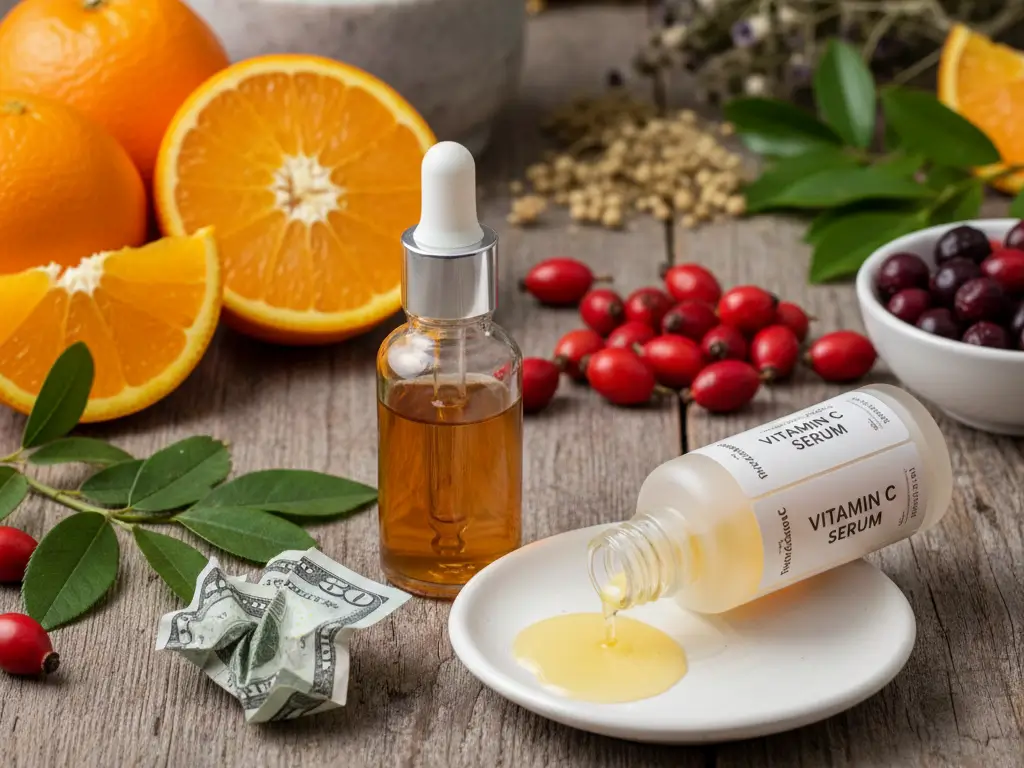
I’ve watched too many people pull out their “natural” Vitamin C serum only to find it’s turned orange. They’re confused, frustrated, and wondering if they just wasted $60.
Vitamin C is one of the most effective skincare ingredients you can use, but it’s also the most unstable, especially in natural formulations.
This matters because Vitamin C (ascorbic acid) is scientifically proven to brighten skin, boost collagen, and fight free radicals. But if your product oxidizes before you use it? You’re literally rubbing expensive orange water on your face. The natural beauty space has made this worse by promoting “pure plant-based” Vitamin C without addressing the stability nightmare.
What makes my approach different? I’m not here to sell you on miracle ingredients. I’ve formulated natural skincare for seven years, and I’ve seen what works in real bathrooms with real humidity and real people who don’t store serums in wine fridges. You’ll learn which natural forms actually survive in products, how to spot oxidation early, and when synthetic derivatives are honestly your best natural-friendly option.
By the end, you’ll know exactly which Vitamin C products deserve your money and how to make them last.
What Makes Vitamin C Different in Natural Skincare?
Natural Vitamin C formulations face unique stability challenges because they avoid synthetic stabilizers and preservatives. Pure L-ascorbic acid oxidizes rapidly when exposed to light, air, and water, the exact enemies of natural, minimal-ingredient products.
The paradox is real. Vitamin C is both the most researched anti-aging ingredient AND the most temperamental to formulate.
In conventional skincare, formulators use synthetic stabilizers, silicones, and chemical preservatives to protect Vitamin C. Natural formulations can’t rely on these. Instead, we work with plant-based antioxidants, specific pH levels, and alternative delivery systems.
Here’s what most people don’t realize: when Vitamin C oxidizes, it doesn’t just become “less effective.” It can actually irritate your skin. That orange or brown color you see? That’s oxidized ascorbic acid, which can be pro-oxidant instead of antioxidant. You’re essentially applying something that could accelerate aging rather than prevent it.
The pH factor adds another layer. Effective L-ascorbic acid needs a pH of 2.5-3.5 to penetrate skin. That’s acidic, closer to lemon juice than the gentle pH 5.5 products natural beauty enthusiasts typically prefer. This creates tension between effectiveness and comfort, especially for sensitive skin.
What I’ve learned from formulating natural exfoliating acids is that you can’t ignore chemistry just because you prefer plants. You need to respect how ingredients actually work.
Natural doesn’t mean “gentle by default.” It means working with plant chemistry instead of against it. When you understand Vitamin C’s actual requirements, you make smarter choices about which forms work for your skin and lifestyle.
Which Forms of Vitamin C Are Actually Natural (And Stable)?
The most stable natural-friendly forms include sodium ascorbyl phosphate (SAP), magnesium ascorbyl phosphate (MAP), and ascorbyl glucoside. Pure L-ascorbic acid from botanical sources exists but requires careful formulation with natural stabilizers like ferulic acid and vitamin E.
Let’s break down what actually works:
L-Ascorbic Acid (Pure Vitamin C)
This is the gold standard, the most researched and proven form. In nature, you’ll find it in citrus, rose hips, kakadu plum, and camu camu berries. The problem? It’s incredibly unstable in water-based formulations.
Concentration matters. Studies show 10-20% L-ascorbic acid is effective, but higher percentages don’t always mean better results. I’ve seen people’s skin freak out from 20% formulas when 10% would’ve worked beautifully.
Sodium Ascorbyl Phosphate (SAP)
This is my go-to for natural formulations. It’s a salt form of Vitamin C that’s stable at neutral pH (around 6-7), so it doesn’t sting sensitive skin. SAP converts to L-ascorbic acid once absorbed, and research shows it’s particularly effective for acne-prone skin because it has antimicrobial properties.
The catch? It’s technically a derivative, not “pure” Vitamin C. But it’s far more compatible with natural preservatives and gentler formulation approaches.
Magnesium Ascorbyl Phosphate (MAP)
Similar benefits to SAP but with added hydration. MAP is water-soluble, stable, and works well in natural emulsions. It’s less irritating than L-ascorbic acid and more compatible with ingredients commonly used in organic skincare routines.
Ascorbyl Palmitate
This oil-soluble form works in anhydrous (waterless) products and facial oils. Since it doesn’t require water, stability improves dramatically. You’ll find this in natural face oils and balms, where it acts as both an antioxidant and preservative.
Botanical Extracts High in Vitamin C
Kakadu plum, camu camu, acerola cherry, and rose hips contain natural Vitamin C. Here’s where I’ll be honest: these are fantastic antioxidants and work well alongside other antioxidant berries in skincare, but they’re unpredictable for Vitamin C percentage. You’re getting a whole-plant extract with various compounds, not isolated ascorbic acid.
I use these in formulas for their synergistic benefits, not as primary Vitamin C sources. They’re excellent supporting actors, not the lead.
The uncomfortable truth? Pure botanical Vitamin C serums sound appealing, but synthetic derivatives like SAP often perform better in real-world conditions. That doesn’t make them “unnatural”, it makes them practical.
What Are the Real Benefits of Vitamin C for Your Skin?
Vitamin C brightens hyperpigmentation, stimulates collagen production, protects against UV and pollution damage, and reduces inflammation. Results typically appear in 4-12 weeks with consistent use, depending on concentration and form.
Let’s go beyond the marketing claims:
Hyperpigmentation and Brightening
Vitamin C inhibits tyrosinase, the enzyme responsible for melanin production. This doesn’t “bleach” your skin, it prevents new dark spots and gradually fades existing ones.
In my experience, this works best when combined with other brightening ingredients. I’ve seen people combine Vitamin C with niacinamide (despite old myths saying they can’t mix, they absolutely can) and get results in 6-8 weeks that either ingredient alone would take 12+ weeks to achieve.
Realistic expectations: Vitamin C won’t erase deep hyperpigmentation overnight. For serious concerns, check out comprehensive approaches in our hyperpigmentation guide.
Collagen Production
Here’s what surprised me when I dug into the research: Vitamin C is a cofactor for collagen synthesis. Your body literally can’t make collagen without it. Topical application stimulates fibroblasts (collagen-producing cells) to work harder.
You won’t see instant plumping, but over 3-6 months, consistent use improves skin texture and firmness. This is where Vitamin C overlaps with peptides in natural skincare, both stimulate collagen through different mechanisms.
Antioxidant Protection
Vitamin C neutralizes free radicals from UV exposure and pollution. This is why many people layer it under sunscreen in the morning. It doesn’t replace SPF (nothing does), but it enhances protection.
What nobody tells you: antioxidants work better in teams. Vitamin C + Vitamin E + ferulic acid creates synergy, each one stabilizes and boosts the others. That’s why you’ll see these three together in high-quality formulas. This principle applies across power ingredient combinations.
Anti-Inflammatory Effects
SAP in particular shows anti-inflammatory properties, which is why it works well for acne and rosacea. L-ascorbic acid at high percentages can actually irritate, so form matters here.
Vitamin C works, but it’s not magic. If you’re dealing with acne, combination approaches using clean beauty for sensitive, acne-prone skin will serve you better than Vitamin C alone. If you want anti-aging, pair it with bio-retinols for comprehensive results.
Natural vs. Synthetic Vitamin C: Which Works Better?
Synthetic L-ascorbic acid is chemically identical to natural sources, more stable, and easier to formulate at effective concentrations. Natural botanical sources offer synergistic compounds but with variable Vitamin C content and faster oxidation.
Here’s the comparison that matters:
| Criteria | Synthetic L-Ascorbic Acid | Natural Botanical Sources |
| Stability | Moderate (still oxidizes) | Low (oxidizes faster) |
| Concentration Control | Precise (10%, 15%, 20%) | Variable (unknown %) |
| pH Control | Easy to formulate at 2.5-3.5 | Difficult to standardize |
| Cost | Lower for same concentration | Higher for comparable effect |
| Synergistic Benefits | Only Vitamin C | Vitamin C + flavonoids, polyphenols |
| Best For | Targeted results, predictability | Whole-plant benefits, gentler formulas |
The science piece that changed my thinking: synthetic Vitamin C is molecularly identical to the ascorbic acid in an orange. Your skin can’t tell the difference. The “synthetic is bad” narrative doesn’t hold up here.
What does matter is the formulation around it. A synthetic Vitamin C serum with clean natural emulsification and preservation can absolutely fit into a natural skincare philosophy.
That said, botanical sources shine in whole-plant formulas. When I use sea buckthorn oil or kakadu plum extract, I’m not just getting Vitamin C, I’m getting omega fatty acids, other antioxidants, and anti-inflammatory compounds. These work differently than isolated Vitamin C, and honestly, I love them for that.
My recommendation? Use synthetic derivatives (like SAP or MAP) for your primary Vitamin C serum where you need consistent, measurable results. Incorporate botanical sources in your facial oils, masks, and supporting products for synergistic benefits.
Don’t let “natural” or “synthetic” labels make the decision for you. Ask: “Does this formulation work, stay stable, and fit my values?” Sometimes the most natural choice is the one that doesn’t oxidize in three weeks.
How to Choose and Store Vitamin C Products That Actually Work
Look for opaque or dark glass bottles, airless pumps, concentrations of 10-20% for L-ascorbic acid (or 3-5% for derivatives), pH around 3 for L-ascorbic acid or 6-7 for derivatives, and formulas that include stabilizers like ferulic acid and vitamin E.
Let me save you money with practical selection criteria:
Packaging Red Flags
If Vitamin C comes in a clear bottle or jar, walk away. Light destroys Vitamin C. Period. Look for:
- Dark amber or cobalt glass
- Airless pump bottles
- Small sizes (you’ll use it within 3 months)
Dropper bottles are fine if they’re dark glass, but airless is better because you’re not exposing the entire bottle to air every time you use it.
Formula Clues
Read the ingredients. For L-ascorbic acid formulas:
- Should be near the top of the list (high concentration)
- Should include ferulic acid and/or vitamin E
- pH should be listed (3-3.5 range) or you can test it yourself
For derivative forms (SAP, MAP):
- 3-5% concentration is effective
- pH 6-7 is ideal
- Often paired with humectants for hydration
Texture Indicators
L-ascorbic acid serums should be slightly viscous, not watery. Watery formulas oxidize faster. Silicone-free natural versions might feel less silky than conventional ones, that’s okay. What matters is that it spreads evenly and doesn’t pill under other products.
Storage Non-Negotiables
- Cool, dark place: Not on your sunny windowsill bathroom counter. A drawer or cabinet works.
- Refrigerator: Controversial, but I do this for L-ascorbic acid serums. It slows oxidation significantly.
- Replace every 3 months: Even if product remains. If it turns yellow, orange, or brown, toss it immediately.
The Oxidation Test
Fresh Vitamin C should be clear to slightly yellow (depending on concentration). As it oxidizes, it darkens. Here’s my rule:
- Clear or pale yellow = good
- Medium yellow = use quickly
- Orange or brown = trash
Don’t try to use oxidized product thinking you’ll “get some benefit.” You won’t, and you might irritate your skin.
Building Your Routine
Vitamin C plays well with most ingredients despite old myths. You can use it with:
- Niacinamide (they’re fine together)
- Hyaluronic acid
- Peptides
- Most antioxidants
Be cautious layering with strong acids (like AHAs/BHAs) or retinoids in the same application. Not because they’re incompatible, but because it can irritate sensitive skin. I typically recommend Vitamin C in the morning and actives like plant-based retinol alternatives at night.
For complete layering strategies, check our skincare layering guide.
DIY Vitamin C: Should You?
I get asked this constantly. You can make Vitamin C powder solutions at home, but here’s the reality: they oxidize within days, pH is hard to control without testing equipment, and you’ll likely irritate your skin or waste ingredients.
If you love DIY, focus on projects where stability isn’t critical, like the approaches in our DIY clean beauty guide. Leave Vitamin C to formulated products unless you’re prepared to make fresh batches every few days and test pH properly.
The Bottom Line
Vitamin C works. The science is solid, the results are real, and you absolutely can find natural-friendly formulations that deliver.
But here’s what I want you to walk away knowing: stability matters more than “purity.” A stable derivative in good packaging will outperform a “pure botanical” serum that oxidizes in two weeks. Don’t let marketing language override practical chemistry.
Start with a well-formulated product using SAP or MAP if you’re new to Vitamin C or have sensitive skin. Once you know how your skin responds, you can experiment with L-ascorbic acid or specialty natural ingredients for targeted concerns.
- Check your current Vitamin C product (if you have one) for color. Oxidized? Replace it.
- Choose one product based on your primary concern, brightening, anti-aging, or acne, and commit for 8 weeks.
- Store it properly and note the date you opened it.
The natural beauty space needs more honesty about what actually works in real life, not just in theory. Vitamin C deserves a spot in your routine, but only if it’s formulated and stored to actually benefit your skin.
For more evidence-based approaches to building your routine, explore our complete resources at Beauty Healing Organic, where we bridge the gap between natural ingredients and actual results.