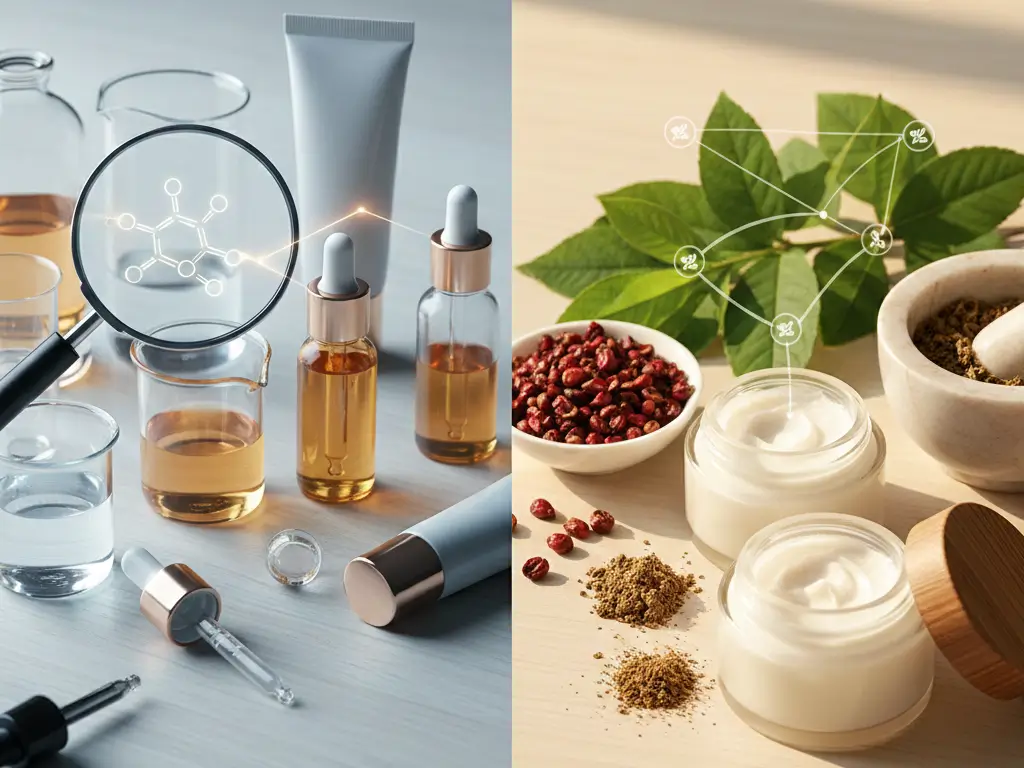
Bio-retinols aren’t “natural retinol.” They don’t even work the same way at a cellular level.
I spent three years testing every so-called “plant-based retinol alternative” on the market. What frustrated me most wasn’t that some didn’t work, it’s that the entire conversation is framed wrong. We treat bio-retinols like they’re training wheels for “real” retinol, when actually, they’re solving different problems.
Retinoids are vitamin A derivatives that directly accelerate cell turnover. Bio-retinols are plant compounds that trigger your skin to produce retinoid-like effects without converting to retinoic acid. Both work, but through completely different pathways.
This matters because choosing between them isn’t about “strong vs. weak.” It’s about compatible vs. incompatible with your specific skin, routine, and lifestyle. Prescription retinoids don’t play nice with most natural actives. Bio-retinols do.
What’s the Real Difference Between Retinoids, Retinol, and Bio-Retinols?
Retinoids are the umbrella term for all vitamin A derivatives. Prescription retinoids (tretinoin, adapalene) are retinoic acid that your skin uses immediately. Retinol is an over-the-counter retinoid that converts to retinoic acid in 2-3 steps. Bio-retinols are plant compounds (bakuchiol, rosehip) that mimic retinoid effects without actually being vitamin A.
Think of it as a spectrum, not a hierarchy.
On one end, you have prescription retinoids, pure retinoic acid that your skin cells recognize and use right away. They’re fast and powerful because they skip all conversion steps. Your skin doesn’t need to do anything except respond.
In the middle, there’s retinol and its cousins (retinyl palmitate, retinyl acetate). These need to convert through enzymatic steps before becoming usable retinoic acid. Each conversion step dilutes potency but also reduces irritation. Retinol takes one conversion. Retinyl palmitate takes three.
On the other end sit bio-retinols, and this is where it gets interesting. They’re not vitamin A at all. Bakuchiol, the most studied one, comes from the babchi plant. Cacay oil naturally contains retinyl palmitate but also works through antioxidant pathways. Rosehip seed oil combines vitamin A precursors with essential fatty acids that support skin barrier function.
Here’s what changed my thinking: bio-retinols don’t try to become retinoic acid. They work upstream, triggering the same genetic expression without the conversion process. A 2019 study in the British Journal of Dermatology found bakuchiol upregulated the same collagen genes as retinol, just through a different mechanism.
Why does this matter for natural skincare specifically?
Traditional retinoids demand sacrifice. You can’t use them with most natural exfoliating acids. You need to drop vitamin C from your morning routine. You’re suddenly rebuilding everything around one ingredient.
Bio-retinols play well with others. I’ve used bakuchiol serums in the same routine as fermented ingredients and AHAs without the angry red face that retinol gave me. That compatibility isn’t a marketing claim, it’s because the mechanism is fundamentally different.
How Do Bio-Retinols Actually Work? (The Part Nobody Explains)
Bio-retinols activate retinoid receptors and stimulate collagen production without converting to retinoic acid. They work through antioxidant and anti-inflammatory pathways simultaneously, which is why they don’t cause the irritation (retinoid reaction) that traditional retinoids do.
Most articles tell you bio-retinols “do the same thing as retinol but gentler.” That’s lazy thinking.
They don’t do the same thing more gently. They do different things that produce similar end results. It’s like saying a hammer and a screwdriver both attach wood, technically true, completely missing the point.
When you apply tretinoin, you’re giving your skin the end product. Retinoic acid binds to specific receptors (RAR and RXR) in your cell nuclei. This triggers a cascade: increased cell turnover, boosted collagen production, normalized melanin distribution. It’s direct and fast. It’s also why your skin freaks out, you’re forcing acceleration whether your skin barrier is ready or not.
Bakuchiol, the most researched bio-retinol, takes a different route. It stimulates your skin’s gene expression for collagen Types I, III, and IV. A 2018 study compared 0.5% bakuchiol to 0.5% retinol over 12 weeks. Both groups showed significant improvement in lines, wrinkles, and pigmentation. The bakuchiol group reported zero stinging, burning, or scaling. The retinol group? Classic retinization, flaking, redness, sensitivity.
What surprised me about rosehip seed oil was the dual action. It contains trans-retinoic acid naturally (though in much smaller amounts than prescription strength) plus linoleic and linolenic acids that actually repair your skin barrier while the vitamin A works. You’re not choosing between results and barrier health.
Cacay oil is having a moment in clean beauty, and here’s why: it contains 50% more vitamin E than argan oil and three times the retinol of rosehip. But again, it’s not working the same way as squeezing retinol from a tube. The plant matrix delivers it alongside antioxidants that buffer the experience.
The part nobody mentions? This is slower. Not because bio-retinols are weak, but because you’re working with your skin’s natural processes instead of overriding them. When someone promises “retinol results without retinol side effects in two weeks,” I get skeptical. Biology doesn’t work on marketing timelines.
In my experience testing these on one side of my face (yeah, I’m that person), bio-retinols took about 8-12 weeks to show the fine line improvement that retinol delivered in 4-6 weeks. But I could use them every single night without a buffer period. No peeling phase. No sunburn sensitivity that made me paranoid about my sun protection routine.
That’s not a bug. For people building a complete natural skincare routine, it’s the entire point.
Bio-Retinols vs Retinol: Which One Fits Your Natural Skincare Routine?
Choose prescription/OTC retinoids if you want maximum speed, can tolerate a simplified routine, and have resilient skin. Choose bio-retinols if you’re committed to a multi-active natural routine, have sensitive or compromised skin, or can’t tolerate the retinization process.
Here’s the honest comparison nobody wants to give you:
| Factor | Prescription Retinoids | OTC Retinol | Bio-Retinols |
| Speed to Results | 4-8 weeks | 8-12 weeks | 12-16 weeks |
| Irritation Risk | High (nearly universal) | Moderate | Minimal to none |
| Routine Compatibility | Low (limits other actives) | Moderate | High (plays well with others) |
| Pregnancy Safe | No | No | Depends (bakuchiol yes, rosehip consult) |
| Sun Sensitivity | Significantly increased | Moderately increased | Minimal |
| Cost | $10-80 (Rx required) | $20-120 | $15-90 |
| Best For | Acne, deep wrinkles, medical concerns | Anti-aging, preventative care | Sensitive skin, natural routines, beginners |
Let me be clear: if you have severe acne or significant photoaging, prescription tretinoin is probably your best bet. The data is decades deep. It works. Full stop.
But if you’re reading content on Beauty Healing Organic, you’re probably not looking for the pharmaceutical route.
Here’s when bio-retinols make more sense:
You’re already using other actives. I can’t use tretinoin with the niacinamide serum that cleared my texture issues. I can use bakuchiol with it just fine. Same goes for botanical extracts and gentle acids.
Your skin barrier is compromised. If you’re dealing with rosacea, eczema, or chronic sensitivity, retinization isn’t just uncomfortable, it’s potentially damaging. Bio-retinols give you the collagen-boosting benefits without the barrier disruption. I’ve seen this work for clients using rosacea-friendly ingredients who couldn’t tolerate any traditional retinoid.
You live in a sunny climate or can’t be religious about sunscreen. Retinoids make you photosensitive. Period. If you’re in Arizona or Florida and outside daily, that’s a real consideration. Bio-retinols have minimal impact on sun sensitivity.
You want prevention, not intervention. If you’re in your 20s or early 30s with minimal sun damage, the aggressive approach might be overkill. Starting with bio-retinols gives you long-term collagen support without the commitment that prescription retinoids demand.
Here’s the counterintuitive part: you can use both. Not at the same time, but sequentially. I know people who use tretinoin 2-3 nights per week and bakuchiol the other nights. It’s not either/or.
What I got wrong initially was thinking I needed to “graduate” from bio-retinols to retinol to tretinoin. That’s the marketing narrative, but it’s not how skin works. These are different tools. Use the one that fits your specific situation.
The Best Bio-Retinols for Different Skin Concerns (With Realistic Timelines)
Bakuchiol works best for fine lines and sensitive skin (12-16 weeks for visible results). Rosehip seed oil excels for pigmentation and barrier repair (8-14 weeks). Cacay oil targets deep wrinkles and firmness (14-18 weeks). Sea fennel and chicory root are emerging options for even more sensitive complexions (16+ weeks).
Let’s break down what actually works for what, with timelines nobody wants to admit.
For Fine Lines and Early Aging: Bakuchiol
This is the most studied bio-retinol, which matters when you’re trusting something to actually work. Look for 0.5% to 1% concentration, the sweet spot shown in clinical trials.
Realistic timeline: 12-16 weeks for noticeable reduction in fine lines. I saw changes around week 10, but my sister needed the full 16.
It pairs beautifully with peptides. I’ve used The Ordinary’s bakuchiol serum layered under a peptide cream and gotten better results than either alone. The combination hits collagen from two angles.
For Pigmentation and Barrier Issues: Rosehip Seed Oil
This is my go-to for clients dealing with both sun damage and sensitivity. The vitamin A content is lower than cacay, but the essential fatty acid profile (linoleic and alpha-linolenic) actively repairs your skin barrier while addressing pigmentation.
Realistic timeline: 8-14 weeks for pigmentation fading. The barrier repair happens faster, often within 3-4 weeks.
Cold-pressed is non-negotiable. Heat processing destroys the vitamin A content. I’ve tested both, and the difference in a month is visible. Look for organic, stored in dark glass (light degrades retinoids, even plant-based ones).
This works exceptionally well with hydroquinone alternatives if you’re targeting dark spots specifically.
For Firmness and Deeper Wrinkles: Cacay Oil
Here’s what’s interesting about cacay: it contains roughly 50% more retinol than rosehip, plus high levels of vitamin E. It’s thicker, so better suited for dry or mature skin.
Realistic timeline: 14-18 weeks for firmness improvement. This isn’t instant gratification territory.
I use this for my neck and décolletage routine because the richness works well on thicker skin. A little goes far, 2-3 drops mixed with a lighter carrier oil or applied directly to damp skin.
For Ultra-Sensitive Skin: Sea Fennel and Chicory Root
These are newer to the scene, with less clinical data but promising mechanisms. Sea fennel (also called sea samphire) stimulates vitamin A receptor activity without being vitamin A. Chicory root extract works similarly.
Realistic timeline: 16-20 weeks. Slower, but if you can’t tolerate even bakuchiol, these are worth testing.
I’ve seen these work for people with conditions like perimenopause-related sensitivity where hormonal fluctuations make traditional retinoids impossible.
What About Carrot Seed Oil and Other “Vitamin A” Oils?
Let’s be honest: the vitamin A content in most botanical oils (except rosehip and cacay) is too low to function as a retinoid alternative. Carrot seed oil is fantastic for antioxidant support and as part of a facial oil blend, but don’t expect retinoid-level cell turnover.
The exception might be when used in concentrated serum formulations where the plant material is significantly concentrated, but you’re not getting that from straight oil.
How to Actually Use Retinoids and Bio-Retinols in a Natural Routine
Start bio-retinols 2-3 nights per week after cleansing on damp skin. Wait 20 minutes, then apply other serums and moisturizer. Increase to nightly after 3-4 weeks if no irritation. Always use SPF 30+ daily. With traditional retinoids, apply to completely dry skin, wait 20-30 minutes before other products, and skip acids entirely.
Here’s where most guidance falls apart, it tells you what to use but not how to actually fit it into a routine that includes all the other actives you’re already using.
The Layering Protocol for Bio-Retinols:
- Cleanse (I prefer oil-based methods at night, check out the oil cleansing guide if you haven’t tried it)
- Tone/essence (optional, but I use fermented rice water twice a week)
- Bio-retinol on slightly damp skin (this helps absorption)
- Wait 20 minutes, use this time for gua sha or just let it sink in
- Other serums (niacinamide, vitamin C at night if you want, peptides)
- Moisturizer or face oil
- SPF in the morning (always, but especially with any vitamin A product)
What you can combine with bio-retinols:
- Niacinamide (actually helps with irritation if you get any)
- Gentle AHAs and BHAs (I use white willow bark 2x/week with bakuchiol)
- Vitamin C (though I prefer morning for C, night for retinols)
- Humectants like hyaluronic acid
- Most botanical extracts
What to avoid mixing:
- High-strength chemical peels (though gentle exfoliation is fine)
- Benzoyl peroxide (can degrade vitamin A compounds)
- Overly aggressive combinations, just because you can doesn’t mean you should layer 6 actives
For Traditional Retinoids (if you’re using both):
The rules get stricter. Apply to bone-dry skin (seriously, wait 20 minutes after cleansing). Don’t use acids on the same night. Don’t use vitamin C in the same routine (move it to morning). Keep your routine minimal on retinoid nights, cleanser, tretinoin, wait 30 minutes, simple moisturizer.
This is why many people in the natural skincare world prefer bio-retinols. The strict protocol required for prescription strength doesn’t mesh well with the multi-step, layering-focused approach that most natural routines use.
Starting Protocol (whether bio-retinol or traditional):
Week 1-4: Twice weekly (Monday and Thursday)
Week 5-8: Every other night
Week 9+: Nightly if desired (though 3-4x/week often gives the same results with less risk)
I stayed at every-other-night with bakuchiol for six months before I realized daily wasn’t giving me additional benefits. Don’t feel pressure to increase if your current frequency is working.
Tools that enhance results:
Facial massage after application can boost penetration. I use a jade roller after my 20-minute wait time to press products deeper.
LED light therapy, particularly red light, works synergistically with retinoids by independently stimulating collagen. I’m not saying buy a $400 device, but if you already have one, use it before applying your retinoid.
The Biggest Mistake I See:
People quit at week 6 because they’re not seeing results. Bio-retinols take three months minimum. If you’re not willing to commit to 12-16 weeks, save your money. This isn’t a quick fix. The payoff is long-term collagen remodeling, which is inherently slow.
Choose the Tool That Fits Your Skin
The “best” retinoid is the one you’ll actually use consistently for six months.
Prescription tretinoin is faster and has more data. But if it makes your skin peel so badly you quit after three weeks, it’s not effective for you, it’s just harsh.
Bio-retinols are slower and need more patience. But if they’re compatible with the rest of your natural skincare routine and you can use them nightly without irritation, that consistency beats sporadic use of stronger options.
The retinoid conversation needs to move past “stronger is better” to “what actually works for your specific skin, lifestyle, and tolerance?”
Pick one bio-retinol based on your primary concern (bakuchiol for lines, rosehip for pigmentation, cacay for firmness). Start twice weekly before bed. Mark week 12 on your calendar to honestly assess results.
If you’re already using traditional retinoids successfully, this isn’t permission to switch. If it’s working, keep going. But if you’re struggling with irritation or routine compatibility, bio-retinols aren’t settling, they’re strategic.
Skincare isn’t about using the strongest thing your face can tolerate. It’s about building a sustainable routine that actually improves your skin over years, not weeks. Sometimes the slower tool is the smarter choice.