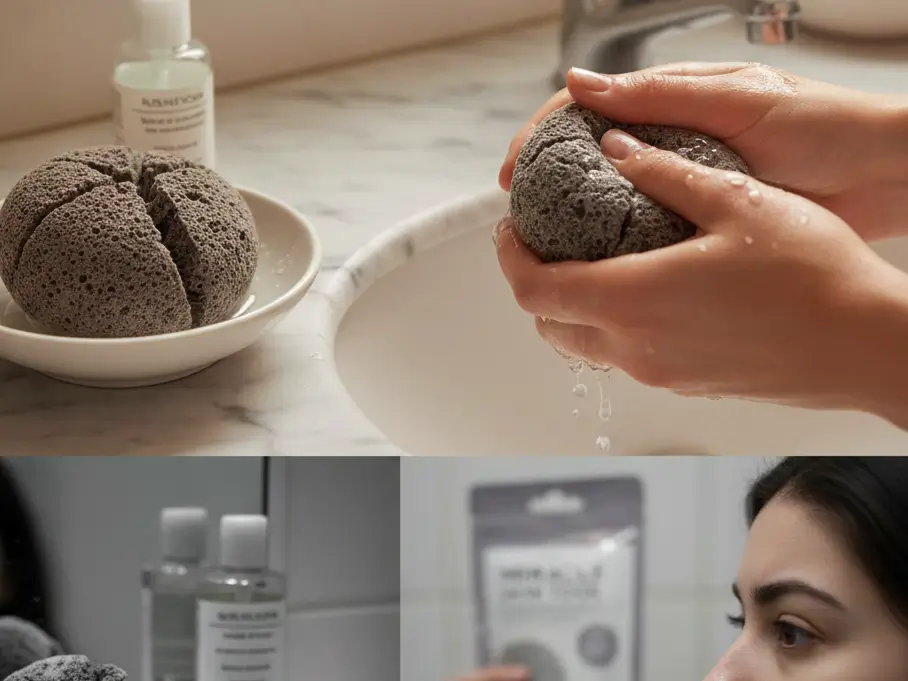
I bought my first konjac sponge three years ago after seeing it in every “must-have skincare tools” roundup. It cost $8, felt like a rock when it arrived, and I genuinely thought I’d been scammed until I ran it under water.
That sponge lasted exactly 23 days before it started falling apart. The second one? I accidentally let it dry out completely and it became a science experiment in mold growth.
Konjac sponges are vegetable-based cleansing tools that gently exfoliate skin when used correctly. They’re not miracle workers, but they’re legitimately useful for specific skin types and routines.
The problem is that most guides skip the practical stuff, like why yours smells weird after a week, whether you actually need one if you already exfoliate, and what “gently squeeze to dry” really means in practice. After six months of deliberate testing (and making every mistake possible), I figured out what actually matters.
What Is a Konjac Sponge (And Why the Hype)?
A konjac sponge is a biodegradable cleansing tool made from the konjac root (Amorphophallus konjac), a plant grown in Asia. When hydrated, it softens into a gentle exfoliator that removes dead skin cells and cleanser residue without scratching.
The konjac plant has been used in Japanese cooking for centuries, you might know it as the slightly chewy noodles in some Asian dishes. The root contains glucomannan, a fiber that holds water and creates that signature soft-yet-textured feel when wet.
Here’s what makes it different from a regular washcloth: the sponge has a naturally alkaline pH (around 8-9) that can help balance acidic skin after cleansing. The texture is consistent throughout, unlike woven fabrics that can have rough spots or loose threads.
The beauty industry jumped on konjac sponges around 2010, marketing them as the “gentle alternative” to harsh scrubs. That’s partly true. The mechanical exfoliation is definitely milder than walnut shell scrubs or those apricot formulas from the ’90s.
But here’s what I’ve noticed: if you’re already using chemical exfoliants like natural exfoliating acids several times a week, a konjac sponge might be overkill. Your skin can only shed so many cells before you’re just irritating it.
I tested this on myself for two months, using both glycolic acid toner and daily konjac sponging. My skin looked perpetually red and tight. When I dropped the sponge to twice weekly, that cleared up within five days.
The sponges come in different varieties: pure konjac (white), charcoal-infused (black), clay-infused (pink or gray), and green tea (green). The additions are mostly marketing, honestly. The charcoal version might absorb slightly more oil, but you’re rinsing it off anyway. The exfoliation mechanism is the same across types.
For comparison, traditional facial massage tools focus on lymphatic drainage and muscle stimulation, while konjac sponges are purely about surface cleansing and mild exfoliation.
How to Actually Use a Konjac Sponge (Beyond the Basics)
Soak the dry sponge in warm water for 2-3 minutes until fully soft. Apply cleanser to your face or the sponge, then massage in circular motions for 30-60 seconds. Rinse thoroughly, squeeze (don’t wring) out excess water, and hang to dry in a ventilated area.
Now here’s what those instructions don’t tell you.
The first-time setup matters. Your sponge arrives hard as a hockey puck. That first soak takes longer than subsequent ones, I’d give it a full five minutes submerged. You’ll know it’s ready when it feels like a damp memory foam pillow, not a wet brick.
You don’t need much cleanser. I wasted half a bottle of face wash my first week because I was applying it like I would to a washcloth. A dime-sized amount is genuinely enough. The sponge creates its own gentle lather and spreads product efficiently.
Circular motions sound simple but there’s a technique. Light pressure only, if you’re pressing hard enough to flatten the sponge significantly, you’re going too rough. I focus about 60% of my time on my T-zone where texture builds up, 30% on cheeks, and barely graze more sensitive areas near my eyes.
For anyone dealing with specific concerns, the approach varies. If you’re working on reducing hyperpigmentation, the konjac sponge helps remove the top layer of dulling dead cells, but it’s not a primary treatment. Think of it as prep work for your actual actives to penetrate better.
The drying process is where most people screw up. Squeezing means pressing between your palms, not wringing it like a wet towel. Wringing tears the fibers and that’s why sponges fall apart in week two instead of lasting 6-8 weeks.
I tried three drying methods:
- Suction cup hook in the shower (grew mold in 9 days despite squeezing)
- Leaving it on the sink edge (never dried completely, smelled musty)
- Hanging on a hook outside the shower with a small fan nearby (lasted the full 8 weeks with no smell)
Air circulation is non-negotiable. Your humid shower stall is basically a bacterial spa.
How often should you actually use it? Despite what product descriptions say, daily use isn’t necessary for everyone. I settled on 3-4 times per week. People with very sensitive skin or conditions like rosacea should start with twice weekly max and watch for irritation.
It fits well into a complete organic skincare routine as the physical exfoliation component, especially if you’re avoiding synthetic exfoliating beads.
What Are the Real Benefits of Konjac Sponges?
Konjac sponges provide gentle physical exfoliation, help remove makeup and cleanser residue, improve product absorption, and are biodegradable. They work best for normal to oily skin types that need mild daily exfoliation without harsh scrubbing.
Let me be specific about what actually changed when I incorporated one consistently.
Benefit 1: Noticeably smoother texture within a week
My skin felt smoother to the touch, not dramatically, but that slightly rough texture on my forehead reduced. This makes sense. You’re mechanically removing the top layer of dead cells that make skin look dull and feel uneven.
A 2019 study in the Journal of Cosmetic Dermatology found that regular gentle physical exfoliation (2-3 times weekly) improved skin smoothness scores by 23% over four weeks. The key word is “gentle.” You’re not scraping; you’re polishing.
Benefit 2: My liquid products absorbed faster
Serums and facial oils sank in within seconds instead of sitting on the surface. When you remove that barrier of dead cells, there’s less obstruction. This particularly mattered for my vitamin C serum, which seemed to work better (more brightness) on sponge days.
Benefit 3: Reduced the little bumps on my chin
I had persistent closed comedones (small bumps under the skin) on my chin that wouldn’t budge with cleansing alone. The konjac sponge didn’t eliminate them, I needed salicylic acid for that, but it reduced them by maybe 40%. The gentle exfoliation kept pores from getting as clogged.
Benefit 4: Legitimately eco-friendly option
After 6-8 weeks, you can compost it. I tossed mine in my garden compost bin and it broke down within two months. Compare that to synthetic face brushes or disposable cotton rounds. For anyone building a zero-waste beauty routine, this actually lives up to the sustainability claims.
The limitations nobody emphasizes:
It doesn’t deep-clean pores. It’s a surface treatment. If you have actual blackheads or congestion, you need clay masks or proper extractions.
It won’t fade dark spots on its own. Exfoliation helps other products work, but you’ll need targeted ingredients like niacinamide or bio-retinols for real pigmentation changes.
It requires consistent maintenance. This isn’t a “toss in your shower and forget” tool. If you’re someone who struggles with skincare routine consistency, the upkeep might frustrate you.
Konjac Sponge vs. Other Cleansing Tools
Konjac sponges are gentler than washcloths, more eco-friendly than silicone brushes, and less expensive than electronic devices, but they require more maintenance and need frequent replacement compared to reusable alternatives.
Here’s how they actually stack up against tools I’ve personally tested:
| Tool | Cost | Lifespan | Best For | Maintenance | Gentleness |
| Konjac Sponge | $6-12 | 6-8 weeks | Normal/oily, daily gentle exfoliation | High (must dry properly) | Very gentle |
| Muslin Cloth | $8-15 | 12+ months | All types, physical cleanser removal | Medium (wash regularly) | Gentle to moderate |
| Silicone Brush | $10-20 | 12+ months | Oily, textured skin | Low (rinse and dry) | Moderate |
| Electronic Cleansing Brush | $100-200 | 2+ years | Deep cleansing, makeup removal | Medium (charge, replace heads) | Moderate to firm |
| Washcloth | $2-5 | 6+ months | All types, budget option | Medium (launder) | Varies by fabric |
When I choose the konjac sponge:
- Morning cleanse when my skin isn’t super dirty
- After wearing light makeup
- When I want mild exfoliation without actives
- Travel (they’re tiny when dry)
When I choose alternatives:
- Heavy makeup removal: muslin cloth with oil cleanser
- Deep weekly cleanse: silicone brush
- Sensitive skin days: just clean hands
- Body exfoliation: exfoliating gloves are way more effective
For anyone also using tools like gua sha or facial rollers, the konjac sponge works well beforehand to create a clean, smooth canvas. But you don’t need to layer multiple tools. That’s where skincare gets wasteful.
The muslin cloth gave me almost identical results with way less babysitting. I could toss it in the laundry instead of obsessing over whether it dried properly. For many people, that practicality might outweigh the konjac sponge’s slightly softer texture.
The Problems Nobody Warns You About (And How to Fix Them)
Common konjac sponge issues include bacterial growth (fix: proper drying and weekly sanitizing), rapid deterioration (fix: gentle squeezing, not wringing), and irritation (fix: reduce frequency or skip if using chemical exfoliants).
Let me walk through the actual problems I encountered and what worked.
Problem 1: The sponge started smelling weird after five days
That musty smell is bacterial growth. Konjac is organic material that stays damp, perfect for bacteria. Here’s what finally worked:
- Microwave method: Once weekly, soak it in water and microwave for 30 seconds (kills most bacteria)
- Vinegar soak: Every 3-4 days, soak in 1:1 white vinegar and water for 5 minutes, then rinse thoroughly
- Actually getting it dry: I moved mine to a hook outside the bathroom where humidity is lower
If it smells even after sanitizing, toss it. You’re rubbing that on your face.
Problem 2: It fell apart in three weeks instead of eight
I was wringing it out like a sponge. That twisted motion shreds the delicate konjac fibers. The correct method is pressing it between your palms or against the shower wall. Firm pressure, but no twisting.
Also, letting it dry completely between uses makes it brittle. If you skip a day and it’s totally hardened, re-soften it gradually with lukewarm (not hot) water. Temperature shock can crack the structure.
Problem 3: My skin got irritated and red
This happened when I used it daily plus AHA/BHA toners. Too much exfoliation. I cut back to using the sponge only on days I skipped chemical exfoliants. Problem solved.
For people with conditions like eczema, rosacea, or active breakouts, honestly, skip the konjac sponge. Use your hands or a soft muslin cloth instead. The texture can aggravate inflamed skin even though it’s marketed as “gentle.”
Problem 4: It’s kind of messy and annoying
Yeah, it is. The sponge drips everywhere during the soak phase. I keep mine in a small bowl on the counter for the first minute, then move to the sink. Small thing, but it saved my countertop from constant puddles.
When you should just skip konjac sponges entirely:
- You have very sensitive or compromised skin (try gentle botanical ingredients instead)
- You’re already exfoliating 4+ times weekly with acids
- You travel constantly and can’t maintain proper drying
- You have active acne cysts (mechanical friction can spread bacteria)
- You prefer low-maintenance routines
For better alternatives in those cases, consider switching to reusable beauty tools that require less intensive care.
So, Are Konjac Sponges Worth It?
After six months of testing, here’s my honest take: they’re worth trying if you want gentle, eco-friendly physical exfoliation and you’re committed to proper maintenance. They’re not worth it if you hate fussy skincare tools or already have a solid exfoliation routine.
I still use mine 2-3 times weekly. It’s part of my rotation, not my entire strategy. I pair it with proper layering techniques and ingredients that actually target my specific concerns.
If you’re curious, buy one single konjac sponge (not a pack of five). Test it for two weeks with proper drying protocols before deciding if it fits your routine. Set a phone reminder to sanitize it weekly.
Once you’ve mastered basic cleansing tools, explore how they integrate with comprehensive approaches like the oil cleansing method or advanced skin barrier care protocols.
The beauty industry will keep launching “revolutionary” tools, but most skincare comes down to consistency with the basics. A $8 konjac sponge works if you use it correctly. It fails if you expect it to replace actives, proper cleansing, or common sense. Start there, and visit Beauty Healing Organic for more honest, tested skincare guidance that cuts through the hype.