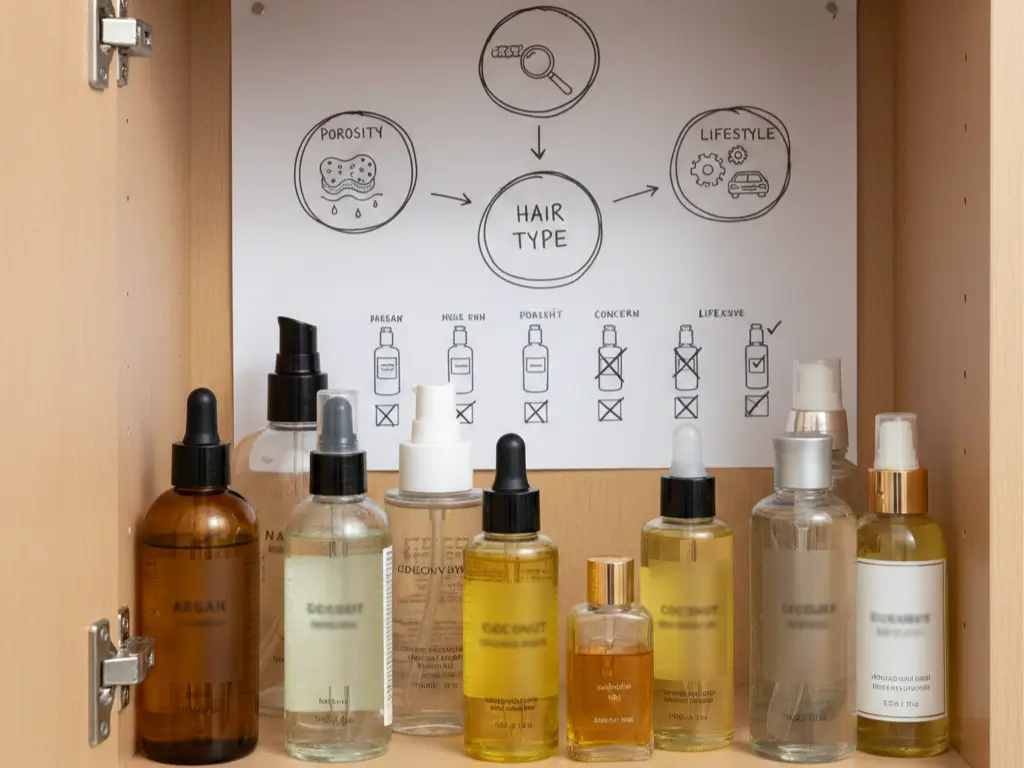
I have seven half-used bottles of hair oil sitting in my bathroom cabinet right now. Argan oil that made my fine hair limp. Coconut oil that somehow left my hair dry and greasy. A fancy blend that cost $42 and smells amazing but does absolutely nothing.
Here’s what I wish someone had told me before I spent $200+ learning this the hard way: Your curl pattern matters way less than your hair’s porosity and what you’re actually trying to fix.
Most guides tell you to pick oils based on whether you have straight, wavy, curly, or coily hair. That’s like choosing a car based only on color. You need to know where you’re driving, how often, and what cargo you’re hauling. In this guide, I’ll show you the three factors that actually determine which botanical oils will work for your specific hair, and which ones you should skip entirely.
Why Hair Type Alone Won’t Help You Choose the Right Oil
Hair type describes curl pattern, but oils need to match your hair’s porosity (how it absorbs moisture), density (how much hair you have), and current condition. Two people with 3b curls can need completely different oils.
I’ve seen this play out dozens of times. Someone with fine, low-porosity waves uses the same heavy oil their friend with thick, high-porosity coils swears by. Three days later, they’re dealing with greasy roots and zero volume.
The problem? Curl pattern tells you about shape. Oil selection depends on structure.
Here’s what actually matters:
Hair porosity determines how easily your hair absorbs and retains moisture. Low-porosity hair has tightly closed cuticles that repel thick oils. High-porosity hair has lifted cuticles that drink up heavy oils but lose moisture fast. If you’re choosing oils without knowing your porosity, you’re guessing.
Hair density affects how much oil you need and how it distributes. Fine hair gets overwhelmed by rich oils. Thick, coarse hair needs more substantial formulas to make any difference.
Your specific goal changes everything. Fighting frizz requires different oils than promoting growth or repairing damage. Yet most people buy “hair oil” without defining what success looks like.
What surprised me when I started paying attention to these factors: my hair isn’t one consistent thing. My roots are oily, my mid-lengths are normal, and my ends are dry and damaged from bleaching. Using one oil everywhere made zero sense. Understanding the science behind botanical oils completely changed how I approached hair care.
What Is Hair Porosity and Why Does It Matter More Than Curl Pattern?
Low porosity = water beads up and takes forever to absorb. High porosity = hair soaks up water instantly but dries fast. Normal porosity = water absorbs steadily in 1-2 minutes. This determines which oil molecules can actually penetrate your hair shaft.
Most people have never heard of porosity until they’re six bottles deep into hair oil confusion. It’s the single most important factor, and you can test it right now.
The Float Test (Do This Before Buying Another Oil)
Drop a clean strand of hair in a glass of water. Wait two minutes.
- Floats on top = low porosity (cuticles are tight)
- Sinks slowly = normal porosity (cuticles are balanced)
- Sinks immediately = high porosity (cuticles are lifted or damaged)
Here’s the part nobody explains: oils have different molecular weights. Some are small enough to penetrate the hair shaft. Others just sit on top as a sealant. Your porosity determines which ones will actually work.
For Low-Porosity Hair
You need lightweight oils that won’t just sit on your hair causing buildup. Think molecular weight under 400-500 daltons. Argan oil, grapeseed oil, and sweet almond oil work because they’re small enough to slip past those tight cuticles. Coconut oil might work in small amounts as a pre-wash treatment, but daily use usually ends badly.
I have low-porosity hair. When I switched from coconut oil (which made my hair feel coated and somehow still dry) to argan oil, the difference was immediate. My hair actually felt soft instead of slick.
For High-Porosity Hair
You can handle, and often need, richer, heavier oils. Your cuticles are already lifted (from chemical treatments, heat damage, or naturally), so moisture escapes easily. Heavier oils like avocado, olive, and even coconut work well here because they fill gaps and seal the cuticle. Many of our guides on natural hair care treatments focus specifically on repairing high-porosity hair.
For Normal Porosity
Congratulations, you won the genetic lottery. You can use pretty much any oil, but jojoba is often ideal because it mimics your scalp’s natural sebum. You have more flexibility to choose based on other factors like scent preference or specific benefits.
The counterintuitive part: high-porosity hair isn’t “better” because it accepts more oils. It usually means damage. Your goal should be gradually improving porosity through protein and moisture balance, not just finding heavier oils.
The Best Botanical Oils for Different Hair Needs (Not Just Types)
Fine hair needs lightweight oils (argan, grapeseed) in tiny amounts. Thick hair can handle medium-to-heavy oils (avocado, castor). Damaged hair needs penetrating oils (coconut, olive as pre-treatment). Frizz-prone hair needs sealing oils (jojoba, marula).
Forget “oils for curly hair” or “oils for straight hair.” Let’s talk about what you’re actually trying to accomplish.
The Lightweight Champions (For Fine, Low-Porosity, or Oily-Prone Hair)
Argan oil is my go-to recommendation here. It absorbs quickly, doesn’t weigh hair down, and adds shine without grease. Use 2-3 drops on damp ends.
Grapeseed oil is even lighter. It’s perfect if you have fine hair but need frizz control. One pump goes a surprisingly long way.
Jojoba oil technically isn’t an oil (it’s a wax ester), which is why it behaves differently. It’s excellent for balancing scalp oil production. If your roots get greasy but your ends are dry, jojoba on the scalp can actually help regulate sebum over time.
The Medium-Weight All-Rounders (For Normal Porosity or Combination Hair)
Sweet almond oil is underrated. It’s got vitamins E and B, penetrates reasonably well, and works for most people. Great for gentle scalp massage.
Sunflower oil has high linoleic acid, which some research suggests helps with moisture retention without heaviness. It’s affordable and easy to find organic versions.
Many people doing DIY hair treatments at home start with sweet almond oil because it’s versatile and forgiving.
The Heavy-Hitters (For Thick, Coarse, High-Porosity, or Very Dry Hair)
Coconut oil penetrates the hair shaft better than almost any other oil due to its low molecular weight and affinity for hair protein. But, and this is crucial, it works best as a pre-shampoo treatment, not a leave-in. Apply to dry hair 30 minutes before washing. On low-porosity or protein-sensitive hair, it can cause stiffness.
Avocado oil is rich in monounsaturated fats and deeply moisturizing. Excellent for thick, dry hair that needs serious hydration.
Castor oil is extremely thick and often mixed with lighter oils. It’s popular for edges and growth goals (though evidence is mostly anecdotal). If you try it, mix 1 part castor to 3 parts lighter oil or you’ll never wash it out.
The Specialty Players
Rosehip seed oil is lighter and contains vitamins A and C. Some people use it for scalp health and hair growth support.
Marula oil is fantastic for frizz. It’s lightweight-to-medium and creates a smooth seal over the cuticle.
Pumpkin seed oil is being studied for its potential DHT-blocking properties related to hair growth. The research is early but interesting.
For more exotic options that might suit specific needs, check out our guides on Amazonian oils and African botanical ingredients.
Here’s my honest take: you probably need 2-3 oils maximum. One lightweight for daily use. One medium-heavy for deep treatments. Maybe one for your scalp if it needs specific attention. The “oil wardrobe” approach doesn’t mean buying 15 bottles.
| Oil Type | Molecular Weight | Best For | Application | Avoid If |
| Argan | Light | Fine, low-porosity hair | 2-3 drops on damp ends | Very oily scalp (use even less) |
| Jojoba | Light-Medium | Scalp balance, normal hair | Scalp massage or mid-lengths | None (most versatile) |
| Coconut | Medium (penetrating) | Pre-wash treatment, high porosity | 30 min before shampooing | Protein-sensitive, low porosity |
| Avocado | Heavy | Thick, dry, high-porosity hair | Deep conditioning masks | Fine hair (too heavy) |
| Grapeseed | Very Light | Fine hair with frizz | 1-2 drops on ends only | Very dry hair (not rich enough) |
How to Actually Use Hair Oils Without Making Your Hair Greasy or Limp
Less is more. Start with 2-3 drops for short/fine hair, 5-6 for long/thick hair. Apply to damp (not soaking) hair, focusing on mid-lengths to ends. Never pour oil directly on your head.
This is where most people screw it up, myself included for years. The oil isn’t the problem, the application is.
The Mistakes I Made (So You Don’t Have To)
Applying oil to soaking wet hair. Water blocks oil absorption. Your hair should be damp, like 70% dry after towel-squeezing. The water content helps distribute the oil, but there’s still room for it to absorb.
Using way too much. I used to pour oil into my palm like it was shampoo. You need drops. Literally. For my shoulder-length fine hair, 3 drops is enough. More just sits there looking greasy.
Putting oil on my roots. Unless you’re specifically treating your scalp, keep oils away from roots. They’ll look unwashed within hours.
Not warming the oil. Rub it between your palms for 10 seconds before applying. It spreads better and absorbs faster.
The Right Way (That Actually Works):
- Wash and condition as normal. Gently squeeze out excess water with a microfiber towel.
- Dispense oil into your palm. Start with 2-3 drops. You can always add more.
- Rub palms together for 10 seconds to warm and distribute.
- Apply from mid-lengths to ends only. Scrunch or rake through gently. Avoid roots unless you have a very dry scalp.
- Style as usual. The oil should disappear into your hair. If it looks shiny-wet, you used too much.
For Pre-Wash Treatments (Especially Coconut or Olive Oil)
Apply to dry hair 30 minutes to overnight before washing. Focus on the driest areas. Cover with a shower cap if leaving overnight. Shampoo twice to fully remove. This method works better for penetrating oils that can stiffen hair if left in.
For Scalp Treatments:
Use lighter oils like jojoba or rosehip. Part hair into sections. Apply small amounts directly to scalp. Massage for 5 minutes to stimulate circulation. Leave for 30 minutes, then shampoo. Do this weekly, not daily.
I started doing Sunday night scalp massages with jojoba oil, and honestly, it’s become my favorite self-care ritual. My scalp feels healthier and my hair seems to grow faster (though that might be the improved scalp circulation more than the oil itself). You can combine this with techniques from our facial massage tools guide, the same principles apply.
Common Mistakes That Make People Think “Oils Don’t Work on My Hair”
If oils make your hair greasy, you’re using too much or applying to wet hair. If they do nothing, you’re using the wrong molecular weight for your porosity. If your hair feels dry after oiling, you need moisture (water-based products) first, then oil to seal.
Here’s the frustrating truth: oils work for most people, but only when matched correctly and used right. When someone tells me “I tried oils and they made my hair worse,” it’s usually one of these issues.
Mistake #1: Using Oil When You Need Moisture
Oil doesn’t moisturize, it seals in moisture. Hair needs water for hydration. Oil prevents that water from escaping.
If your hair is genuinely dry (not just damaged), you need a water-based leave-in conditioner or cream first, THEN a light oil to lock it in. Putting oil on dry hair is like applying lotion to unwashed skin. It just sits there.
Think of it like this: moisture is water, oil is the lock. You can’t lock in something that isn’t there. This is why understanding humectants and hydration matters for hair as much as skin.
Mistake #2: Not Accounting for Protein Sensitivity
Some people’s hair reacts badly to protein. Coconut oil, which binds to hair protein, can make protein-sensitive hair feel stiff, straw-like, or even cause breakage.
If coconut oil makes your hair feel weird despite having high-porosity hair, try protein-free oils like argan, grapeseed, or sunflower. Not every oil works for every person, regardless of porosity.
Mistake #3: Expecting One Oil to Fix Everything
I thought argan oil would solve my frizz, dryness, split ends, and slow growth. It helped with frizz. That’s it.
Growth requires scalp health (and honestly, mostly genetics and nutrition). Split ends can’t be repaired, only trimmed. Dryness needs internal moisture plus external sealing.
Set realistic expectations. Oils improve manageability, add shine, reduce breakage from friction, and can protect against some damage. They’re not magic.
Mistake #4: Ignoring Seasonal Changes
What works in humid summer might be too heavy when winter heating dries everything out. I use lighter oils in summer (frizz control) and slightly richer ones in winter (seal in moisture against dry air).
Your hair isn’t static. Neither should your oil routine be. Our guide on seasonal hair care goes deeper into adjusting your routine throughout the year.
Mistake #5: Not Giving It Time
You won’t see major changes overnight. Consistent use over 4-6 weeks is when most people notice healthier-looking hair, less breakage, better texture, more shine.
If something makes your hair actively worse (greasy, stiff, more tangled) after three uses, stop. But if it just seems like “nothing,” give it a month of proper application before deciding.
Bottom Line: Build Your Oil Strategy, Not Your Oil Collection
You don’t need to understand organic chemistry to pick the right botanical oil for your hair. You need to know three things: your hair’s porosity, your hair’s density, and what specific problem you’re trying to solve.
Do the float test. Choose one lightweight oil (argan or jojoba) and use 2-3 drops on damp ends for two weeks. Actually measure the amount. Apply to damp-not-soaking hair. Keep it away from your roots.
If that works, you’re done. If your hair needs more, try a slightly richer oil or a pre-wash treatment. If it’s too heavy, go lighter or use less.
The most valuable shift I made wasn’t finding the “perfect” oil. It was realizing my hair needed different things in different situations. A light oil after every wash. A deeper treatment once a week. Scalp massage with jojoba every Sunday.
Visit Beauty Healing Organic for more guides on building a personalized natural hair care routine that actually fits your hair’s needs, not just trending ingredients.
Your hair isn’t broken. You’ve just been using the wrong tools for the job.