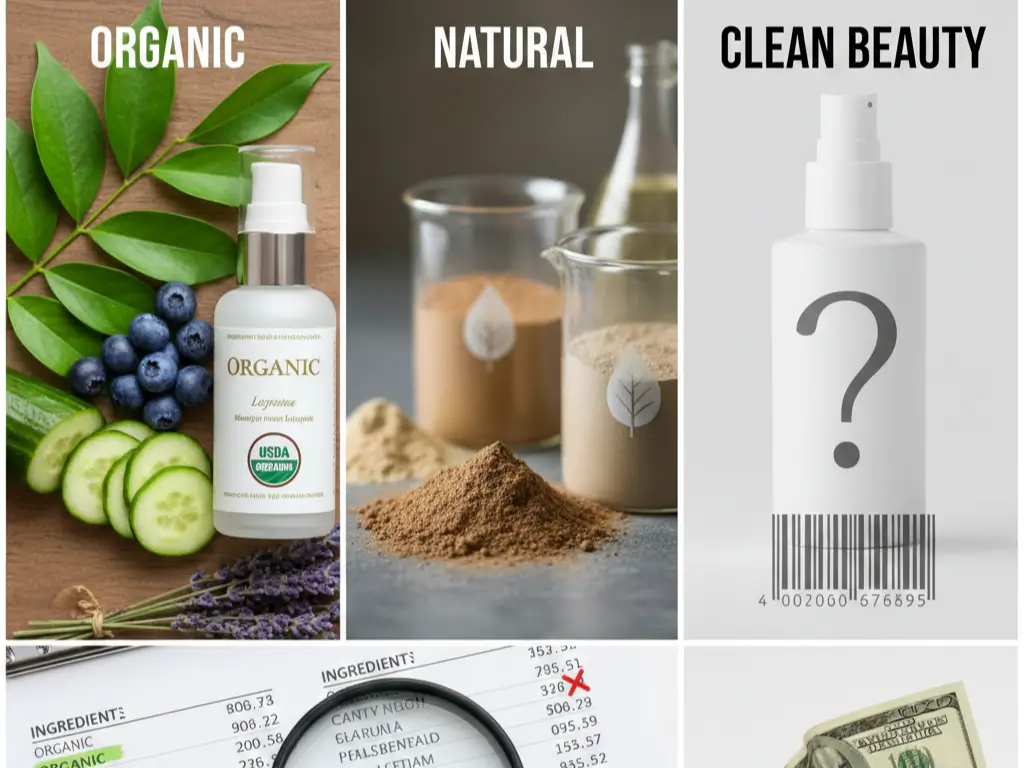
Here’s a number that should make you pause: the clean beauty market will hit $22 billion by 2024. That’s a lot of money spent on a term that has no legal definition.
I’ve spent years reading ingredient lists, researching certifications, and testing products across every category. And I’ll be honest with you, the more I learned, the more frustrated I became with how brands use these buzzwords.
Organic beauty is the only term with federal regulation. Natural and clean beauty are marketing terms with no legal standards. Understanding this distinction will save you money and help you actually find products aligned with your values.
This guide provides educational information about beauty industry terminology and certifications. Individual skin sensitivities vary, so always patch test new products. If you experience reactions or have specific skin concerns, consult a dermatologist.
What makes this guide different? I’m not going to sell you on one approach being “better.” Instead, I’ll show you exactly what each term means (or doesn’t mean), which certifications actually matter, and how to read labels like someone who knows the industry’s secrets.
Whether you’re building an organic skincare routine from scratch or just trying to understand what’s in your products, you’ll walk away with the clarity these labels were designed to obscure.
What Does “Organic Beauty” Actually Mean?
Organic beauty products contain ingredients grown without synthetic pesticides or fertilizers. In the US, only products with the USDA Organic seal meet federal standards, and even then, there are different certification levels with different requirements.
The United States Department of Agriculture runs the National Organic Program, and it’s the only federal body regulating organic claims in cosmetics. According to USDA guidelines, products displaying the organic seal must contain at least 95% certified organic ingredients.
But here’s where it gets tricky. You’ll see three different organic claims on beauty products:
“100% Organic” means every ingredient is certified organic. This is rare in skincare because water (a common ingredient) can’t be certified organic.
“Organic” (with the USDA seal) means 95% or more organic ingredients. The remaining 5% must come from an approved list.
“Made with Organic Ingredients” means at least 70% organic content. These products can’t display the USDA seal but can list which ingredients are organic.
What about products claiming “organic” without the seal? They’re making a marketing claim, not a certified one. The FDA doesn’t require cosmetics to be approved before sale, so brands can call products “organic” without certification. The difference matters when you’re paying premium prices.
Understanding your facial oils and botanical butters becomes much easier when you know which organic claims carry legal weight.
What Does “Natural Beauty” Mean? (Spoiler: Almost Nothing)
“Natural” has no legal definition in US cosmetics. The FDA doesn’t regulate this term, meaning any brand can use it regardless of what’s actually in their products. It’s the most meaningless label in the beauty industry.
I know that sounds harsh. But it’s true.
The FDA explicitly states on their website that they haven’t defined “natural” for cosmetic products. A product could contain 99% synthetic ingredients and one plant extract and legally market itself as “natural.” No federal agency will stop them.
Why does the term persist? Because it works. Consumer research shows that “natural” triggers positive associations with safety, purity, and gentleness. Brands know this, which is why you’ll find the word plastered on everything from truly plant-based formulas to conventional products with token botanical extracts.
Here’s what I actually look at when a product claims to be natural:
The ingredient list. Every cosmetic sold in the US must list ingredients in descending order of concentration. If “natural” ingredients appear at the bottom while synthetic ones dominate the top, you know what you’re really buying.
Third-party certifications. Organizations like COSMOS, NSF, and Ecocert have created standards for natural cosmetics. These aren’t FDA-regulated, but they’re independently verified.
Brand transparency. Companies serious about natural formulation typically explain their standards publicly. Vague marketing language without specifics is a red flag.
The truth about natural preservatives perfectly illustrates this issue. Many brands avoid synthetic preservatives to claim “natural” status, but that decision has real tradeoffs for product safety and shelf life.
When evaluating essential oils in skincare, the “natural” label tells you almost nothing about whether they’re properly diluted, appropriately sourced, or safe for your skin type.
What Is “Clean Beauty”? The Newest Term with the Most Confusion
Clean beauty refers to products formulated without ingredients considered harmful or controversial, but there’s no federal definition, and every retailer creates their own standards. What qualifies as “clean” at Sephora may differ from Target’s definition.
The clean beauty movement emerged around 2015-2016 as consumers demanded more transparency about cosmetic ingredients. Unlike “organic” (which has federal backing) or “natural” (which has historical roots), clean beauty is entirely industry-created.
Major retailers responded by developing their own clean beauty programs:
Sephora’s “Clean at Sephora” program excludes ingredients like sulfates (SLS and SLES), parabens, phthalates, mineral oil, and formaldehyde. Products meeting their criteria get a special seal.
Ulta’s “Conscious Beauty” program covers clean ingredients, cruelty-free practices, vegan formulas, and sustainable packaging.
Target’s “Target Clean” icon indicates products free from common concerns like parabens, phthalates, and synthetic fragrances.
See the problem? Each retailer decides what “clean” means for their shelves. A product might qualify as clean at one store and not another. There’s no consistency, no federal oversight, and no independent verification.
Understanding what Sephora considers clean helps when shopping there specifically. But don’t assume those standards are universal, or even scientifically justified.
This is where the science behind clean beauty becomes important. Some ingredients excluded from “clean” lists have strong safety records. Others remain on “clean” lists despite limited research. The movement is driven as much by consumer perception as by toxicology.
Organic vs. Natural vs. Clean: The Key Differences at a Glance
Only organic has federal regulation. Natural has no legal meaning. Clean is defined differently by every retailer. Your shopping strategy should focus on certifications and ingredient knowledge, not label claims.
| Feature | Organic | Natural | Clean |
| Federal Regulation | Yes (USDA) | No | No |
| Standard Definition | Yes | No | No (varies by retailer) |
| Third-Party Verification | Required for seal | Optional | Optional |
| Ingredient Requirements | 95%+ organic for seal | None | Excludes specific ingredients |
| Price Premium | Usually higher | Varies widely | Varies widely |
| Certification Bodies | USDA, COSMOS, Ecocert | None required | Retailer-specific |
What does this mean practically? If avoiding synthetic pesticides matters to you, look for USDA certified organic, not just organic-sounding marketing. If avoiding specific ingredients matters, learn those ingredients by name rather than trusting “clean” labels.
Many people start with affordable clean beauty brands to explore this space without major investment. That’s smart. Just know that “clean” doesn’t mean certified, verified, or necessarily safer.
There are persistent myths about clean beauty that trap consumers into overspending or false confidence. The biggest myth? That choosing any of these categories automatically protects your skin.
How to Actually Choose Safe, Effective Products
Look beyond marketing labels to third-party certifications, readable ingredient lists, and brand transparency. Certifications like USDA Organic, Leaping Bunny, and COSMOS actually require verification, buzzwords don’t.
After years in this space, here’s my practical approach:
Certifications worth looking for:
- USDA Organic – Federally regulated, independently verified
- COSMOS Organic/Natural – European standard with strict requirements
- Leaping Bunny – Cruelty-free verification (not ingredient-related but values-aligned)
- EWG Verified – Products scoring low on Environmental Working Group’s hazard scale
- NSF Contains Organic Ingredients – Third-party verified organic content
Understanding cruelty-free and vegan certifications adds another layer of informed shopping.
How I read ingredient lists:
First five ingredients make up most of the formula. I focus there. If I see water, glycerin, and plant oils at the top with botanical extracts near the bottom? Those extracts are likely present in tiny amounts, more marketing than function.
Learning about ingredient extraction methods helped me understand why the same ingredient can perform differently across products. Cold-pressed rosehip oil behaves differently than solvent-extracted versions. Labels rarely specify.
Questions to ask before buying:
Does this brand explain their standards anywhere? Can I find their ingredient sourcing information? Do they use third-party testing? Are their claims verified or just stated?
Common Myths That Keep Consumers Confused
The biggest myth is that natural equals safe and synthetic equals harmful. Toxicity depends on the specific substance and concentration, not whether it came from a plant or a lab.
Myth: “Natural ingredients are safer.”
Poison ivy is natural. So is arsenic. “Natural” describes origin, not safety. Meanwhile, many synthetic ingredients have decades of safety research behind them. The FDA evaluates ingredients based on scientific evidence, not whether they’re naturally derived.
Myth: “Synthetic ingredients are always harmful.”
Some of the best-researched, safest skincare ingredients are synthesized. Niacinamide, certain forms of vitamin C, and hyaluronic acid are often lab-created, and extensively studied for both efficacy and safety.
Myth: “Clean beauty is scientifically superior.”
Clean beauty is a movement, not a scientific standard. Some excluded ingredients (like certain parabens) have more safety data than some included “clean” alternatives. The science is often more nuanced than marketing suggests.
Myth: “Organic skincare works better.”
Organic certification relates to agricultural practices, how ingredients were grown. It doesn’t determine efficacy. A well-formulated conventional serum might outperform a poorly formulated organic one. Botanical extracts for specific skin concerns work when formulated properly, regardless of organic status.
Myth: “Price reflects purity.”
I’ve found excellent products at drugstore prices and overpriced products at luxury counters. Certification costs money, so certified organic often costs more, but “clean” and “natural” premiums are pure marketing.
Making Sense of It All
Here’s what actually matters: understanding what you’re buying rather than trusting marketing language.
Organic has federal teeth. Natural means nothing legally. Clean depends entirely on who’s defining it. Once you internalize these distinctions, label shopping becomes less about emotion and more about information.
My advice? Start with your actual priorities. If organic agriculture matters to you, look for USDA certification, specifically. If you want to avoid certain ingredients, learn their names and check every ingredient list yourself. If third-party verification matters, look for recognized seals rather than self-proclaimed claims.
- Pick one product you use daily and actually read the full ingredient list. Notice what’s at the top versus the bottom.
- Identify which certifications (if any) align with your values and start recognizing those seals.
- Explore resources at Beauty Healing Organic to deepen your ingredient knowledge and find products worth your investment.
The beauty industry spends billions convincing you that their words mean something special. Now you know which words actually do, and which ones are just expensive vocabulary.
SOURCES CITED
- U.S. Food and Drug Administration. (2024). Organic Cosmetics. FDA.gov. https://www.fda.gov/cosmetics/cosmetics-labeling-regulations/organic-cosmetics
- U.S. Department of Agriculture. (2024). National Organic Program. USDA.gov. https://www.usda.gov/topics/organic
- U.S. Food and Drug Administration. (2024). “Natural” on Cosmetic Labeling. FDA.gov.
- Grand View Research. (2023). Clean Beauty Market Size Report. (Referenced for $22 billion market projection)
- Environmental Working Group. (2024). Skin Deep Cosmetics Database Methodology. EWG.org.